


December 9th, 2025: Greetings from Taipei. I had a little left I wanted to share on Wise Agency. As a reminder, my pathless hardcover launch bundles started shipping last week. If you order this week, we should be able to get it to you by Christmas. We are going to gift wrap and include the bonuses in every single one and hand-write a custom note if you request it.

This is part of the Wise Agency series. Click here for all three parts.
In the last post, I covered the period of “getting lost” and arriving home to “wise agency.” It’s a remix of past ideas I’ve written about, but in the context of an interesting 2x2 framework, with some fun visuals I created using Google’s latest image model. You can read the first two installments:


This post is a continuation of the “wise agency” part of the quadrant, which, for me, is just the beginning of acting in the world from a new perspective, a journey that basically will never end. In the last eight and a half years of this journey for me, I have not really moved past a feeling of “beginning again.” I suspect this never ends, in a good way.
More specifically, I wanted to focus on a few things that almost everyone struggles with and some useful ideas and frameworks that might help with:
What to work on
How to do it
When and how much to do it
Zooming out, these are pieces of a book that was never finished, something I was tentatively calling a “creator’s field guide,” something I’ve now chopped up into Good Work (published!) and Buy Your Freedom (publish date: TBD), and delivered in several workshops over the last year.
There’s a lot of interesting stuff in that draft that I want to share in some form, so I’ll likely be sprinkling it out via the Substack in 2026 or thinking of fun ways to launch it as a lower-lift book in digital form (if you have thoughts, let me know!)
First, how do you know what to work on?
One of the biggest fears people have about making a life transition: I don’t know what I’d do with my time.
Most people who do end up making a big change in their life either don’t have this fear or have said, screw it, I’m going to step into the unknown anyway.
They typically have one or two things going for them, too:
They’ve either been dabbling with projects, identities, or interests that don’t fit their current life, and they want to do more of them, or
They have reframed needing to be perfect at everything to seeing life as a series of experiments, most of which are allowed to fail
Shoutout to Anne-Laure Le Cunff who wins coined phrase of the year with “Tiny Experiments,” the title of her book, which lays out this shift
My spin on doing tiny experiments has been something I’ve called “Ship, Quit, and Learn.”
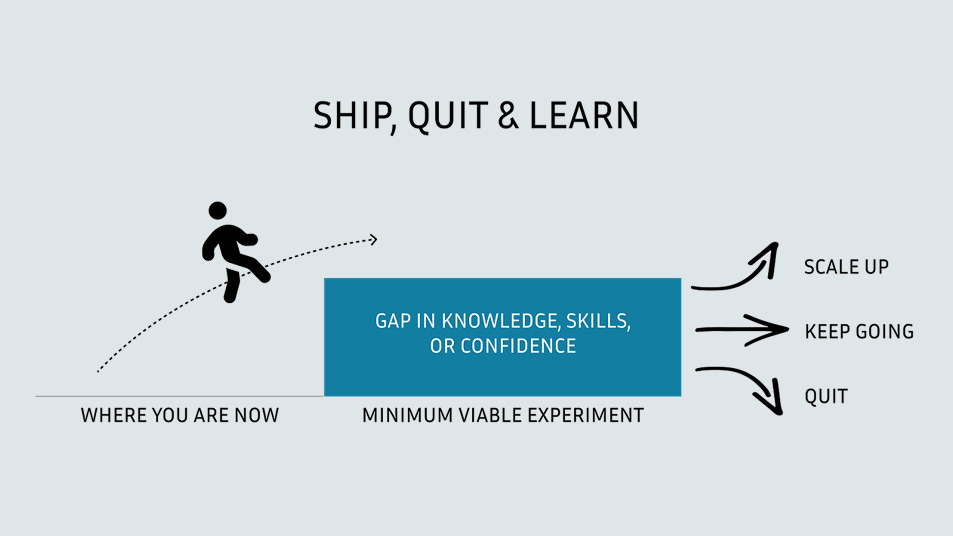
Since 2018, I’ve taken this approach with launching experiments, focused on three things:
What can I ship quickly?
What’s the off-ramp? How do I design it for quitting?
What does the experiment tell me about what to do next? (What did I learn)
This is the opposite of what many people think they should be doing.
Most of us grew up in a culture and schools that teach us a lesson we must unlearn: That we should always do our best to get an A on everything we do.
This is a bad approach if you are embarking on a new path because the goal is not to be universally successful, but to keep learning and evolving without re-creating the path you are moving away from.
The way to do this is to try lots of stuff.
Without this shift in aims, many people will re-create the same problems they just escaped because they are using the same strengths and tendencies as they did before.
The point of wisely acting in the world is to step into new terrain and to create new possibilities for living your life that you couldn’t quite access before. This requires embracing new emotions and new behaviors despite knowing there might be more productive and expedient ways forward
The thing I like about being self-employed is that I can try tons of stuff, somewhat without anyone noticing. When employed, a new experiment looks like a dramatic job change. Now, I can spin something up or shut it down quietly within a couple of days.
Here are dozens of the legible experiments I’ve tried over the past ten years, most of which have “failed”:
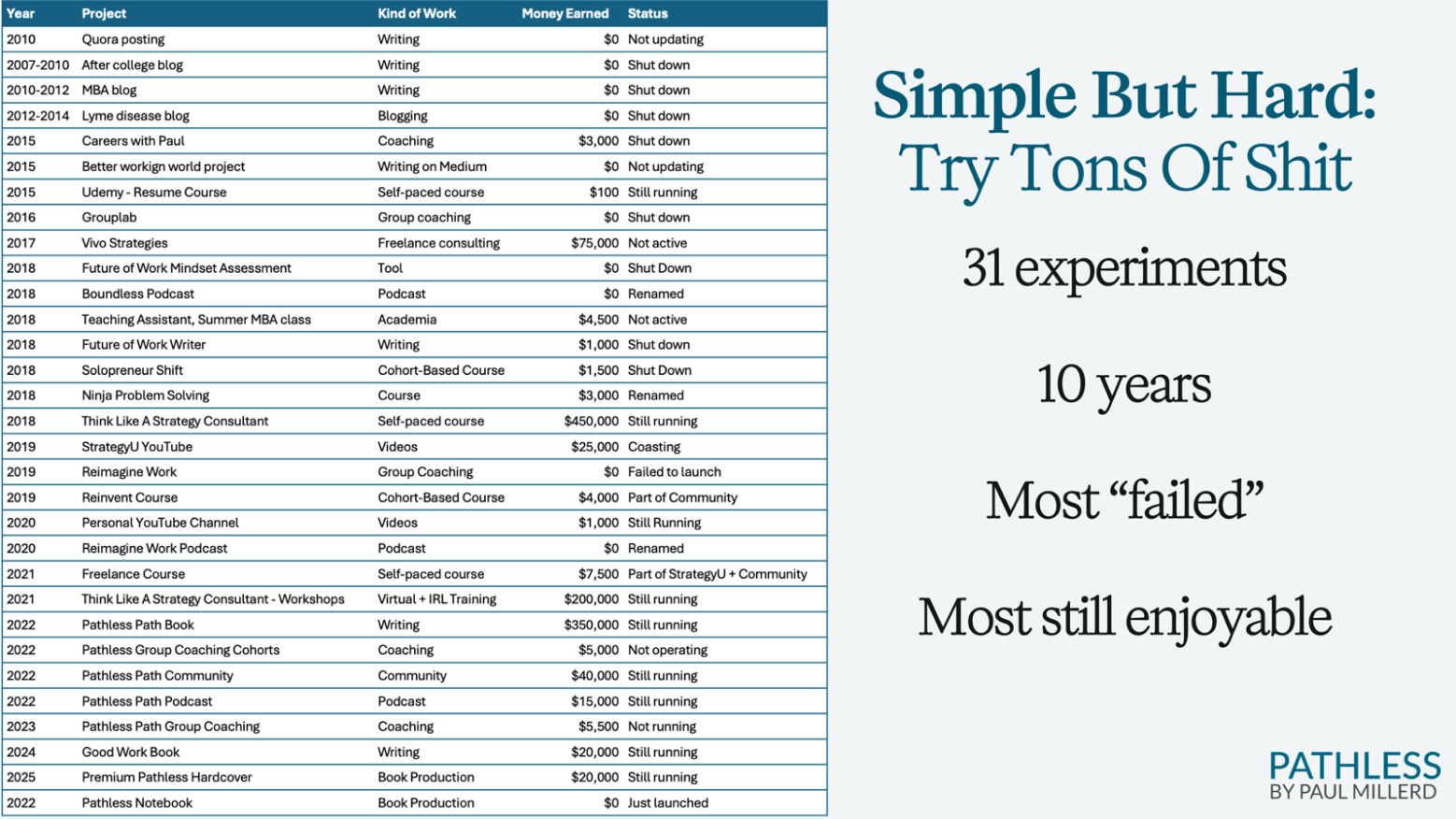
Beyond this, there are probably 100 other things I’ve thought about doing that I haven’t taken much action on. Usually, it’s because I’ve tested the thought with people and saw a lack of resonance, or I decide to wait a bit to see if I’m still excited about it. My recent hardcover book is an example of a project that I couldn’t stop thinking about.
Over the years, I’ve stolen a bunch of decision-making heuristics from others to help me make decisions and get better at starting and stopping various endeavors.
These six decision lenses help me look at things from different perspectives and override some of the more base impulses that drive us to chase various things:
If you knew it would fail, how would you approach it?
How excited are you on a scale of 1-10? You can’t pick 7. Only 8+ is a yes
Hell yeah or no. Simple.
How much would you pay for the opportunity to work on the project?
Is it a “full body yes”?
Am I deciding to be myself and follow what I want, or am I deciding to try to manage the future or a future projection of myself?
As an example, using question #4, I realized I’d pay $1,000 to avoid a project two years ago. This gave me the confidence to make a strong counteroffer on my terms, which turned the project into something I was excited to do and paid me twice as much money.
But many things, especially if they are new, novel, or weird, still require a leap of faith. No decision framework will ever give you perfect information. The goal on a path of wise agency is to be pushing the frontier of what you are currently capable of and what is slightly beyond that, all aligned with a growing intuitive sense of what is “right” for you.
Charlie Becker has a great phrase here, “do the weirdest thing that feels right.” That’s what I’m talking about here.
This doesn’t stop people from wanting a playbook. Many people approach me now and ask how they can sell a lot of books. While I’ve written 7k words on my marketing efforts, I still would claim that I don’t fully know why anything worked.
All I could honestly say is do exactly what I did: Spend years on the wrong path, but developing tons of skills that will later help you be a good writer. Then quit. Decide to write more consistently after a year. Then, write without attempting to make money from writing for years without any goals. Talk to literally anyone who wants to talk to you about work, optimize your project selection and experiments around interest level and fun, and all along the way, live well below your means so you can keep buying time to keep going.
Oh.
Most people just want a magic book launch playbook.
The reality behind most people’s successes, if they are honestly willing to share it with you, will look messy like this:
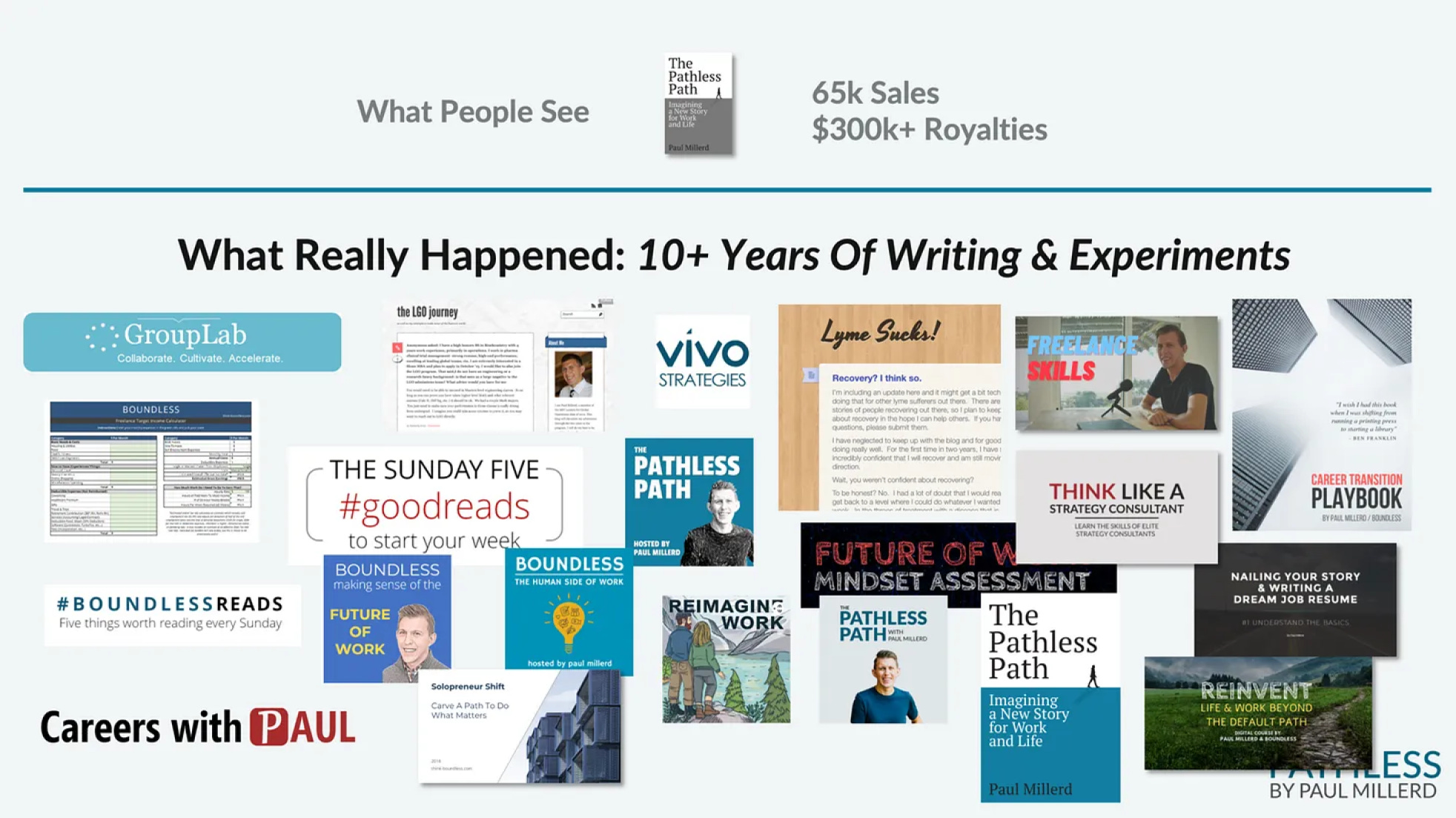
This only “worked” for me because, along the way, I was enjoying what I was doing, getting better at selecting projects, and becoming wiser about a meta-game I was participating in.
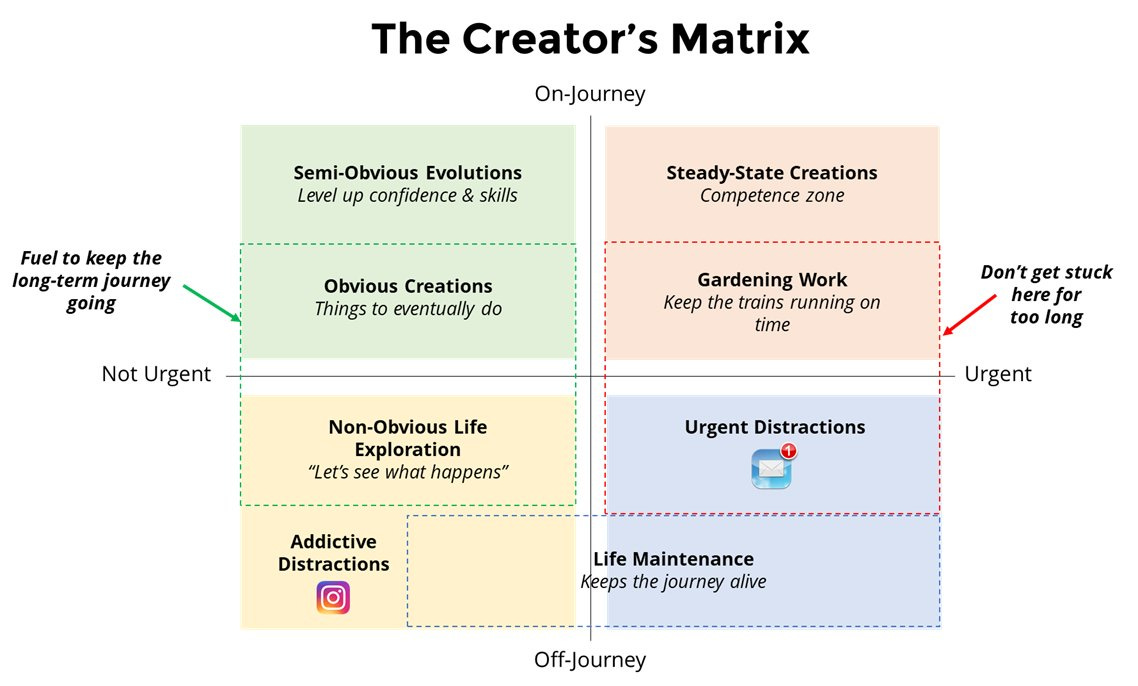
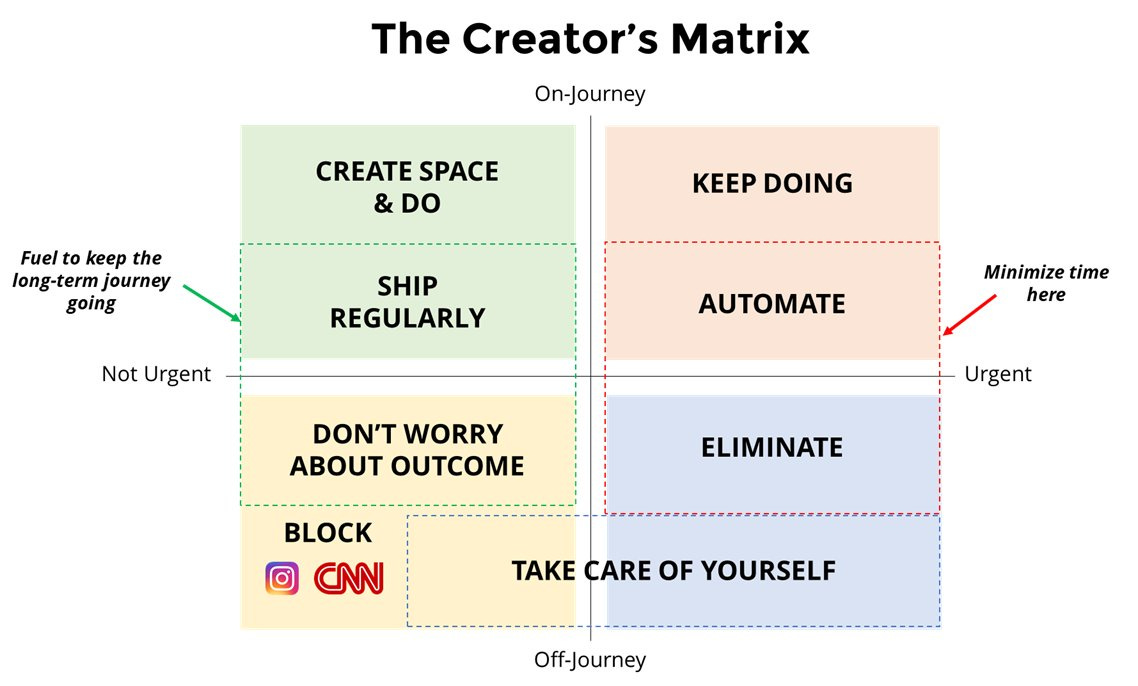
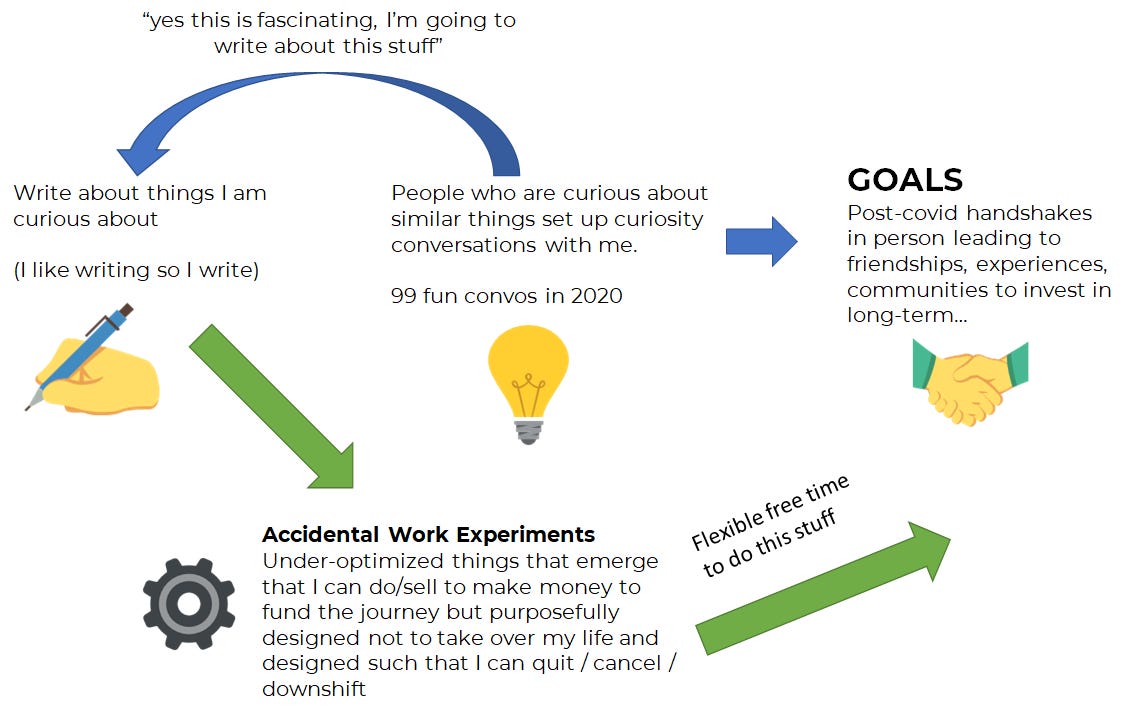
As I was in the midst of all of these projects, I kept trying to make sense of my own game, learning about what was working, and trying to be honest with myself throughout. This tendency to sensemake my own path has resulted in many fun diagrams over the years.
From 2020:
2021:
2022:
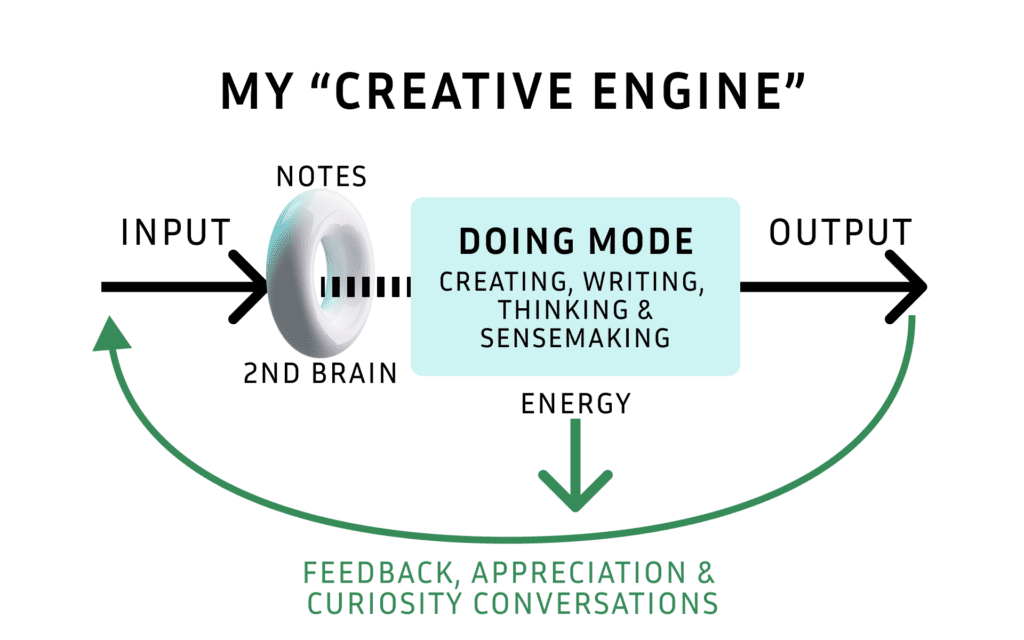
None of these are perfect representations of my path. But all capture my attempts to play a long-term game without legible money or status goals as the priority.
I think one thing they do capture is the confusing state of going against the default games that most people are playing. I suspect that if you are also rejecting default aims, you must develop your own frameworks, sets of principles, and a good understanding of the trade-offs you are making.
Each time I write about what I’m doing or create a new framework, I am reality-checking my own internal storytelling and then exposing it to public criticism.
This has helped me remain honest with myself. If I were claiming success but were not financially viable or satisfied with the way things are going, what the hell am I doing?
Some people can’t tell a story that doesn’t align with how they show up. That inconsistency drives me nuts, so I use it to my advantage.
Second, how do we think about our relationship to the work?
Too many people try to fit themselves into existing paradigms on new paths.
They look at what other people are doing and think: I will do that!
Everyone is doing a Substack subscription, so I will do that!
Everyone is making money on Substack doing X. I must do that too!
This is a fine place to start if you are still learning about what works, but eventually, you need to move on to what works for you, for long periods of time, independent of outside forces.
This is really hard, but it is something you should almost always be thinking about. If you are someone who is going to take a shot at being an independent consultant, you should definitely have models of pricing, offerings, ways of working, and different styles. In fact, learning about the range of models is vital early on. But eventually, the point of the work needs to shift away from copying what works to you making choices that will help you naturally evolve into a style and way of working that only you can inhabit. You can probably map this to any sort of life mode beyond work, for example, parenting.
The reason copying other people is not wise is that you are not in a position to be adaptive. You are at the whims of a complex system that is on the edge of chaos and will keep changing.
A shift I encourage people to make is to Don’t Find a Niche, Find a Mode. As I wrote:
Find a mode where you can continue to be excited about what you are doing.
Find a mode where the friction to getting started declines over time.
Find a mode where you are excited to keep going despite being ignored.
Find a mode where you want to do something despite not having anything to show for it or in the worst case, despite criticism.
After I quit my job, my niche goggles made it very obvious that I could morph myself into a character in the LinkedIn corporate thought leader space. There are lots of legible opportunities, speaking gigs, consulting projects, and status up for grabs, plus lots of models to copy like Adam Grant and Simon Sinek. I quickly realized I was not wired for it. Clear ways to make money, sure, but I couldn’t see myself giving a talk to Accenture, telling people how to adapt to The Future of Work™.
Instead, I accidentally focused on finding a mode: finding projects and kinds of work that I actually enjoyed.
Within a couple of years of doing things on my own terms, most of which didn’t have any clear path to financial payoffs: oh, I can keep doing these things for a long time!
I realized this was quite a strong tailwind I could ride for years.
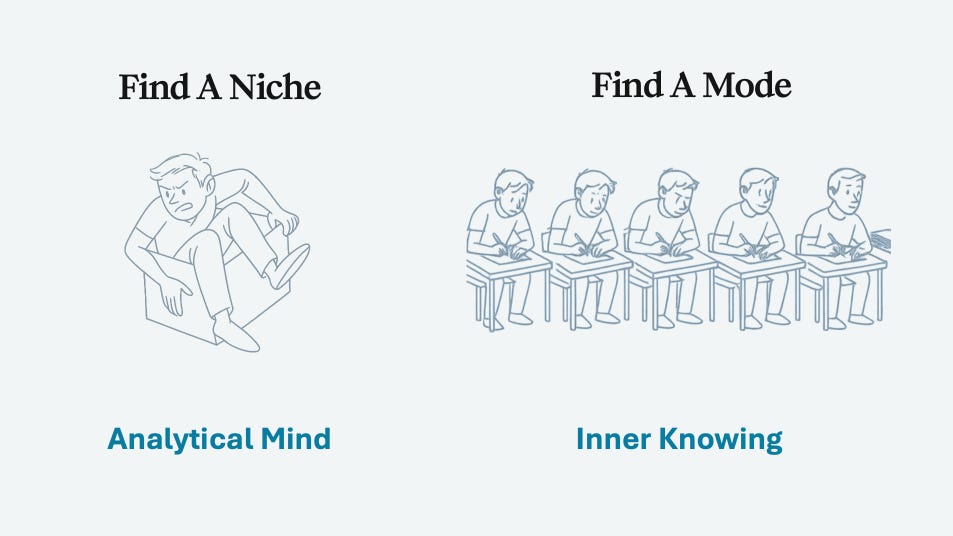
The advantage of finding a mode, and sometimes “wasting” years trying to inhabit and embody this mode, is that you can later insert yourself into a niche world and know why you are doing something and on what terms.
If someone wants to hire me to give a $25k opening speech for Simon Sinek at the Accenture ITCorps AI APAC offsite, I’d be happy to do it, knowing I could playfully embrace the role of LinkedIn thought leader guy, have fun with it, and not be subject to the constraints of being that person for the next ten years.
People who embrace finding a mode early in their lives or a reinvention journey are also confusing to observe. They flow from project to project or interest to interest with much more ease than people expect. They write a book, then launch an app, then do a course, and then take a mini-sabbatical. Nat Eliason is a good example of embracing this. Every time I hear from him, he’s launching something new, but it sort of makes sense. He’s built a life around literally just being himself.
The hidden trap of “find a niche” is not that it doesn’t work.
It’s that it will work, and you will waste years of your life on the wrong path, doing things you don’t actually want to be doing.
Finding a niche is an intellectual stance toward life. It is about figuring out what you need to achieve certain outcomes.
You need to know what niches are, how they form, and how they lead to very different financial realities. For example, if you love writing about finance, you will make a lot more money than if you love writing about buttons, or even work.
Finding a mode says, “okay I see how the world works. I see the niches. I am aware of them. I might make some changes in terms of how I communicate my thing to adapt to that a little. But at the end of the day, I’m going to keep making choices such that I have more opportunities to keep making decisions as a person that I don’t need to pretend to be.”
Third, how much and when do we actually work?
Most of us know that work days are Monday through Friday, and when many people become self-employed, they go through a phase of still showing up Monday through Friday and performing a normal workweek.
I urge people, however, to remember to fire the “manager in their head” and take the next Tuesday off. Most people would benefit from a lot more experimentation and asking some questions that help you zoom out:
What is the ideal work month?
What is the ideal work year?
What are the months or years of work that I now have trouble remembering?
What would my year look like if I had to work in four seasons?
What are the work projects that seem more satisfying to reflect on, the more time passes?
What is your ideal work decade?
A good way to think about spending your time is this 2x2 of life quality and mindset:
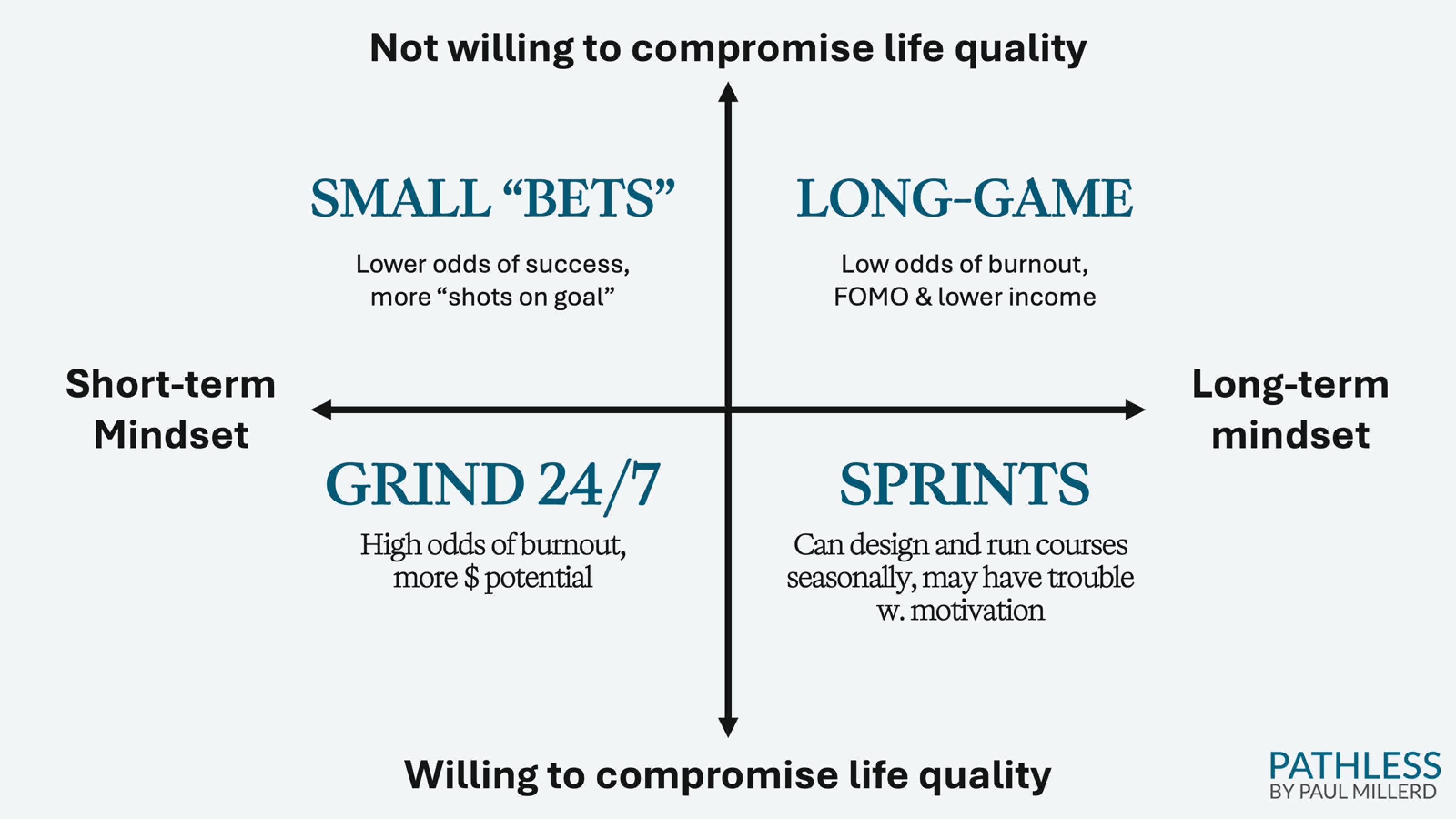
This gives us four ways we can approach a project:
Grinding: Working as hard as possible on everything
Small bets: Doing a bunch of small experiments while eliminating risk
Sprints: Intensive building for weeks or months that are followed by periods of rest
Long-game: Work you are designing your life around that you know you won’t quit because it’s so important. You find the right pace that works for your life
Over time, as people get smarter about what they want to work on, they focus more and more on their “good work” over a long game and more strategic bets that they can sink a bunch of time into over periods of weeks or months. But they also probably do different kinds of work in each of these quadrants.
Over time, many people shift to shifting between consistent effort on things they enjoy doing and short-term sprints that might be the key to getting things done or shifting momentum. For my recent hardcover launch, I’m in “sprint mode” sharing the book and promoting it. In this mode, I have a lot more energy for a lot of things like writing this Substack and tweeting. But it’s not quite sustainable as I’m not building in enough time for exploratory work, time in leisure, and at the gym. At the beginning of the year, I’ll anchor back into long-game mode around slow “most days” writing.
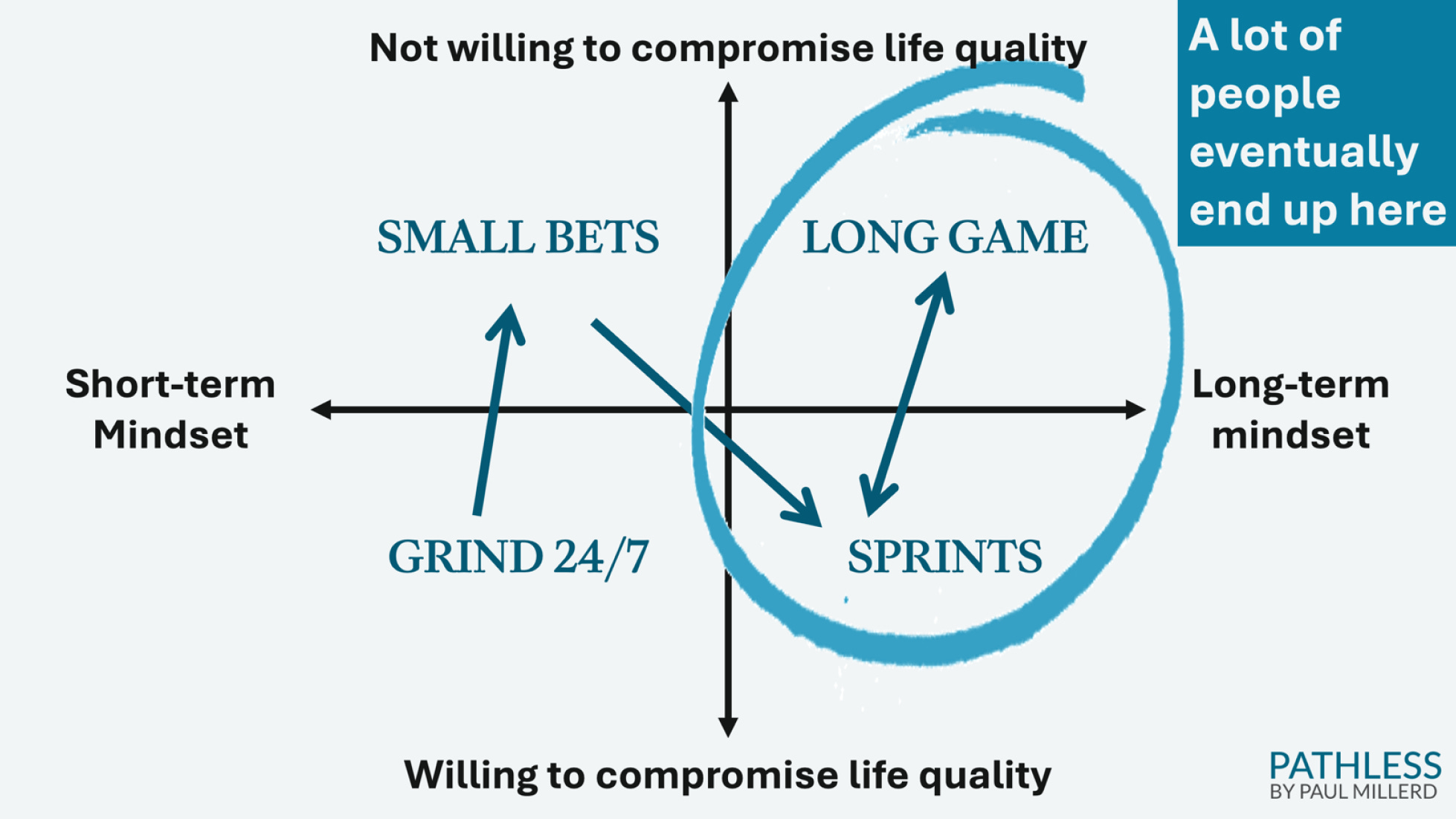
The key with this right-hand side is that it is moving in the direction of doing things that you actually want to do. You aren’t pivoting to a crypto ICO because it will make a bunch of money, but force you to repair reputational damage. You are making bets on your future self and interest and on where you hope you might evolve to in the kinds of work you want to keep doing. As always, this is hard to aim at, but the thing that does become more obvious over time is what not to work on.
The sprints are a way of ramping up the intensity of things you are already doing, but in some new way. It’s a way of testing new hypotheses, new kinds of work or products, or new ways of showing up in the world. It could be something like “I’m going to experiment with consistently posting on Instagram,” to “I’m going to host an event at my house in two weeks,” to “I’m going to go home early every day and hang out with my kids.”
I’m doing a “sprint” around my hardcover launch to test the viability of selling books directly right now. I’m chatting with people buying the book, doing podcasts, writing about the experiment, and reflecting on my feelings about the project. It seems promising, and it’s changing a lot about how I think about the next couple of years of how I share and sell my work. But I’m also going to slow down a bit and approach it more deliberately in the new year.
The sprint compresses time, a variable you should always be playing with. Sometimes it’s best to do nothing and go slow, waiting to see what might emerge as if you are a big game hunter. Other times, it’s worth going a little faster, executing on clear opportunities or pathways to different futures.
How to balance all of this
The best framework I’ve seen for bringing this all together is Venkatesh Rao’s “choose 2” triangle framework in his must-read indie classic Art of Gig.
On an indie path, he says that you must pick two of three and face the consequences of your decision:
Autonomy of Goals
Integrity of Methods
Standard of Living
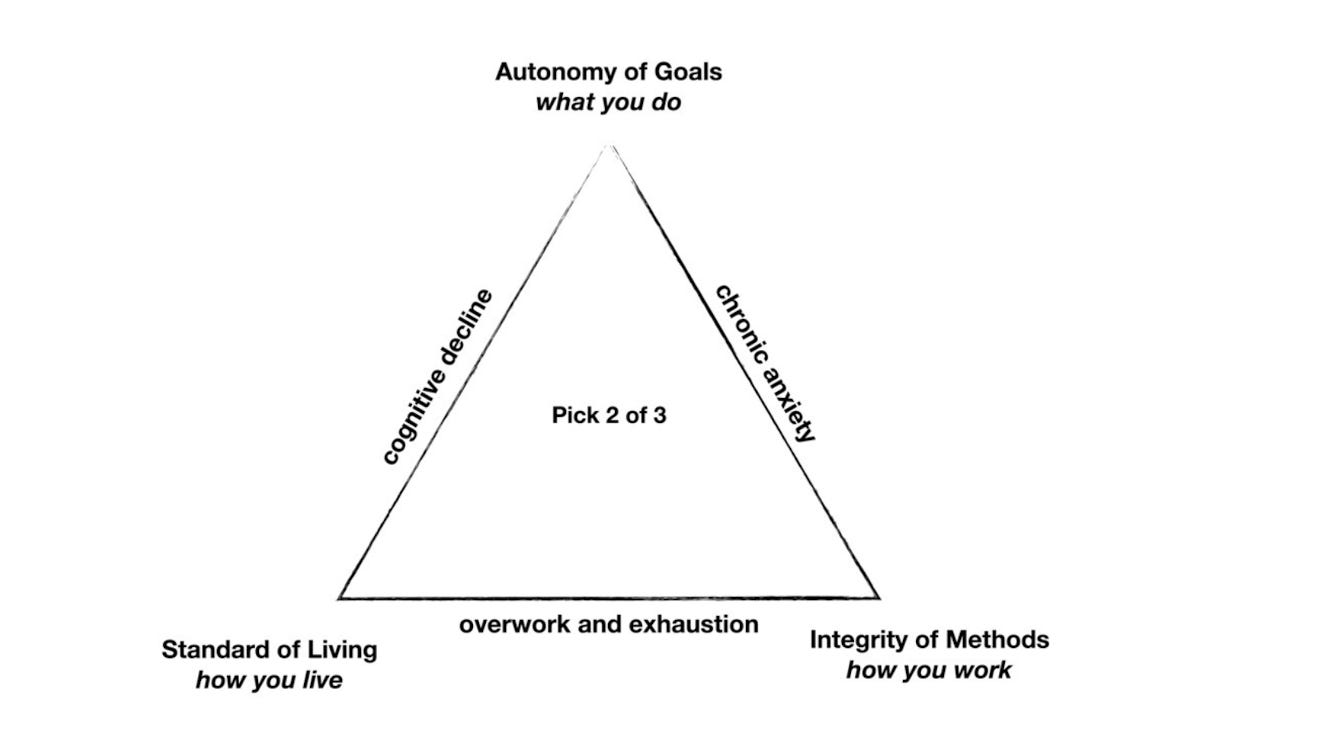
I like the triangle framework because it forces hard trade-offs. If you choose to optimize for how you work and what you do, you’re likely going to face financial challenges.
This is mostly the side of the triangle I like hanging out in.
But not always!
The hack, as he says, is to make different tradeoffs for different situations:
if you want to stay in the gig economy, you can hack the triangle! Yes, you have to pick two of three, but you don’t have to make the same choices in all situations and at all times. You can rotate through them in various creative ways! This creates a much more unstable lifestyle, but it allows you to address the root causes of the pathologies that lie in wait down each pure path. It’s like keeping a set of spinning plates spinning by darting among them.
The three ways he suggests to do this are:
Have multiple parallel gigs with different trade-offs in each: I have a lot of things I’m usually working on at once and am usually making slightly different trade-offs in all of them.
Make different choices in different seasons: This is mostly what I do, shifting focus to my consulting training workshops whenever I need money and then going into unhinged artist mode after
Made different trade-offs in different elements of the projects: For example, you might be willing to make compromises on how your book is packaged or sold, but not on how it is written or structured. For this substack, I take the writing much less seriously than I do my book projects, as another example.
I think this is a good summary matrix as it gets to the point that is behind almost all action in the world: it’s all tradeoffs all the way down.
The most interesting work, however, is often on the other side of rejecting the standard trade-offs that most people see as reasonable and finding the ones that may be unreasonable for others but are fun for you to make and keep making.
Ultimately, I don’t know much about “wise agency.” I’m still not quite sure what it is. But I have learned quite a bit about what I want to do, what I don’t want to do, and expect to continue learning quite a bit about it for years.
I hope I can look back on this little series in a few years and laugh because I have become quite a bit wiser.
Heyo, you made it all the way down here
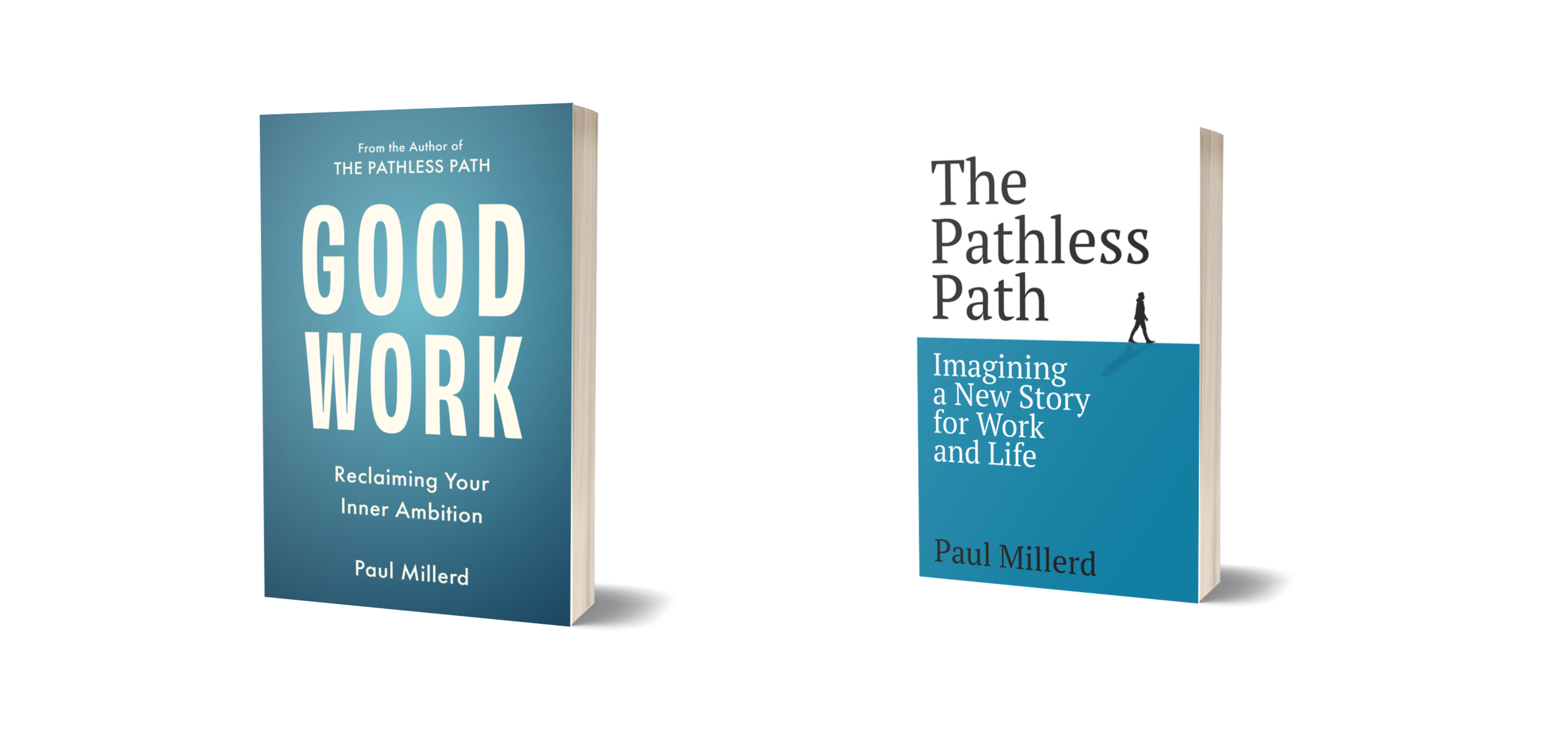
I’ve been doing some form of public writing since 2015. I’ve somehow figured out how to hack a living doing things like writing books and launching premium art editions of my book. If you like what you read here, you’ll probably enjoy my books The Pathless Path and Good Work:
If you’d like to join a virtual community of others on “pathless paths” from around the world, and get access to courses, tools, and other resources I’ve created over the years, you can join The Pathless Path Community. Our recent WhatsApp community is very active if you like hanging out on messaging apps instead of Circle.
Some things I endorse:
Readwise is offering 2 months free (I use it for book notes and reviewing highlights). Or two months free on
Readwise Reader, which I use for RSS reading and epub reading
Crowdhealth, an alternative to US health insurance that I’m still using while abroad
Postbridge: A social scheduling app created by a reader without crazy upcharges for more accounts
Kindred, a home-sharing app
Collective for handling your S-Corp accounting needs, and Nat Eliason’s Build Your Own AI Apps course
If you received this and find yourself in a state of outrage, thinking, “What is this?” I strongly encourage you to unsubscribe below. It is your god given right, and there is plenty of other good stuff online.
A reminder: I don’t check unsubscribe alerts and never look at my subscriber list. So if you feel like unsubscribing, you can do so below.
This is so good, I loved how you tracked and shared all your experiments.what worked and what you quit. As sometimes it feels like we should stick to something as quitting can feel like a failure even though it isn’t.
Hey Paul. Once again, there so much to apply to my own life from this write-up. Thanks for always helping provide a framework as I navigate living off the default path.