


Monday, December 1, 2025: Greetings from Taipei. If you missed it, I announced I’m giving away 100 notebooks, shipping only, to people in the US (18 left) and added some bonuses to my hardcover launch (free copies of Good Work) if you order before Christmas. Read more here.
This is part of the Wise Agency series. Click here for all three parts.
I gave a talk for Peter Limberger’s Stoa last week around the idea of “wise agency.” It was a fun topic to think through.
Agency is an idea I’m partial to, and I wrote about it in The Pathless Path in the context of Fromm’s idea of “positive freedom.” Positive freedom, in my interpretation, is about leaning fully into your own genuine path and the things that you actually want to be doing, in a sustainable, life-giving way. Agency was the mode of practicing such freedom through experimentation, spontaneity, and discernment about what a good life looks like for you.
In the past couple of years, however, “agency” has become a meme in itself. It’s a suitcase word that can describe anything from ironically ordering 153 chicken nuggets at 2 am to celebrating one’s preferred authoritarian leaders crushing their opponents.
At its best, it is used to describe people moving on a positive trajectory in their lives. We can call this “wise agency.” And at its worst, it’s a cynical or nihilistic embrace of do whatever you must do to achieve your desired ends, regardless of the fallout. Or simply, foolish agency.
Sadly, I see this cynical stance everywhere. From the widespread embrace of gambling and speculative trading to the loss of interest in committing to work without immediate payoffs (or asymmetric equity payoffs) to the embrace of sketchy tactics to make money online, we appear to be going through a period where we have more agency than ever but seem not to have any idea what to do with it.
This has all made me a bit tentative to write much about agency. After all, how foolish must I be to think I have any of this figured out?
After my initial rejection of his offer, Peter pushed me to do it, and I’m glad I did. I’m not sure I have anything novel to offer here, but I do have a better understanding of what I’m trying to do in my own life.
This post got a bit out of hand, so I’m sharing part 1 here. Part 2 will follow…sometimes in the future.
The Problem With “High Agency”
For this talk, I’m building upon Peter’s ideas in a great piece titled, How To Win Friends and Get Things Done…With Wisdom. In it, he argued a similar notion, that “Highly intelligent people with high agency can win many ‘friends’ and get a lot of things done, but they might be doing so foolishly.”
He came up with the following 2x2, which immediately became its own meme, as Scott Britton added a simple red line, showing his journey.
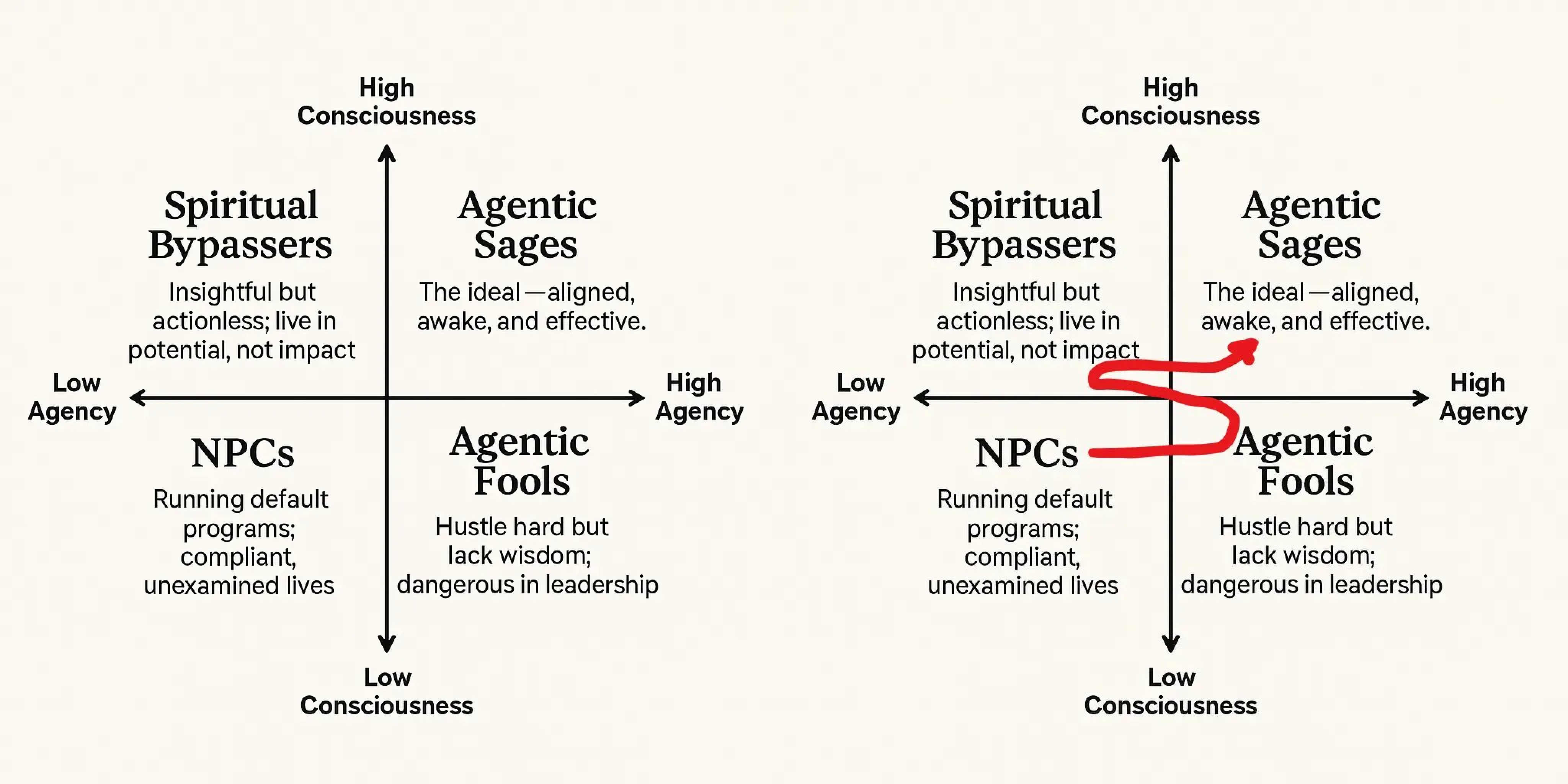
As Peter responded:
Exactly!
It maps to my personal journey.
NPC. You don’t take the “blue pill”; you’re born into it.
Agentic fool. Unexamined success = unquestioned “good.” Hustle, hustle, hustle until burnout.
Spiritual bypasser. A spiritual emergency happens. Aliveness. A new way of being opens up. You overindex on it. It becomes impotent.
I’ve experienced a number of these phases too.
I’ll attempt to map my experience and add my spin to it.
Phase 1: World-Class Hoop Jumping
This was me at 32:
Working for CEOs & Boards of the biggest companies in the world
Knew how to “hack” the career game, networking my way to new jobs, and how to break into top-tier institutions
Guaranteed career path for even more $$, success & status
Living in New York City
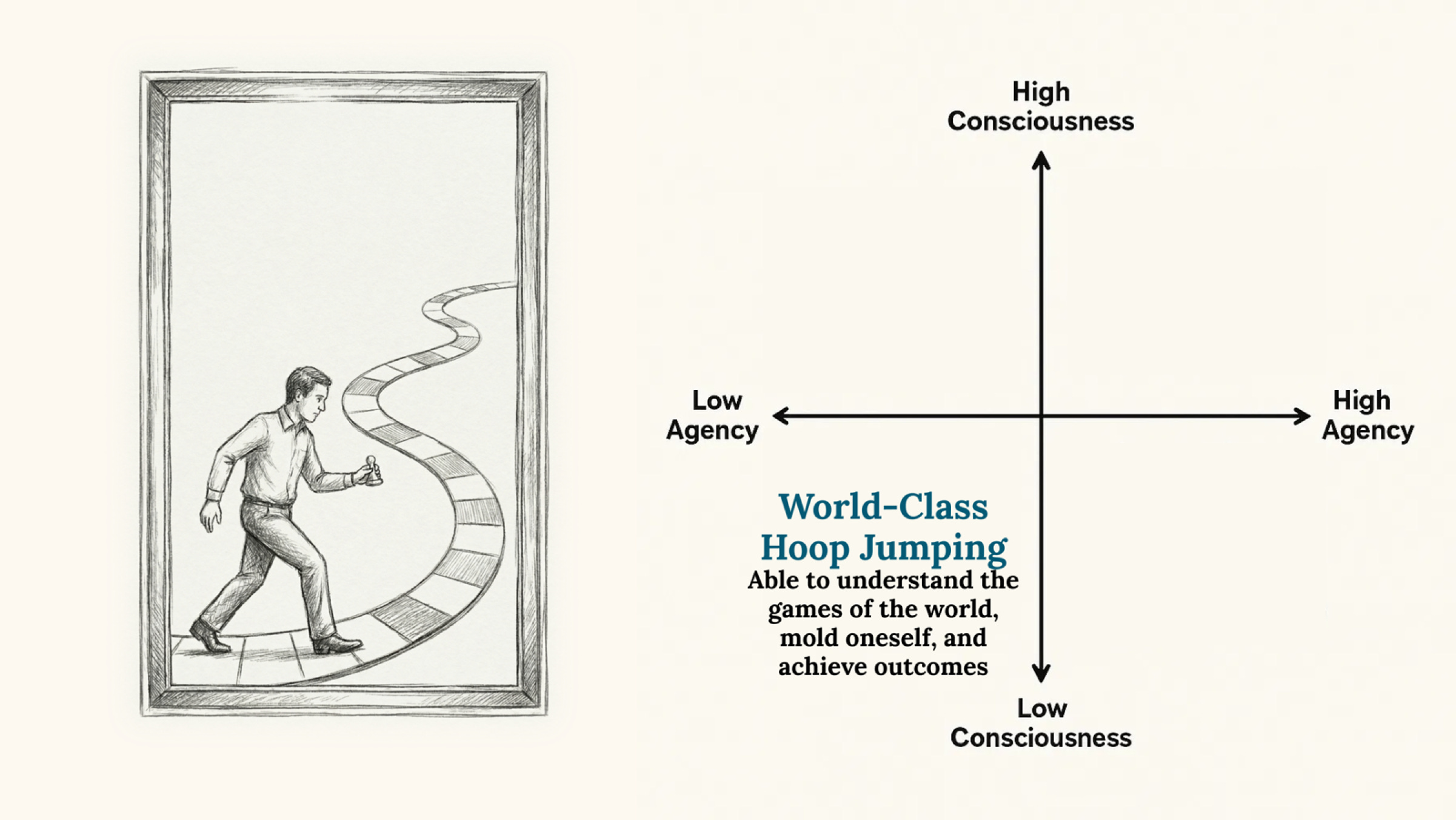
I knew how to play the career game. I felt agentic, or at least if I heard the phrase “you can just do things,” I would have thought I was doing it. Friends would come to me and ask for help, and I felt like I had some secret knowledge of how the world worked because when they followed what I said, it often worked.
But I was a fool.
I didn’t stay in a job for more than 17 months for eight years
Constantly wanted to escape my present to an imagined future
I couldn’t see the frame, and even though I’d poke at the edges, I kept moving forward playing the same game.
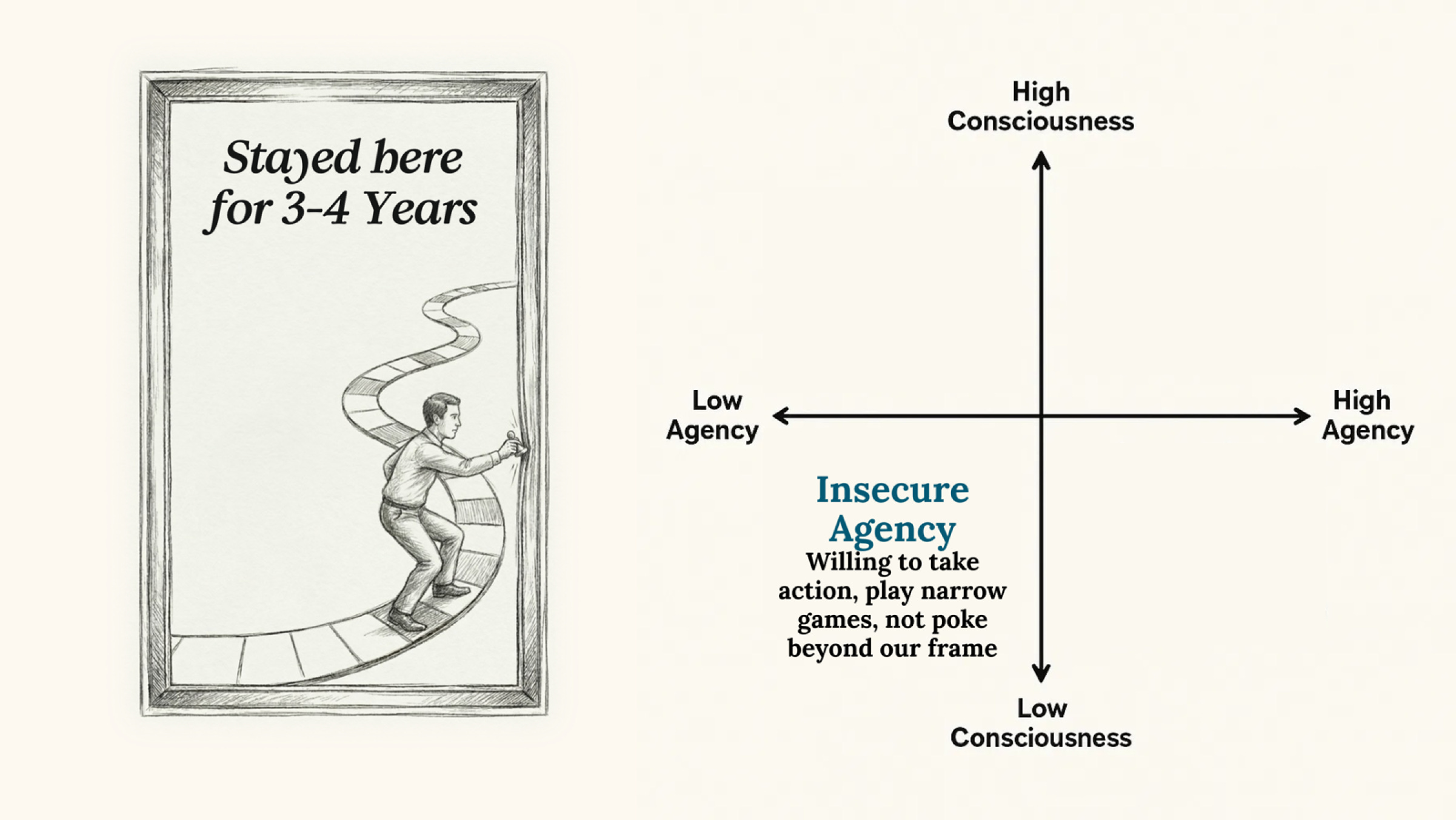
I was stuck in a cycle of insecure agency.
My “moves” from my early twenties that did improve my situation were no longer useful. They were keeping me in this vicious cycle: I needed to keep moving to avoid what was really bubbling under the surface.
The thing that tipped the scales for me was a growing disconnect between my intense desire to learn and explore my curiosity and the scoreboard (my income).
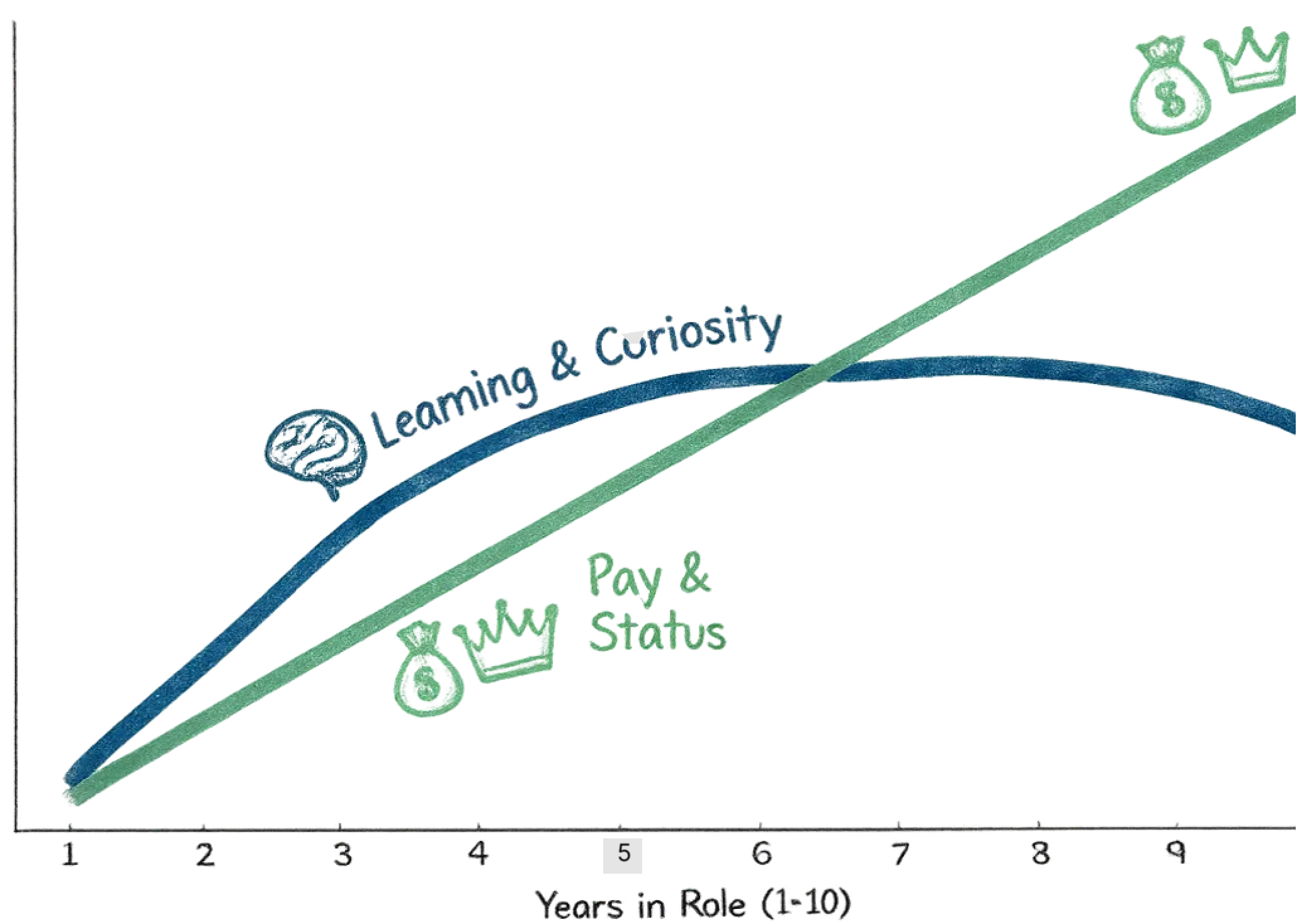
Eventually, I got to the point where the costs of this diminishing intellectual curiosity were no longer worth it.
But how do you start to see these unconscious scripts you are following?
I personally love Robert Anton Wilson’s frame of “reality tunnels.” These help us make sense of “the muddle of existential reality or ordinary experience,” and the more we are hypnotized by them, the more our “existential experience we then edit out or blot out or blur into conformity.”
One thing I’ve realized is that many people will say things like “oh, society is forcing us all to do X.” But after asking hundreds of people the scripts and stories they grew up with, I found something much more interesting.
Most people may have more beliefs and unconscious scripts than they think
Our strongest reactions to others’ scripts and our own indicate our most interesting avenues of exploration
In workshops, I’ve been asking people to go through 15 sets of statements and to give themselves a +1 if they have an extremely strong negative or positive reaction.
You can do it too. Go through these and +1 if you react strongly
“I must consistently improve to be a good person”
“Anything worthwhile requires suffering”
“Work hard, and you’ll be rewarded”
“You should always do the hardest thing possible in your life.”
“Get good grades, get to a good university, and you can then do anything you want.”
“You don’t have to enjoy your work. Work is just to pay the bills.”
”You should love what you do. Work is the most important thing in the world.”
“Anyone not doing inner work is sleepwalking through life.”
“Playing society’s default game is a sucker’s move.”
“The contemplative life is the best life.”
“Rich people are worse people”
“Money is just a flow of energy”
“Don’t be a sucker, everyone is trying to get rich”
“My spiritual journey is the most important journey”
“A pathless path is fundamentally lazy”
Feel free to put your score or reactions in the comments.
But the key reflection here is that, “wow, I have more going on than I thought.”
Many people often follow this thread and eventually decide:
It’s time to blow it up.
Phase 2: Blow it up
Blowing up your life is underrated. Reading Life is In The Transitions made me realize that our lives are already being blown up all the time, so better to lean into it.

Like Peter’s initial diagram, this is often a period for easily falling into the traps of becoming an agentic fool. You’ve thrown off the shackles of your own reality tunnel and are now SMART. You know the game you were playing and exited.
But as soon as you start walking in a new direction, you see traps around you.
The fundamental challenge is leaving behind your previous path without identifying with the rejection.
In other words, reject the default path, but don’t turn rejecting the default path into your personality.
But this is incredibly hard!
In today’s world, there are an endless number of people who understand that they can turn the vulnerability of not knowing what’s next into profit.
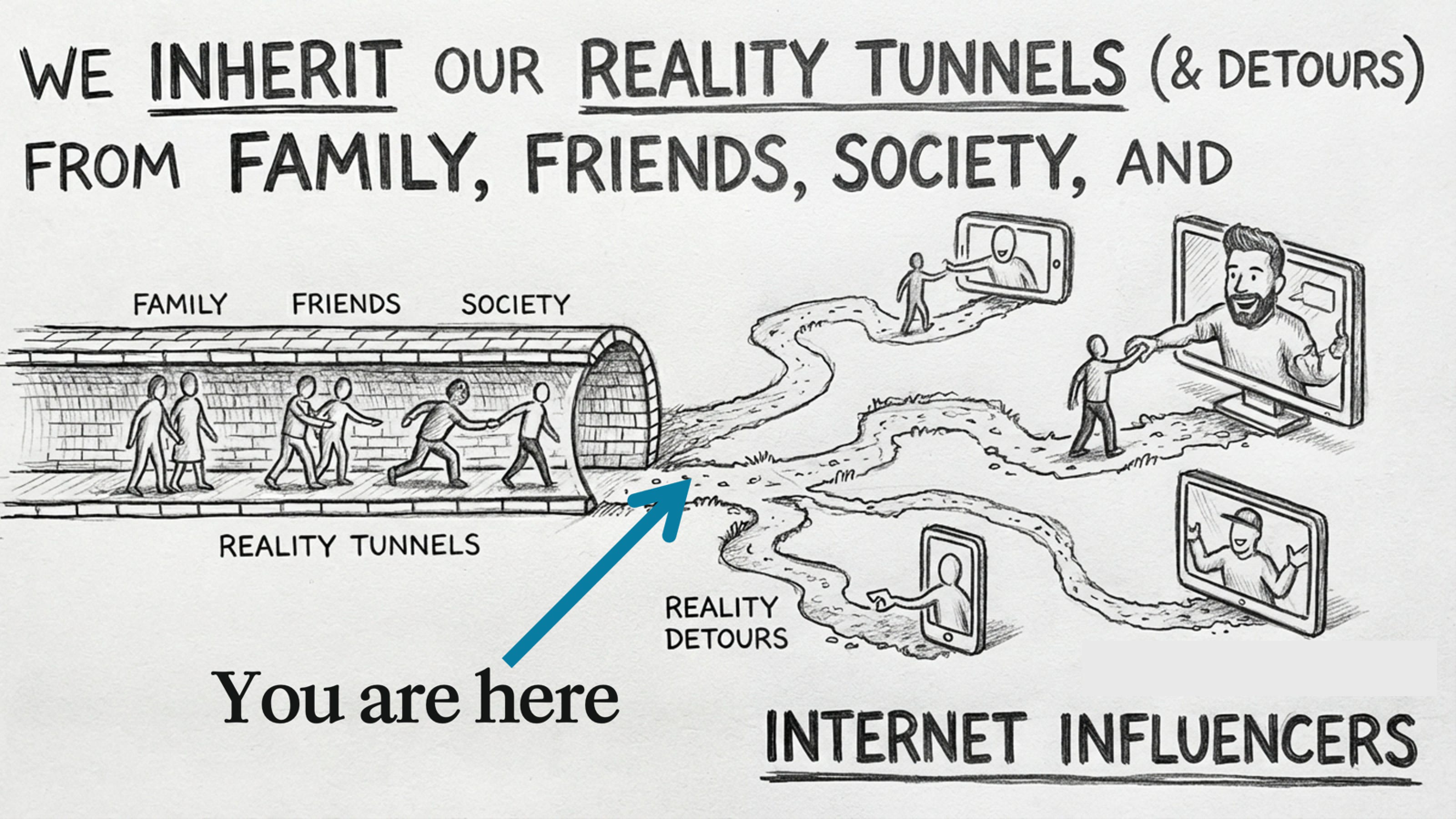
We are often tempted by two forces:
Comfort in conformity, as Jed McKenna warns: “The first thing we want to do when we begin our journey is find the companionship and validity that comes with an established group, and in so doing we effectively end the journey before it begins.”
The desire to “find the others” is vital. You do need people to support you on a new path. But if we mistake belonging for arrival, we risk getting stuck before we get started.
The second trap is trading one identity for another. As Rene Girard wrote: “Modern society is no longer anything but a negative imitation and the effort to leave the beaten paths forces everyone inevitably into the same ditch.”
Which is hard because of how many legible replacement suits are offered to us immediately upon leaving the default path:

The whole game of this phase is to avoid the ditch.
But I think avoiding the ditch for most people is impossible.
I went through a phase when I was pretty angry at my previous path. Why are the organizations led by all these people who love manipulating people? Why are they promoting the most political, not the most valuable? The system was broken, and early on, I wrote many essays trying to make my case!
Eventually, I saw it was a trap. Although there’s lots of money to be made selling coaching or products to people who want to escape, I saw it was not going to be “wise action” for me. I’d end up attracting people I didn’t want to help, and I’d be spending my time with similarly frustrated people. I knew I needed to process this frustration, accept it, and move on.
I think most people will spend at least some time in the ditch. The key is to know that this phase exists and resist all attempts to make it your identity.
The key to moving past this? Allow yourself to get lost.
Keep reading:
On Wise Agency, Part 2 | #316

Tuesday, December 2, 2025: Greetings from Taipei. If you missed it, I announced I’m giving away 100 notebooks, pay shipping only, to people in the US (18 left) and added some bonuses to my hardcover launch (free copies of Good Work) if you order before Christmas.
Heyo, you made it all the way down here
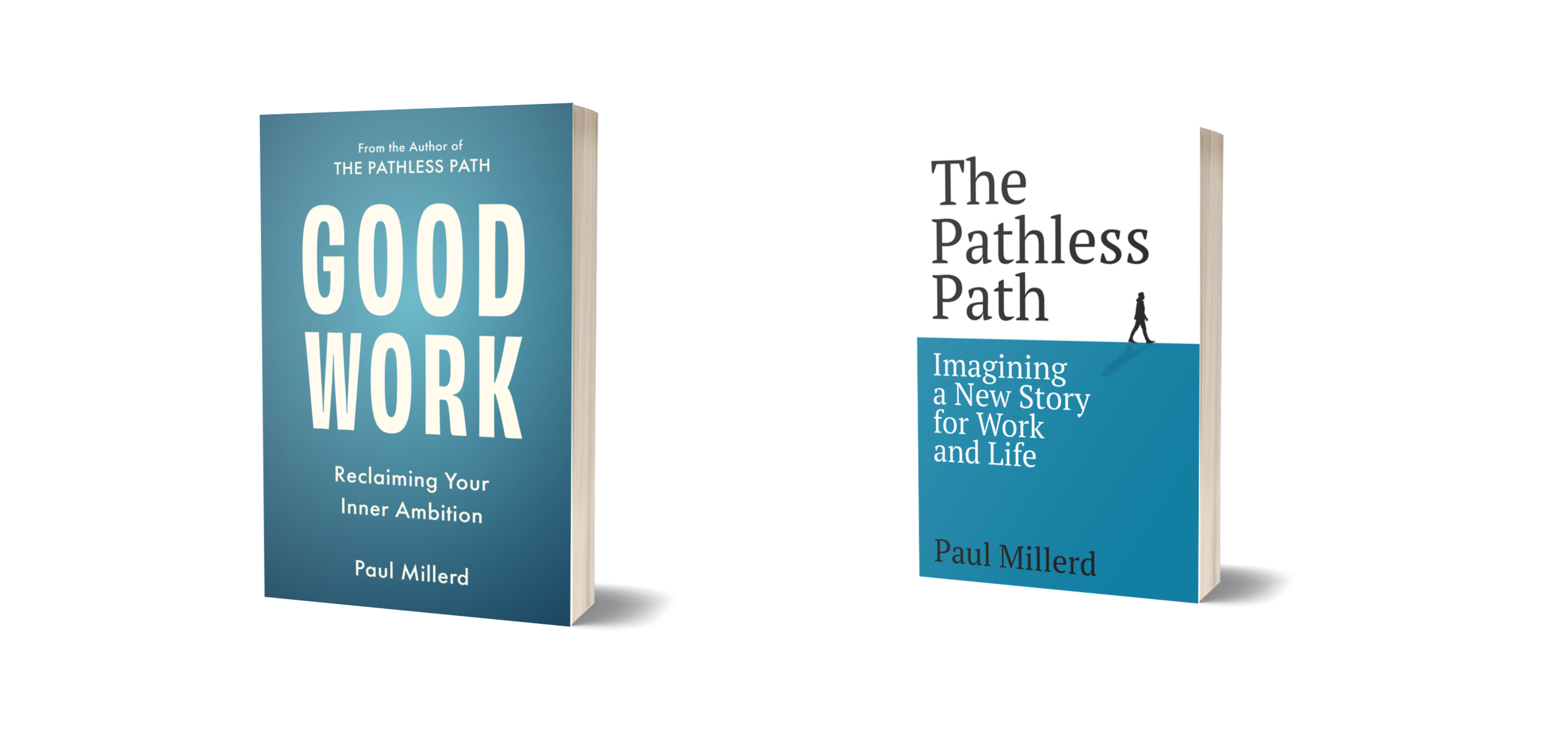
I’ve been doing some form of public writing since 2015. I’ve somehow figured out how to hack a living doing things like writing books and launching premium art editions of my book. If you like what you read here, you’ll probably enjoy my books The Pathless Path and Good Work:
If you’d like to join a virtual community of others on “pathless paths” from around the world, and get access to courses, tools, and other resources I’ve created over the years, you can join The Pathless Path Community. Our recent WhatsApp community is very active if you like hanging out on messaging apps instead of Circle.
Some things I endorse:
Readwise is offering 2 months free (I use it for book notes and reviewing highlights). Or two months free on
Readwise Reader, which I use for RSS reading and epub reading
Crowdhealth, an alternative to US health insurance that I’m still using while abroad
Postbridge: A social scheduling app created by a reader without crazy upcharges for more accounts
Kindred, a home-sharing app
Collective for handling your S-Corp accounting needs, and Nat Eliason’s Build Your Own AI Apps course
If you received this and find yourself in a state of outrage, thinking, “What is this?” I strongly encourage you to unsubscribe below. It is your god given right, and there is plenty of other good stuff online.
A reminder: I don’t check unsubscribe alerts and never look at my subscriber list. So if you feel like unsubscribing, you can do so below.
Relationship analogy... your 2 traps/temptations sound exactly like going on a "rebound" after newfound freedom following a breakup:
1. Comfort in Conformity = either going back to the same bad relationship and/or embracing it with ANY new relationship to fill the void.
2. Trade One Identify for Another = our last significant other was a certain way, so we go for the person who represents the opposite way. Or worse, we give up on relationships altogether.
The healthy option, we know, is to endure the post-breakup weirdness ("the ditch"), learn our lessons, maybe experiment a little without attaching too quickly, and ultimately, come out the other side a bit more wiser with who we are + who we're compatible with. Then, move forward with our lives, not stuck in a permanent state of post-breakup-ed-ness.
The only one that got me was “I must consistently improve to be a good person”
I laughed out loud.
I’d never articulated that belief before. It was like the water I was swimming in.
It prompted me to write thousands of words about getting sick this past summer
Might share