


Tuesday, December 2, 2025: Greetings from Taipei. If you missed it, I announced I’m giving away 100 notebooks, pay shipping only, to people in the US (18 left) and added some bonuses to my hardcover launch (free copies of Good Work) if you order before Christmas. Read more here.
If you missed it, I put out Part 1 of this Wise Agency series yesterday. Catch up here:

This is part of the Wise Agency series. Click here for all three parts.
On Wise Agency, Part 2
Ok, in the last post we left off in the lower right quadrant of this remix of Peter Limberger’s idea of the agency 2x2:
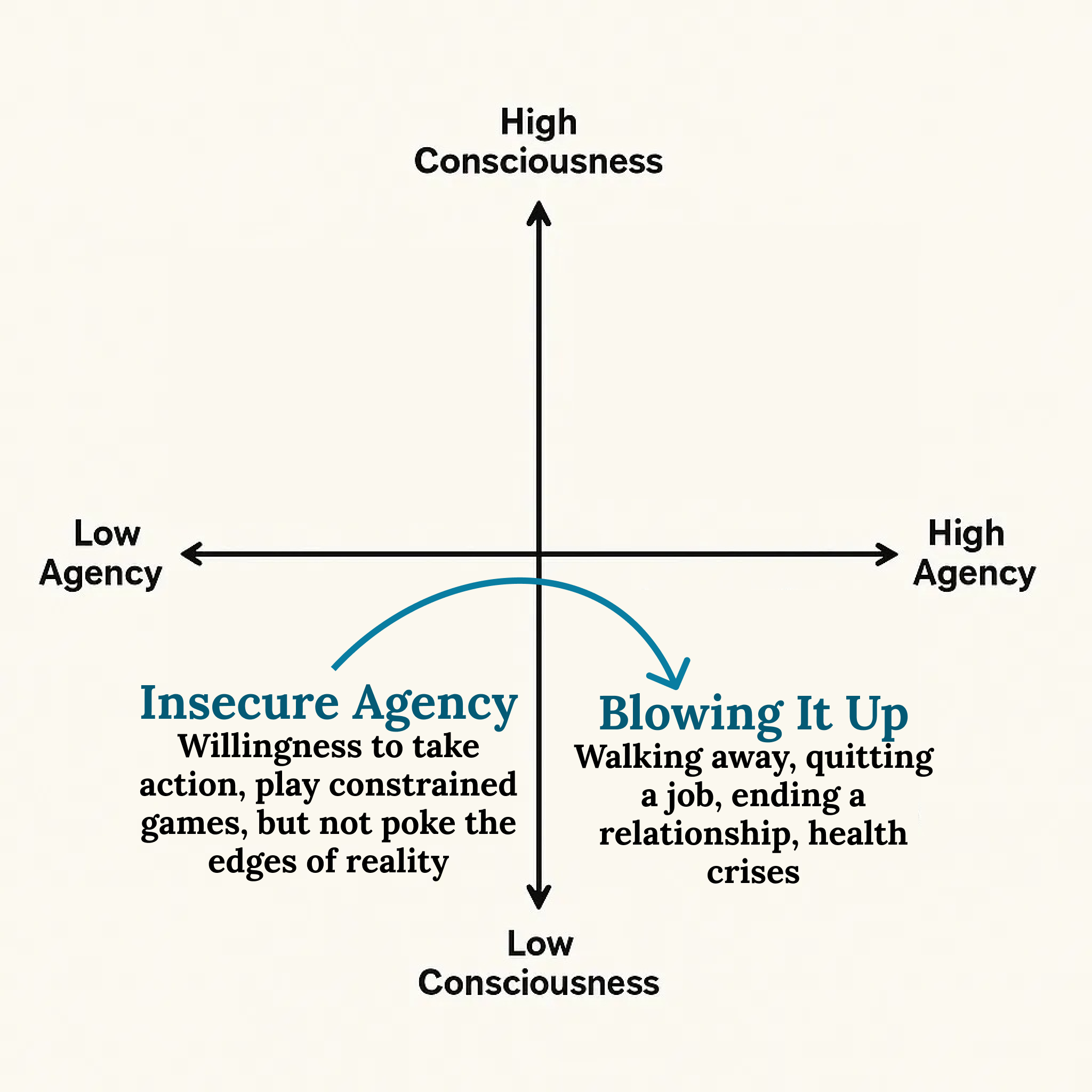
You’ve grappled with your “reality tunnels,” decided to step off the default path, avoided the ditch of negative imitation, and are ready to get lost.
Onward.
Phase 3: Surrender & Get Lost
A strong belief I have from talking to several hundred people over the last decade about work: I believe the continuously-employed adult life is unnatural.
I suspect that the vast majority of people would benefit from occasional short- and long-term breaks from their work lives, and more importantly, their work identities.
This is not to say people should follow my path and go full pathless, become self-employed or an entrepreneur permanently. But I do think most people working today would benefit from elevating the importance of looking for time and space in their lives to get lost, embarking on season of solitude, wandering, or adventure.
But even if you pull off such a feat, it’s still hard to surrender fully to such a phase.
After quitting my job, I reflexively rejected many of the the replacement identities on offer: venture-backed founder, tech worker, impressive freelancer, “thought leader.” This is the trap of phase two I talked about yesterday.
In my mode of rejection, I still had the feeling like I should be doing something.
This tension nagged at me for nearly a year as I floundered around the US for about 15 months taking freelance gigs, booking random trips, and flaneuring around Boston.
Then, I booked a one way flight to Taiwan. Perhaps it was a seed inside of me from my future nudging me in this direction or just my acknowledgement that wandering around the US begging my full-time employed friends to hang out with me during the day. It doesn’t really matter. But arriving in Taiwan was enough of an environment shift that I finally gave myself permission to not have a plan.
It was time to wander in the metaphorical wilderness of my new path.
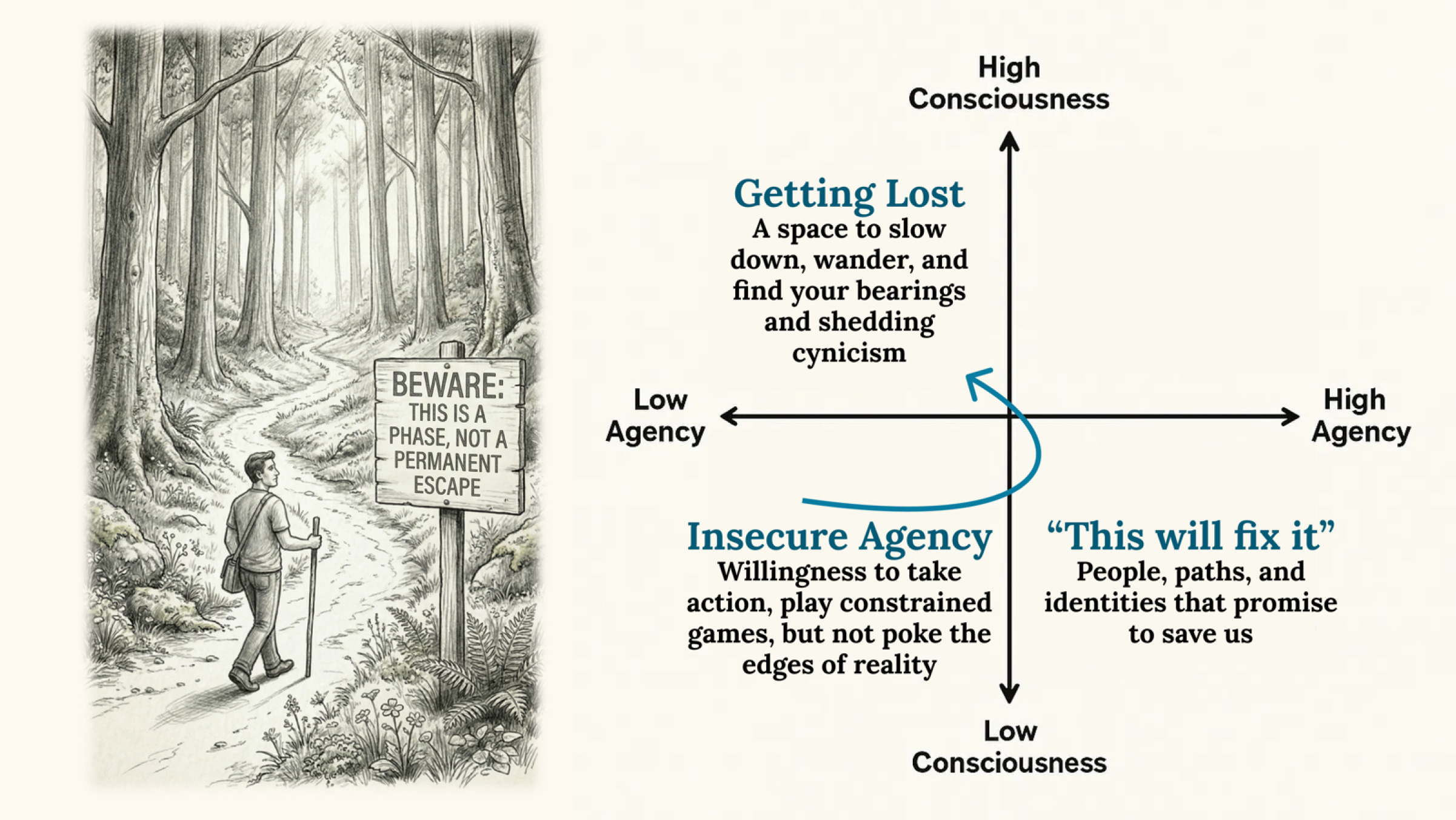
I shifted from trying to do things to trying to do nothing at all.
Which was confusing.
I had this inner exuberance about shifting in this new direction but also felt immensely stuck. I’ve never accomplished or done so little.
I was in what Scott Britton in his recent book, Conscious Accomplishment, calls this “inner purgatory”:
Inner purgatory is the intermediate state between focusing on your inner work and feeling invigorated to take creative action in the world. When you’re in inner purgatory, you desire to accomplish things from an updated perspective, but find it inexplicably difficult. You may struggle with a lack of motivation, inspiration, or energy for external goals, despite knowing that you want more for your life than doing inner work all the time.
Activities that once came easily may feel difficult. You may no longer feel like you have the same raw horsepower you once did. You can try to will yourself to push through things, but without the natural force behind you, you eventually exhaust yourself.
Underneath it all, I was rewiring myself. I was letting go of my past anxiety-driven achievement patterns and toward ones that were more natural and driven by self-awareness. But this didn’t just happen. It was a process.
I needed to let go and mourn the loss of my inner grinder, as I wrote about in Good Work:
Letting go of a life strategy that seems to be working can be terrifying. For me, it meant stepping away from a formula for life that provided me with money, status, and real confidence. I loved feeling competent and being good at what I did. So realizing that I never wanted to return to that world initially filled me with grief. I do miss telling people about my impressive achievements and watching their eyes light up with instant respect.
This period was tough.
I was scared to tell people close to me what I was doing, or really what I wasn’t doing. I lied. I made up fake plans. But I could see that the instant respect I used to command was gone. I still craved respect and hadn’t fully sat with the insecurity of not having that anymore. Comments from other hurt.
What is your plan?!
There is none. I felt lost. Intensely lost.
But like I said, underneath, I also had this deep sense of okayness. I knew I was on the right metaphorical path even if I couldn’t “prove” it. I’ve quoted Rebecca Solnit on this so many times because when I read this line in her book The Field Guide to Getting Lost during this period, it send a jolt through my body:
That thing the nature of which is totally unknown to you is usually what you need to find, and finding it is a matter of getting lost
Getting lost is beautiful.
But this phase can be a trap too!
If you spend too much time being lost, distancing yourself from the default world, things can quickly turn into escapism.
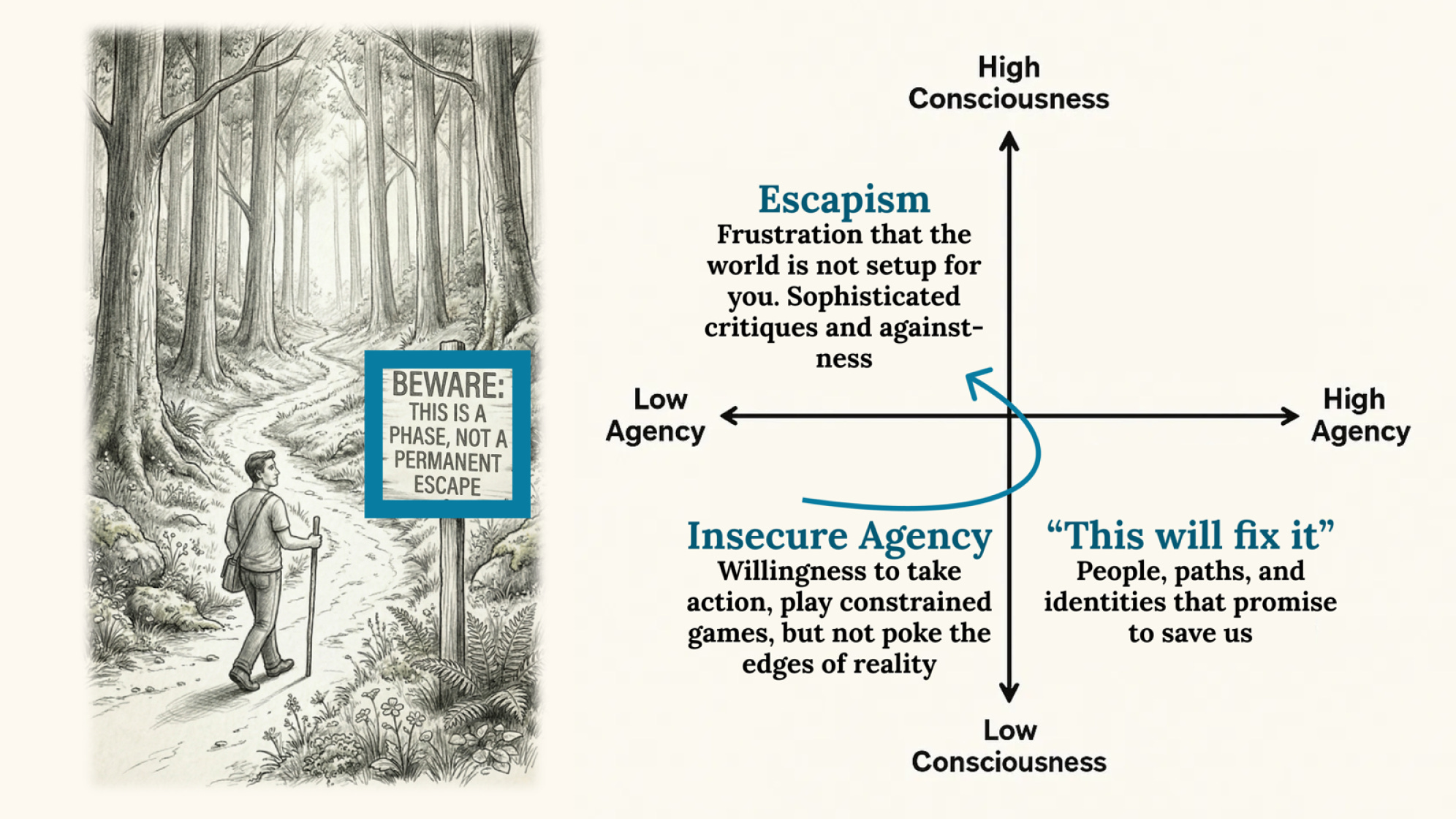
Just like its easy to quickly embrace a new path after quitting your job, its just as easy to immerse yourself into groups where being lost is a permanent lifestyle.
Spiritual paths to enlightenment
Productivity & personal growth toward endless achievement
Seasons of “healing” and therapy and inner work that never end
Psychedelic and reality altering substances or communal practices
Going to Bali and not being able to live “back” where you left behind
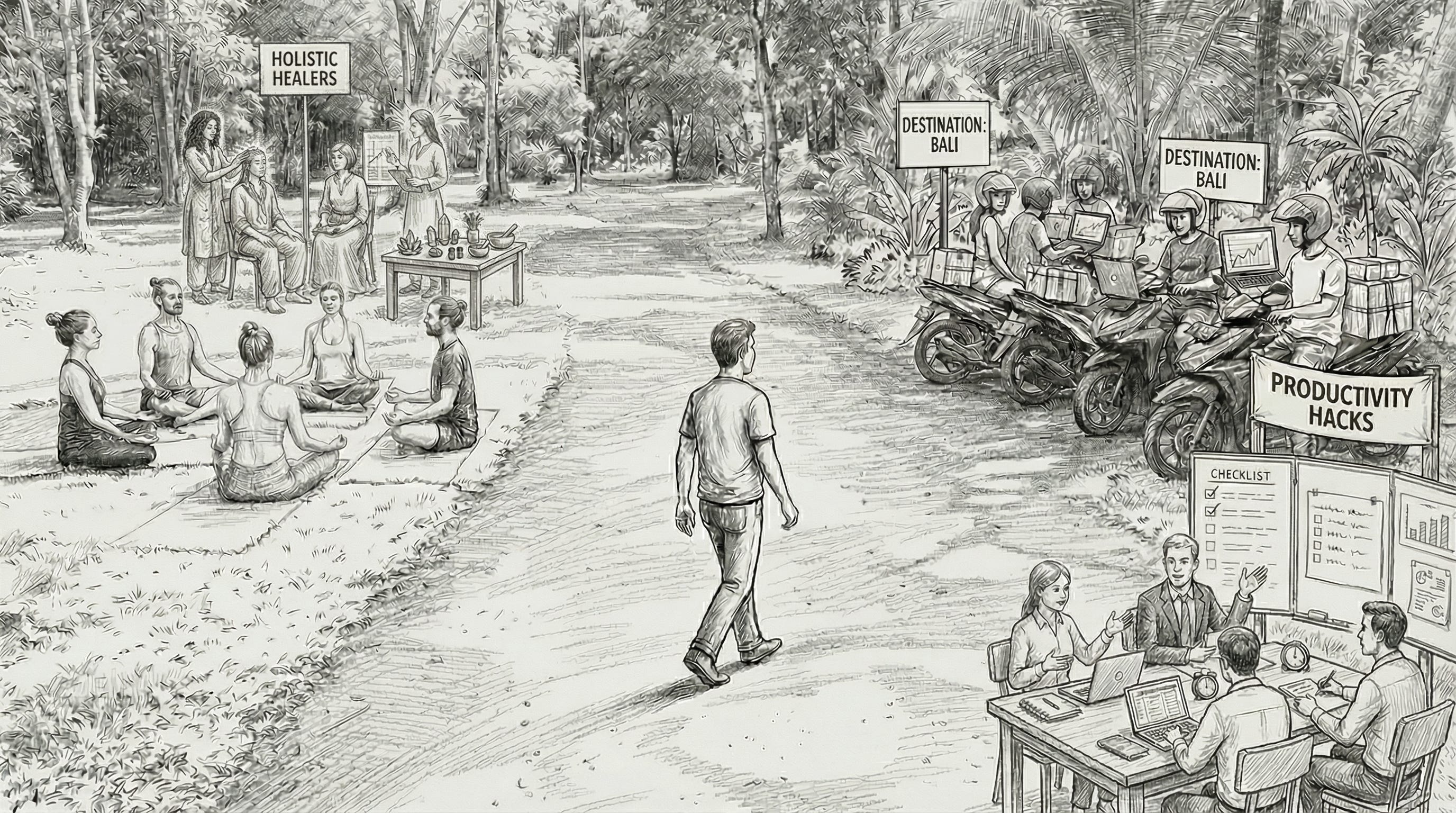
The key with these things is to embrace them to leave them.
Go to Bali to eventually be able to leave metaphorical Bali (I did this for two months in 2019, it was a perfect place to hang out 1.5 years into my journey). You can even stay in Bali but you don’t want to live in the reality of Bali
Embrace the productivity hacks to leave the productivity hacks
Do the psychedelics and healing work to be able to leave the healing work behind
You’ll also be tempted to join the mob against the world you left behind.
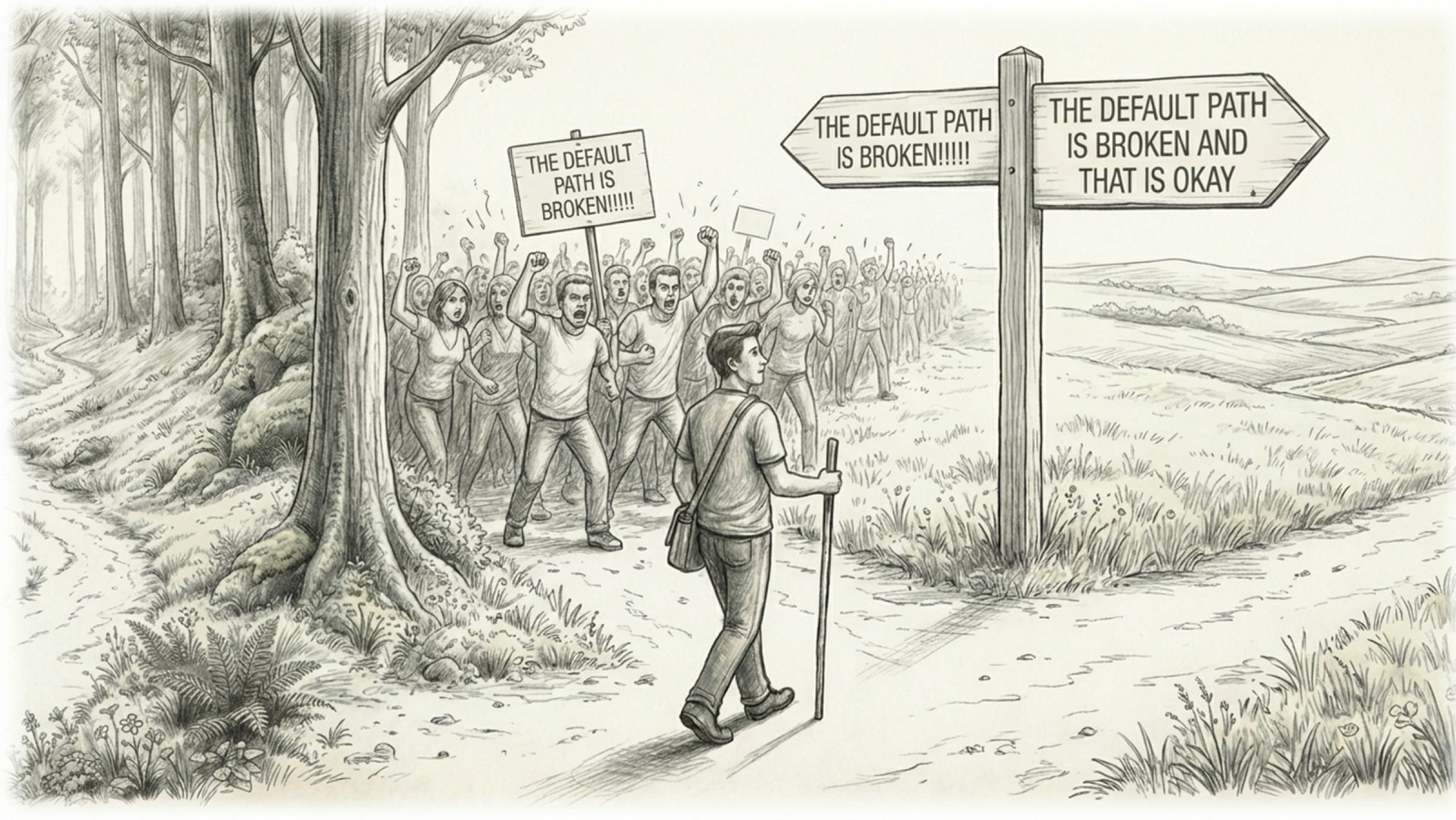
The way out of this phase is to realize that no escape is possible.
You have the desire to be saved but you should stop trying to be saved. You must finally accept that you need to navigate uncertainty, doubt, and vulnerability and befriend them instead of running from them.
For me, Joe Hudson’s work has helped me understand the rough process I took to get out of this: befriending them.
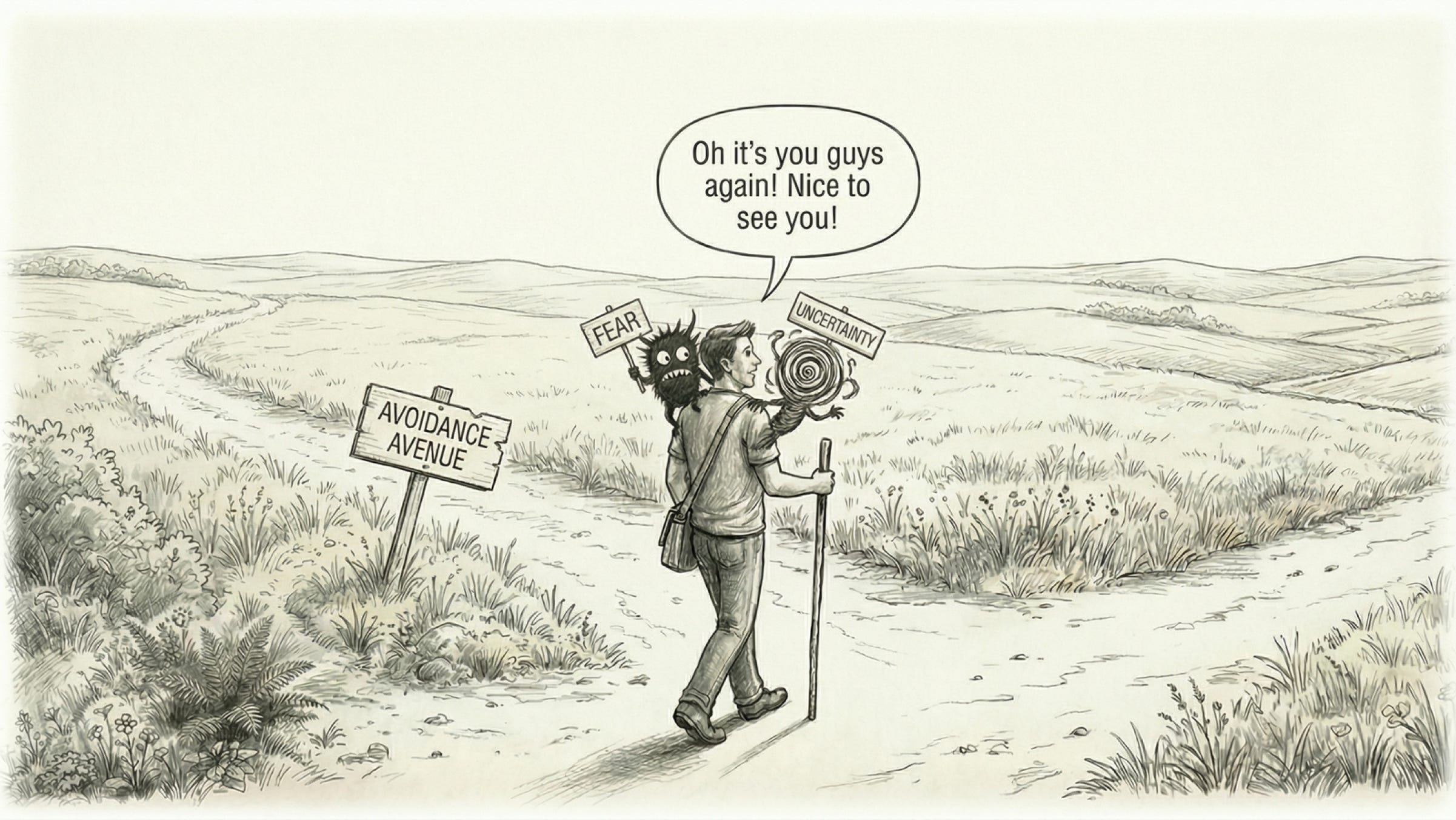
Before this, I spent 10+ years in what Joe calls the golden algorithm: Run from emotions only to re-create them from my action. My formula was simple: Try to escape my current situation => run from emotions => search for another job => praise and validation => feel same dissatisfaction again => repeat.
The way out was simple but hard: feel the emotions. Fully.
Getting lost and making your way out is about accepting it all:
The uncomfortable emotions
How you may not be a fit for the default world anymore
Your frustration at how things work
The many new challenges you are facing
How others aren’t open to your new perspectives.
And saying, ahhhh yes, this is okay, let’s keep going.
In other words, you can leave the world but you must leave the world in order to find it again. You can leave work temporarily, only to find it again in new form.
Phase 4: Wise Agency
It’s exciting to think you can arrive at the magical upper right quadrant, the place Peter called “agentic sage,” in his first post.
I think the only realistic way to arrive there is to completely lose interest in any such arrival.
The key idea that I picked up in my season of solitude was that only through knowing thyself can one figure out what is worth doing.
This inverts the logic that we do what others around us are doing or that we should do what is “smart” or best practice. But when you approach life in this way, you can end up making interesting choices, ones only you can make. This looks like “agency” to others but weirdly will not feel like you are doing much at all.
One frame that’s helped me think about knowing thyself is John Vervake’s “four ways of knowing” or the 4Ps:
Propositional (facts, concepts)
Perspectival (other peoples ideas, other viewpoints)
Procedural (how to do things, process)
Participatory (active engagement with)
Early in our lives, most of us over-index in the propositional (“I know these facts”) or the procedural (“this is the correct way to do things!”).
A movement toward wise agency requires embracing all four and then continuing to engage in these throughout life, ideally moving away from the propositional and procedural as you learn more about yourself and the world.
As you enter a new phase, you inevitably engage in new modes. For me, some of the ways I engaged were:
Perspectival: Travel to understand new ways of living and opportunities; podcasts to understand new perspectives
Procedural: Books to understanding how to approach new problems; courses to understand how things really work
Propositional: Learn basics like tax law, accounting rules, and realities of making money on my own so you can ensure you stay in the game
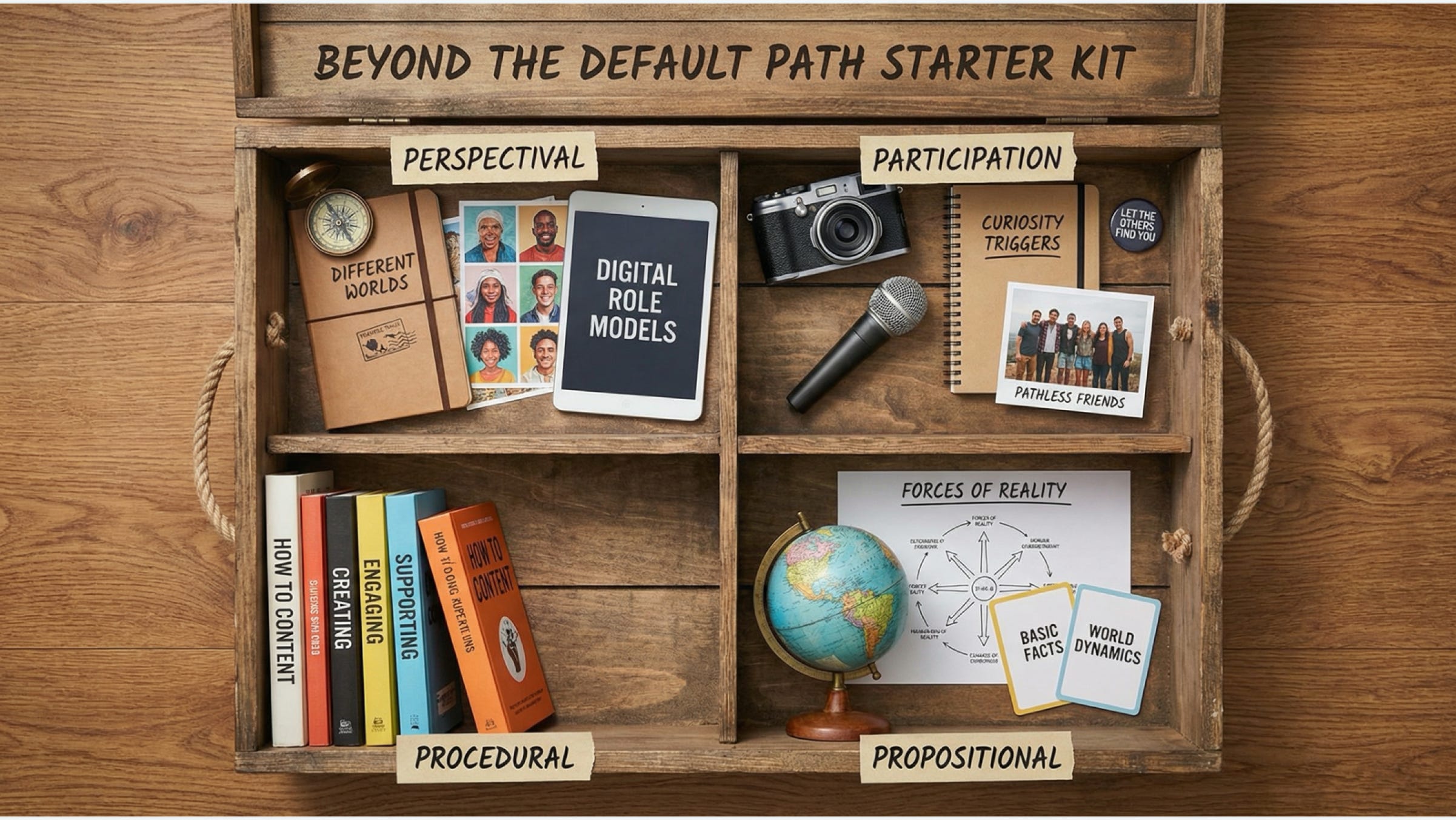
These give you confidence about your new path and enable you to see new possibilities for your life that you didn’ see before.
But the trap is that you lean too hard on the ones you are best at: The engineer who leaves their job spending all their time on reading how-to books and prodctivity hacks and only spending time trying to make money in the new startup, who forgets to take a day off to assess what might have changed after shifting in this new direction.
This is why the last one and most overlooked is Participatory knowing: through action I can come to know more about myself and the world.
This can be a broad definition of participation:
Offering something: supporting family members, mentoring people, giving encouragement, sharing your expertise, being the person who reaches out
Hosting and gathering: dinner parties, book clubs, online communities, group chats with intention, workshops, retreats, or even just a group chat
Doing new things: taking a class, volunteering, joining a sports league, learning an instrument, showing up to local government meetings, traveling somewhere that challenges you
Creating something: a business, a piece of writing, a podcast, art, a newsletter, open-source software, a course, even a journal entry
Religious or spiritual practices: Religious groups, Meditation, mindfulness, breathwork, retreats, and the endless list of woo- and woo-adjacent practices
This kind of participation in the world is increasingly important the further you are away from any sort of default path you left behind.
Vervaeke argues that the modern human needs an “ecology of practices” to stay sane. For me writing has been a powerful practice but so have things like meditation, breaks from work, time with my daughter, breathwork, travel, and all of the weird work things I do in public that stir up all sorts of emotions and discomfort.
On a podcast, he said the aim of these participatory practices if to be open to failure:
An ecology of practice is a complex dynamical system. It takes a time and effort and commitment and a willingness to transform and fail and learn from mistakes in order to make this work.
This rhymes with Peter’s frame of being “less foolish” rather than seeing “wise agency” as a place for arrival.
A metaphor I offer for this is Posting:
Posting is not just about posting online but it can be that too. It is about making an offering to the world. It is moving in the direction of things that feel scary but feel right. It can be any form of participatory action. It is ultimately about making an “opening offer” to the world and being okay that nothing may come back while also being open to whatever may come to you regardless.
At it’s core, “posting” is a generous act, and it is a multi-player game.
I think this is an important metaphor because so many people have reflexively rejected the digital age. Cal Newport tells us to run from the internet, hide in your cavern and do your deep work. I think in today’s age this is the wrong stance.
Real growth comes from engagement. Dancing in the chaos of the world as it is and being open to seeing where you might be able to take wise action.
The biggest challenge for most people is that wise action is very hard.
This is because many of the things you learned about how to operate in that first chapter of your life will no longer be effective.
Either because you are not operating with the same source of fuel (things like the desire to prove others wrong), or that the rules of the world you are now inhabiting and participating in are different.
But now, you have some sense of what you are capable of and more importantly, not capable of. Having this wisdom enables you to hold everything you do much more lightly. Success isn’t your savior and you don’t attach yourself to script of being special through work. This opens you up to the ability to be immensely existed by what others around you are doing. You are amazed at how little you are threatened or triggered by their accomplishments. You don’t feel as much pressure from your projection of “the world” about what you should be doing.
Despite this, you will be constantly tempted to take shortcuts. You will be shown quick paths to riches, easy ways to sell out what matters, and hacks that will enable you to do things the easy way. You will be offered instant acceptance in new groups that promise belonging and a refuge from the world. This never ends.
But wise action is knowing that all of these things are paths to foolishness.
Wise agency is about knowing that the path forward in the world is usually just about surrendering to the work and ways of life that become more obvious over time, through simply continuing to show up in the world.
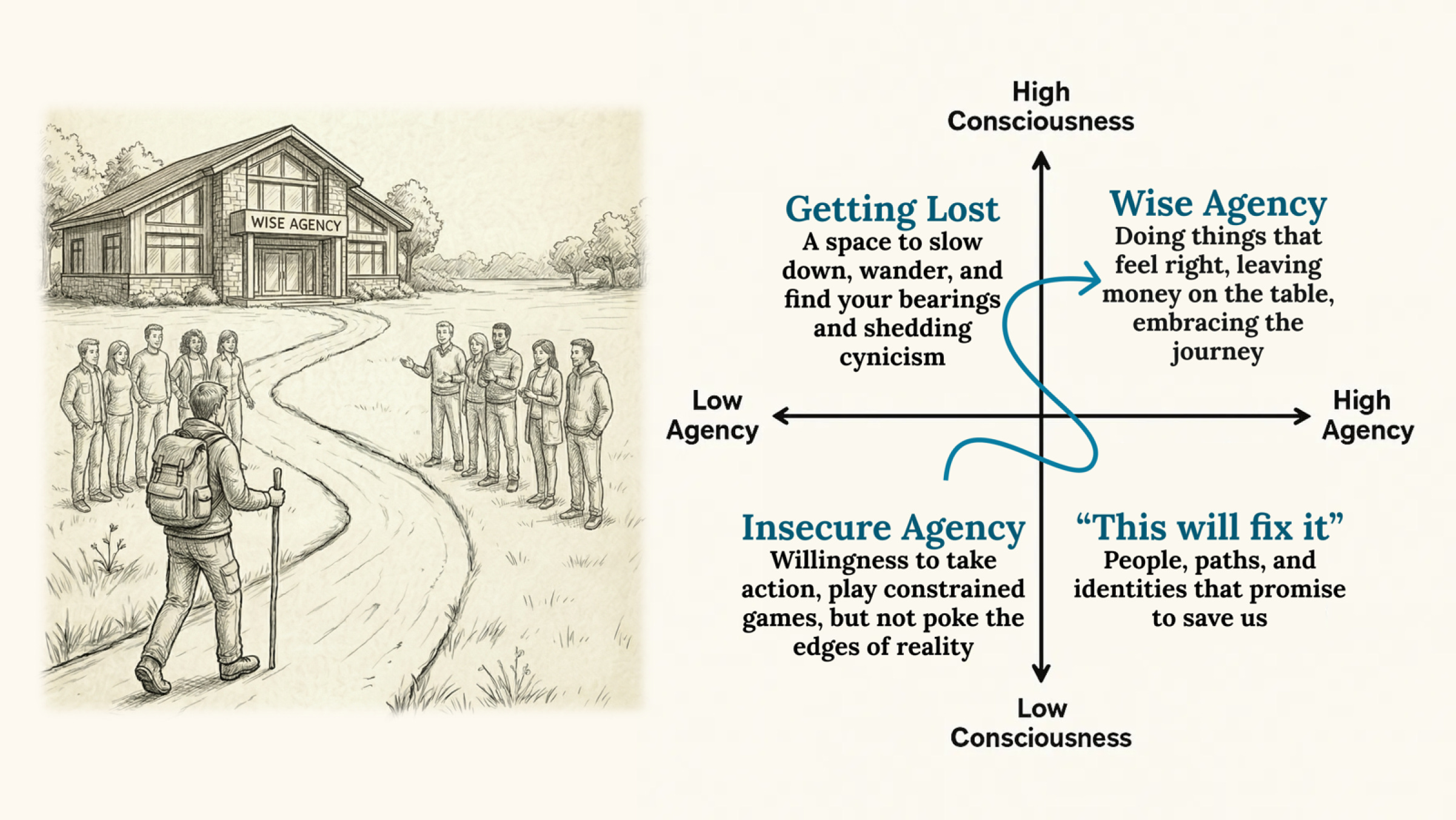
It may seem like you are arriving when you realize all of this. That you are smart.
But you are wise enough to know that you are still on the beautiful journey of life.

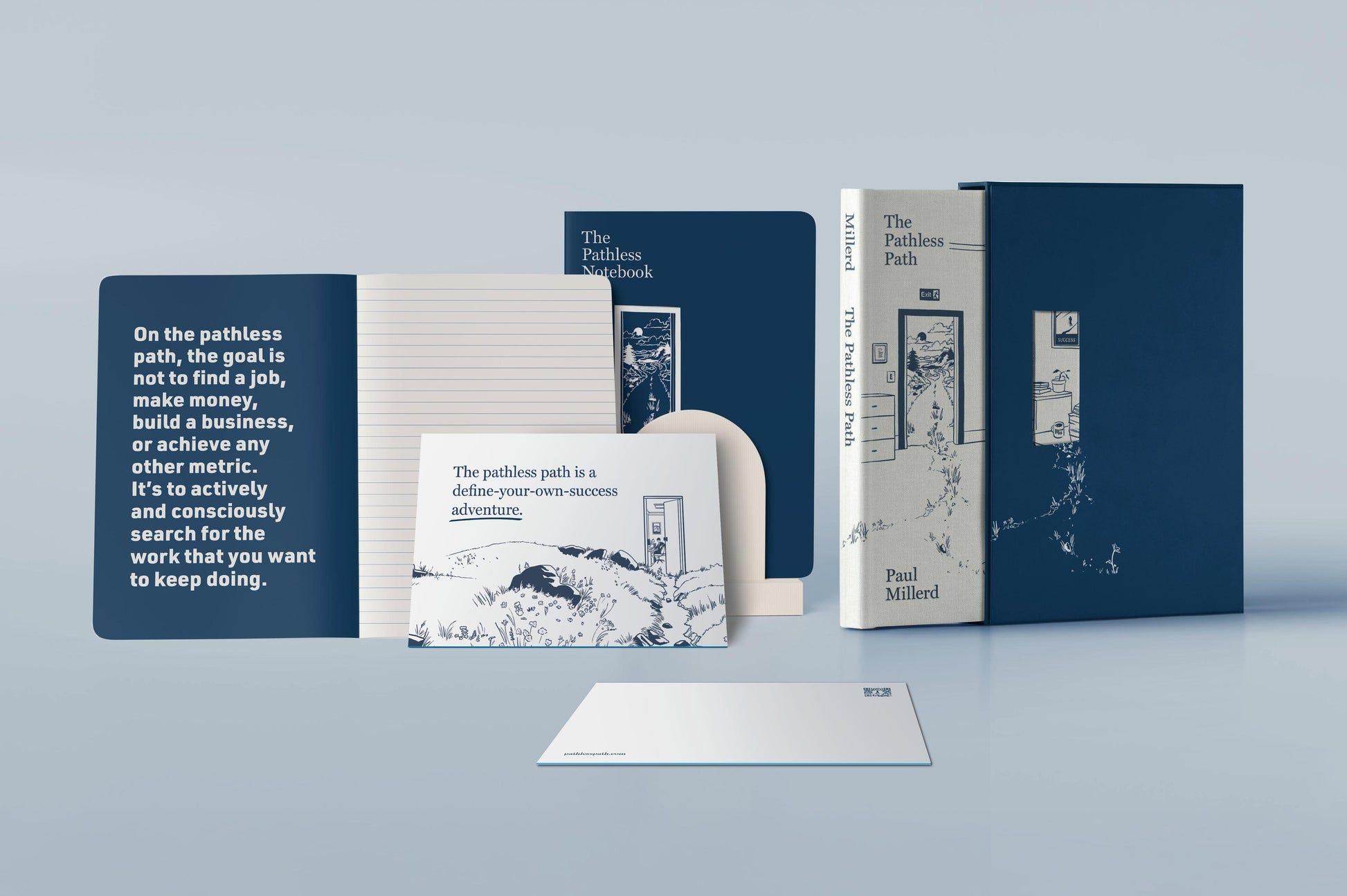
I recently launched my premium hardcover version of The Pathless Path. If you order before Christmas, I’m shipping it out gift wrapped (custom note optional) with a bonus notebook and note cards.
"The key with these things is to embrace them to leave them... Go to Bali to eventually be able to leave metaphorical Bali"
Wow this is so real, and maybe a universal experience for travelers and wanderers? I'm finding so much of my learning in the past few years has been getting everything I think I want... only to find out that it's not quite what I really want... and refining my goals and intentions from there.
This was such a relatable email. Every word felt like talking to me directly. Thanks Paul.