


I don’t really know how to write about anything except AI right now. But I am more excited and energized than ever. It’s also the best year financially I’ve had for my business (mostly from consulting work) in three years.
Coming into 2026, I had been feeling stuck. I was disillusioned with the fracturing internet and the increasing attention-war dynamics of social media, podcasting, and online writing. I decided to take a mini-sabbatical.
The night before, I had a call with Alex Dobrenko`. In less than 15 minutes, I was Claude Code-pilled. The next few months, I dropped the ball on most stuff, but I started dabbling with Claude Code. It was very fun, and the possibilities for injecting life into my journey and work were clear.
In the last 10 months, AI has seeped its way into almost everything I’m doing and I’m more excited than ever. The way AI works weirdly aligned for a number of things that are specific about my preferences and journey:
I have nearly infinite ideas for things I’d like to do, but I’ve almost always been constrained by time or money trade-offs.
I’ve been tinkering on computers since I got my first one at 8 years old and like trying out pretty much any new software tool. AI is not one thing and to use it well (for now) requires tons of experimentation and tinkering without clear goals. I love this. Many people don’t.
I can code at a basic level and always knew it would be helpful to go deeper, but never wanted to go all-in because the opportunity costs were always too high. This has made learning much of the dev side of agentic coding rather painless and fun as well.
I spent several years in operations and as a process engineer, and I love thinking about process, something that feels increasingly important. I then spent several years as a manager in consulting environments, having to harness the intellectual gifts of over-eager junior consultants through endless iterations, false starts, and rabbit holes. The combo of these skills seems well suited for managing agents.
Given this context, here are a few reflections I have on working with AI.
#1 For my actual work, I ignore most prognostications about AI and simply try stuff. I focus on field reports instead
In How to Make Sense of AI, Cedric Chin offers a rule I’ve been using to guide my own sensemaking.
“You will pay attention only to detailed field reports of use.”
His advice is to ignore predictions and opinions about AI and focus on specific accounts of what people are actually doing with it.
When I see someone trying something and sharing it, I try it myself and notice my own reaction. If you are spending more time worrying about how AI will change the world than actually trying to do cool stuff, you are doing it wrong.
#2 It’s changed what I want to write about and I’m doing more dictation
I’ve always been someone that relied heavily on analytical analysis and reasoning. It’s what helped me stand out in my 20s in consulting and something that I’ve injected into a lot of my writing.
But as models have gotten better and more accurate at this kind of analysis and reasoning, it’s made me lose interest in doing that kind of writing. I still do some of it but just post it directly to my site (see this ebook pricing analysis).
I’ve been playing around with finding data sets that have been unexplored for topics I’m interested in. I’m even playing with the idea of trying to get an article published in an academic journal.
More broadly, it seems hard to write about anything except AI, given how much it is changing work, changing my specific work, and how it is dominating the public conversation.
One thing I’ve been doing more of is dictation, which works well for some of the points I make below about feedback. Thanks to the amazing free Fluid app on Mac and iPhone, I’m doing a lot more dictation. This sentence is being dictated and cleaned up using free local models.
I highly recommend trying these out, as AI cleanup with local models is very easy.
I suspect this may change how I think about writing too, but it’s too early to say, as I’ve just started using these tools in the past few months.
#3 It lowers the “cost” of doing things that I would have had to hire people for in the past
I’ve designed most of my work around not having to put in crazy hours or show up on a fixed schedule. Before AI, that meant limiting what I took on. After having kids, my rule was no more than two major projects at a time.
Earlier this year, I set up agents to run weekly reviews of the Meta ads for my Think Like a Strategy Consultant course and the Amazon ads for my books. Each week I’d log in, read the suggestions, and say, “Yes, those sound great, do it.” So for at least six months, they’ve basically run on their own: creating ads, uploading them, and shifting spend based on results. I pop in once a month to make sure nothing’s going crazy and I’m not overspending.
My StrategyU email marketing was a different story. It’s a web of ads, webpages, email sequences, tags, and automatic triggers, and for years something in it was always broken. I dreaded working on it because every fix meant two or three days of locked-in focus, and even then, small things never quite worked.
A few weeks ago, I realized the models could handle far more context, especially Opus 5.5. So I dropped everything into a single folder and promoted my Meta ads agent to Chief Growth Officer. It now owns the strategy for growing the course and hands work to a team of specialist agents. My job is the work that’s easy and fun for me: content and ideas.
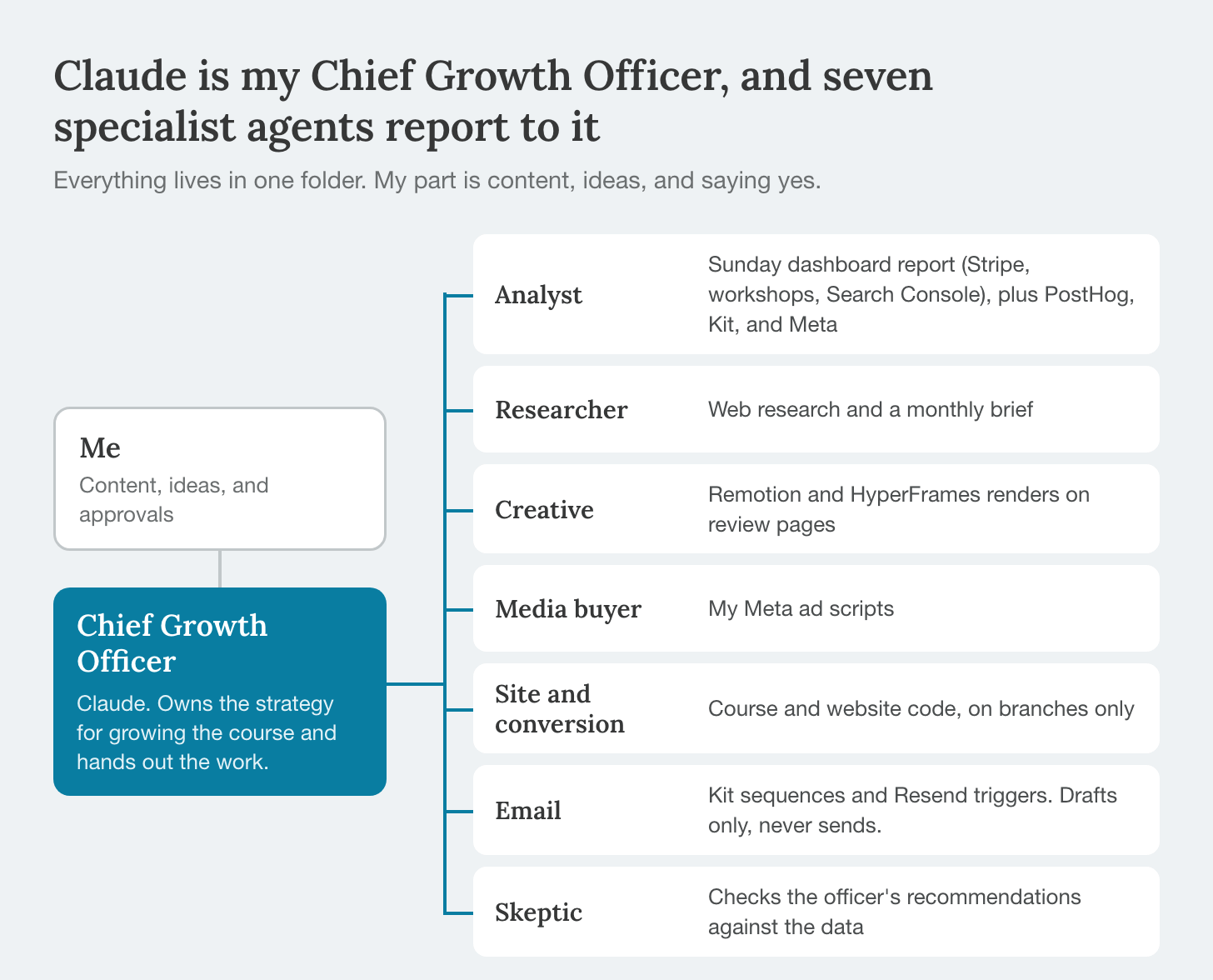
For the first time, I can see my whole customer journey, which used to be full of broken templates and tags, incorrect URLs, and inefficient pitches.
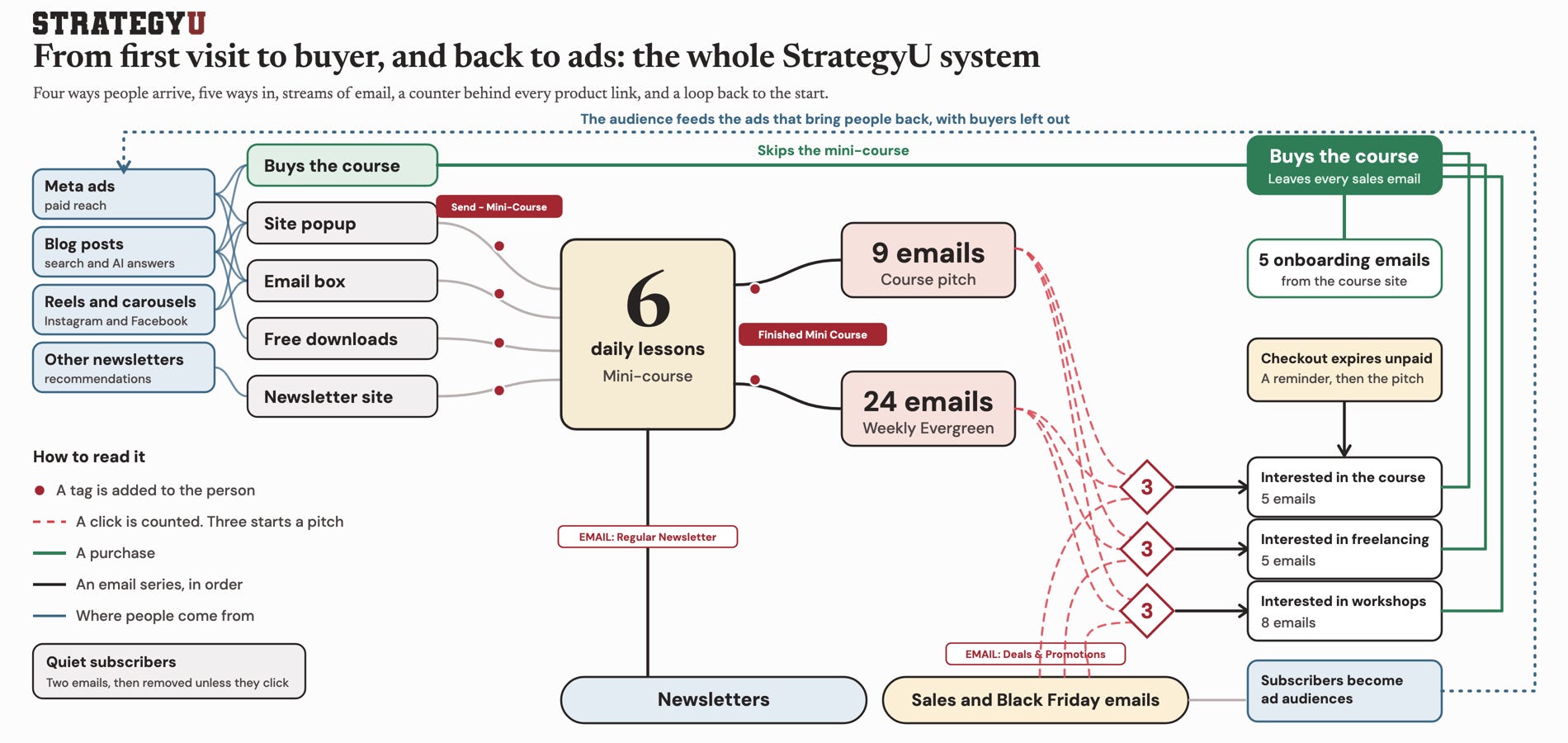
I used to be scared to change anything because of the cascade of edits and fixes that followed. Now that everything lives in one folder with all these connectors, I can:
Check every single link for accuracy across every site, email, ad, and social post
Create automated DM responses on social via my ManyChat clone
Add a new offer (like free consulting templates) and then cascade it across every site, email, and offer page.
#4 Doubling down on advisory work
Part of why I’ve been motivated to focus more on StrategyU is that there has been increasing demand for virtual and in-person workshops teaching the consulting toolkit. As AI has turned every worker into an infinite content machine, the challenge shifts to discernment, process, culture, and getting employees to adapt to their new superpowers.
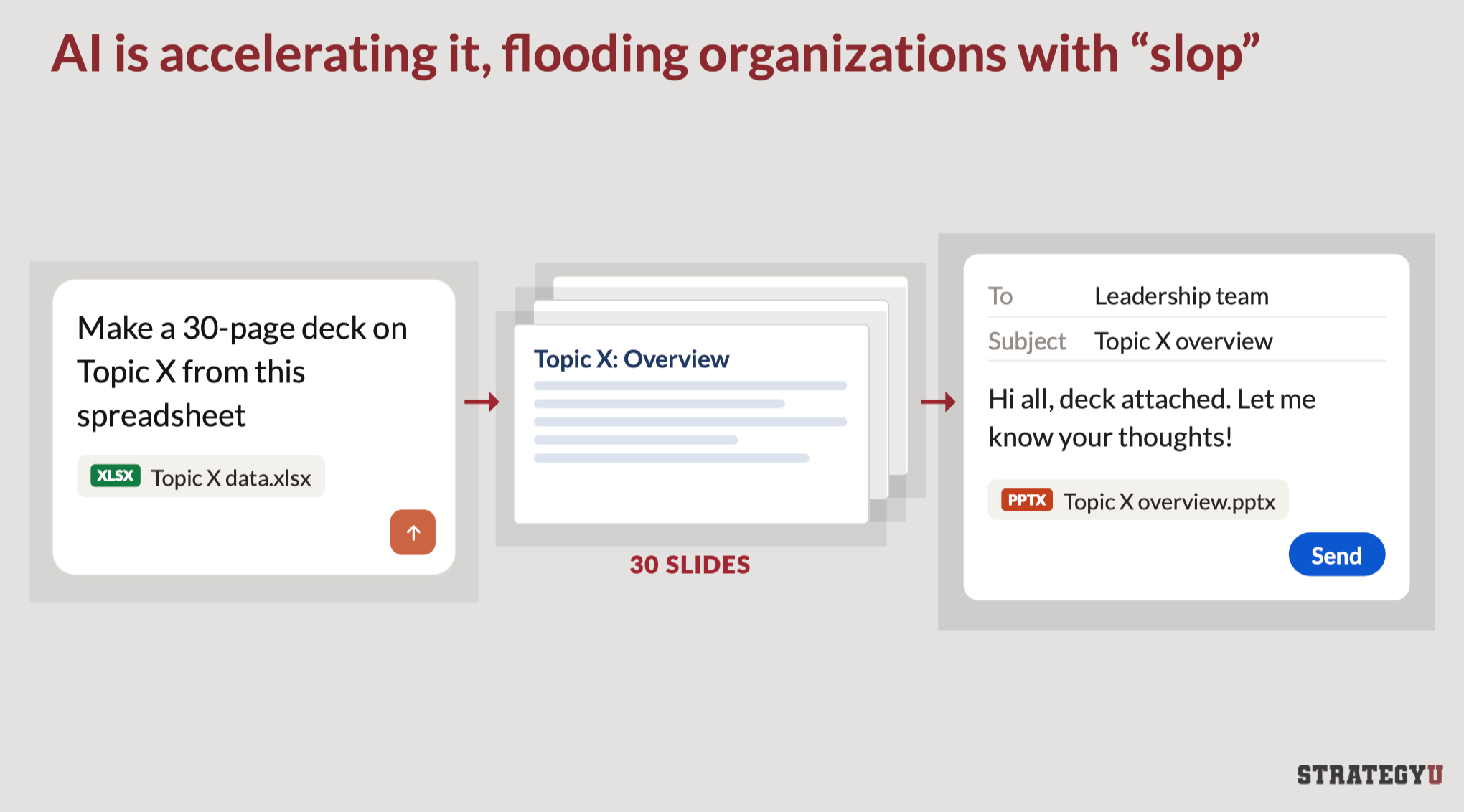
No one has the right answers here, and as the models get more intelligent, things are going to change even more. I’m having a lot of fun thinking through these challenges, though.
From this work, I’m developing a talk on how AI is changing knowledge work and organizations. I’ll share it here soon.
#5 Many more iterations on work I’m good at
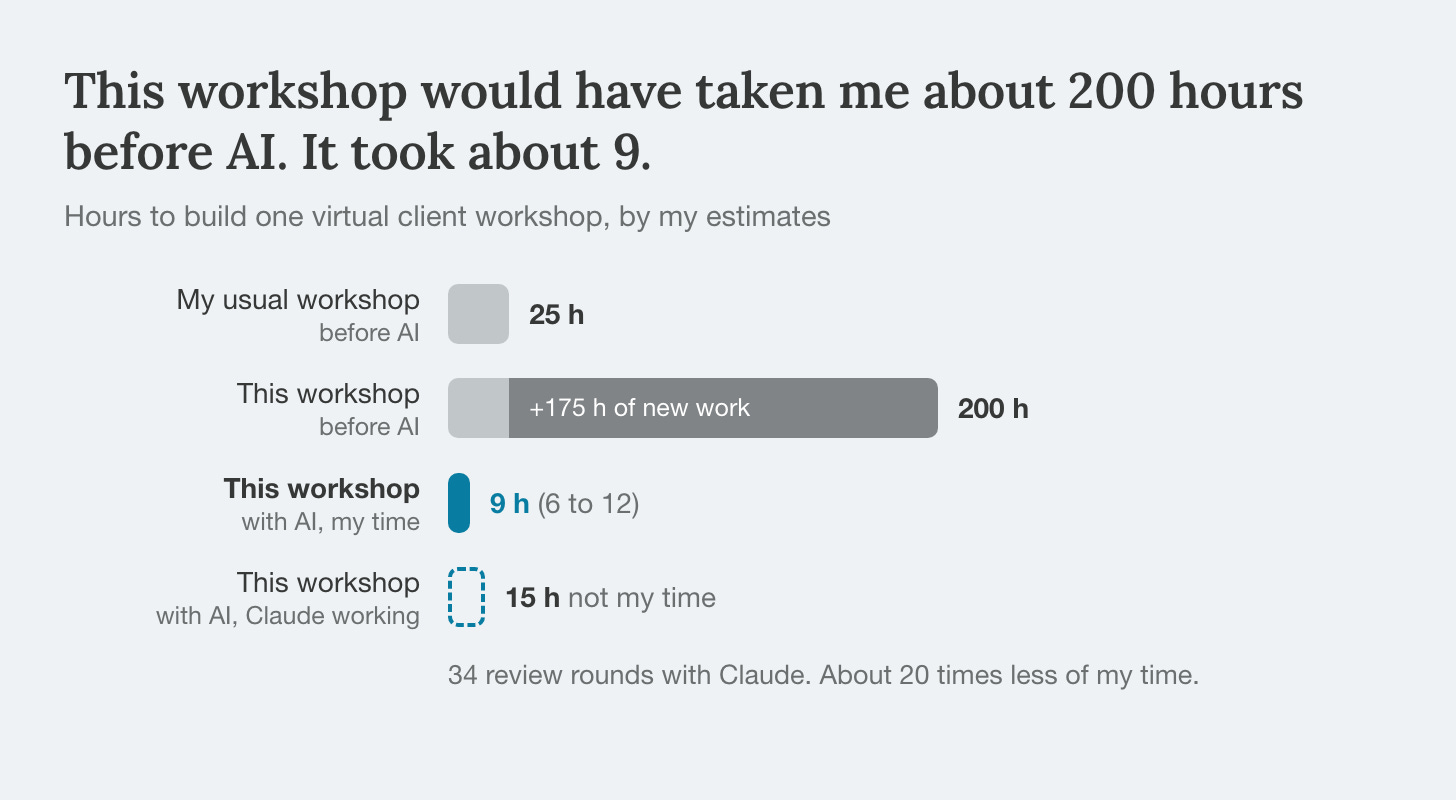
I recently developed content for a virtual client workshop and was able to create something that was far more ambitious and better than I had ever created before. The interesting thing is that it actually took me less time to do, but I ended up doing far more revisions.
If I had done this work before AI, it would have taken me about 200 hours based on my estimate. Which is to say, I definitely wouldn’t have done it because I didn’t have enough time.
But now, working with the models, I can do far more iterations and create all sorts of additional things like handouts, facilitator guides, and follow-on material that make my workshops a lot more valuable.
For my core teaching deck, I did about 34 full iterations. Before AI, and really before Opus 5.5, when none of the models were good enough, I might have done six or seven.
#6 Promoting myself to partner and focusing more on giving feedback
In consulting, there’s a meme phrase that captures the experience of being a consulting analyst: “pls fix.”
Consulting partners put this on a yellow sticky note on a slide after looking through a client deck for 5-10 minutes mixed in with some “make better title” or “not sexy enough.” You roll your eyes but then just try again, until you can meet the partner’s standards.
With the latest models, you should be thinking about what parts of your work you can promote yourself to partner on. Where can you be the person dropping the “pls fix” rather than doing the grunt work?
Most knowledge work software is designed for the people doing the work. This is why I made my own slide deck tool that lets me play partner, focusing on revisions and feedback rather than any of the manual grunt work.