


Saturday May 16th: Greetings from Taipei, I’m writing from a small office overlooking a tiny mountain on the outskirts of the city. We just signed a lease after finishing traveling village and sixteen months of being nomadic. We are nesting in preparation for baby #2 in July. I’m excited to be in one place for a bit, having access to reliable and consistent childcare, and an opportunity to spend more time in one of my favorite cities in the world. If you plan to be in Taiwan, let me know!
This is the longest stretch I’ve had without consistently writing the newsletter since 2018. A few reasons:
Mini sabbatical: In January, I decided to take a mini-sabbatical. This was partly because of participating in Traveling Village, a four-month trip with 20 families across three countries, something I wanted to sink myself into fully, At the beginning of the year, I was feeling a bit stuck and lost with my writing and work generally. When I’m feeling stuck, my instinct is to do less. I think that was the right instinct, and I’m happy to report I’m finding my way out of the long shadow of a 2025 slump.
Agentic Coding: Getting unstuck was almost directly linked with the dabbling I did with agentic coding tools. After a call with Alex Dobrenko` in January (the day before I started my sabbatical) I started dabbling with agentic coding tools and ended up getting nerdsniped by the possibilities and reality that I could now refactor my entire digital stack (more below) for how I’m working. In the months since, I’ve rebuilt my StrategyU business, moved six sites off WordPress, built a custom bookstore, and automated Amazon ads for my books.
Shift: The experience of shipping so many projects and taking action on so many things that were previously too daunting or too hard was thrilling and disorienting. I had my “holy shit, AI is going to change everything we know about work” moment several times in the past couple of months.
While many people who have had a similar awakening are quick to pronounce that you “only have six months” or that “you need to make money so you don’t become part of the permanent underclass,” my position is closer to wonderment and lots and lots of unanswered questions. I sense many people are reasoning from exuberance rather than allowing the uncertainty to wash over them.
Today’s post is a reflection on how I’m thinking about all of this, especially AI, work and the indie path in the context of my new AI-enhanced superpowers.
Embracing Full-Stack Weirdness
The best phrase I’ve ever found to describe my ideal path is "feral free agent." It’s perfect for someone who doesn’t like to be pinned down. I enjoy shifting between projects and identities. Some days I write. Some days I code. Some days I goof off. Other days I take a nap. I may try to make money, but it’s not my only aim.
Another more legible frame on this same idea is Tiago Forte’s “full-stack freelancer” from 2017:
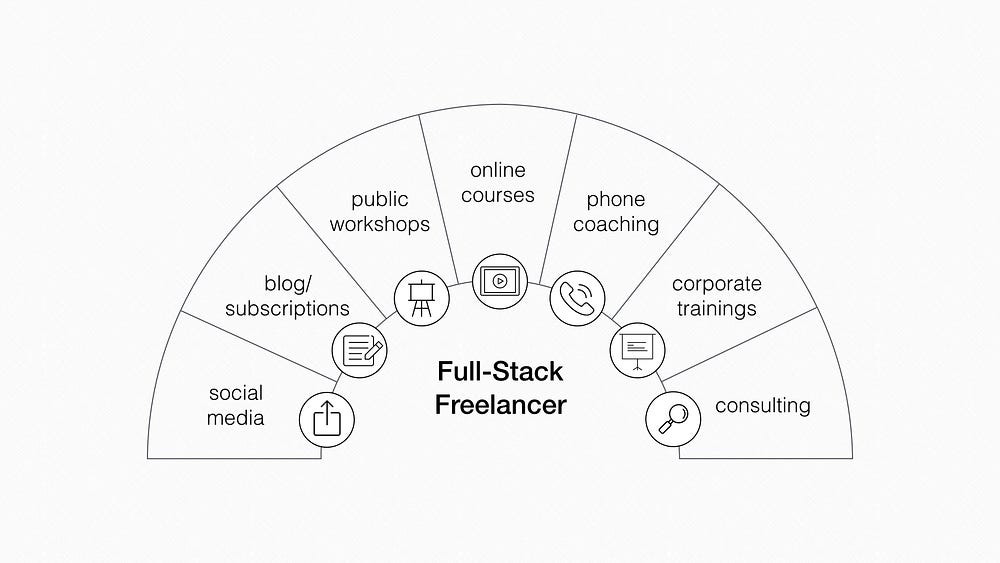
When I first stumbled upon Tiago’s framing of this in early 2018, I found it incredibly appealing. I had just finished six months where I was in freelance mode, trying to prove to myself that I could make it on my own. But I didn’t want to be just a freelancer. As Tiago put it in the original article:
Full-Stack Freelancers respond to technology as an opportunity, not a threat. They leverage software-as-a-service and online platforms to vertically integrate a “full stack” of capabilities, instead of focusing on one narrow function. This allows them to capture a much greater percentage of the value they create, instead of giving it away to gatekeepers and distribution bottlenecks.
As an overeager early adopter of technology, this definition appealed to me. I wanted to embrace the latest tools not only because I liked tinkering with them but through using them, I would see and feel new possibilities for working. I remember the first time using Zoom thinking wow, remote work is now legit. Same thing with Stripe. Payments were hard and annoying and then they were solved.
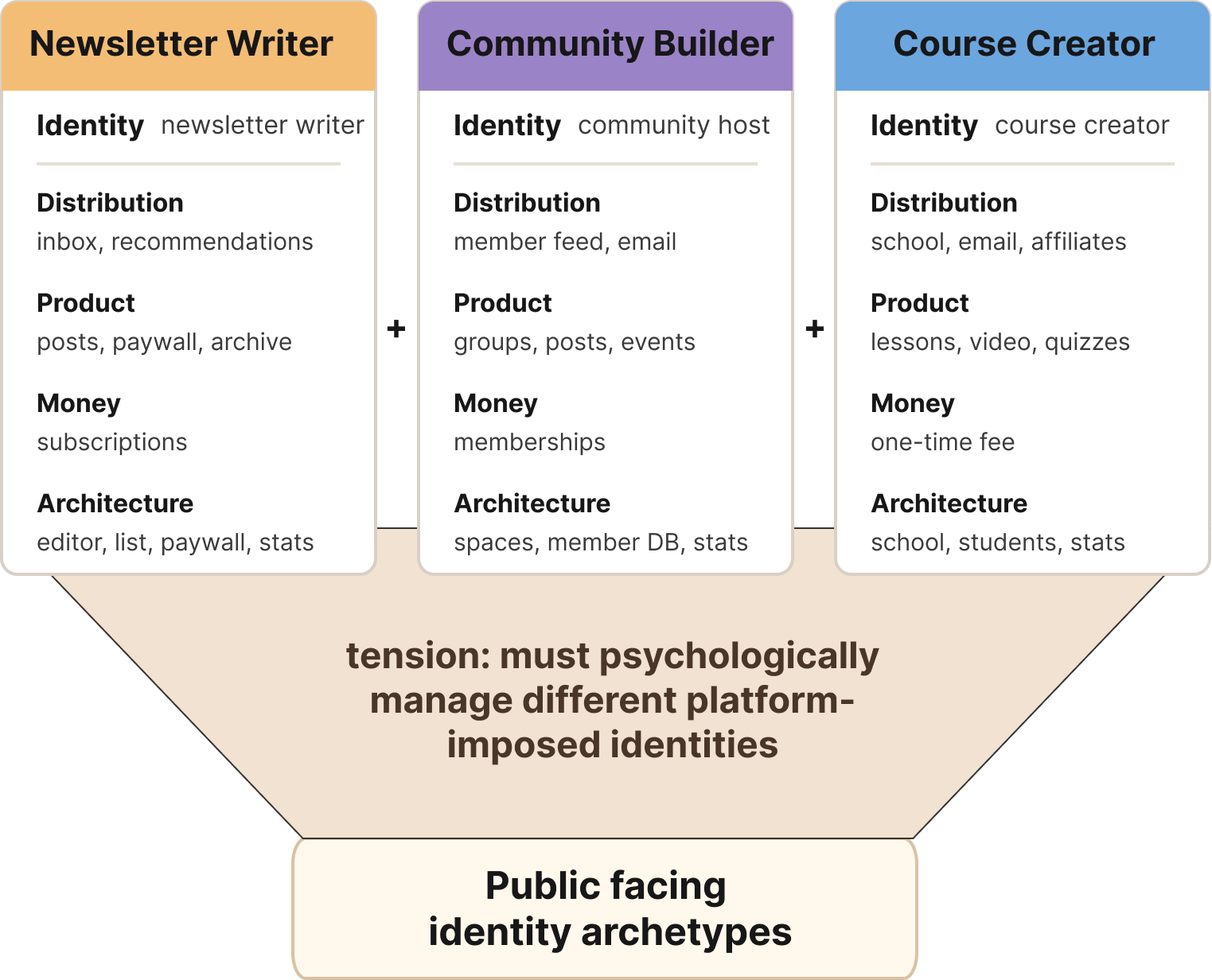
While much of Tiago’s formulation was right, there were hidden constraints if you wanted to scale. Each platform meant new possibilities but also unique constraints. Each one forced you to repackage your work and sell it in specific ways. The mental overhead of fitting your work into the strong opinions of different platforms meant economies of scale were hard to find as a solopreneur. And these platforms only became more distinct and less interoperable in my time on this path. It’s no surprise that Tiago and many others who started in the solo indie mode eventually built teams.
While the indie mode has enabled me to hack a living and make a decent income for the last nine years, the constraints across various algorithms, systems, and platforms have become increasingly taxing. Each social media platform now nudges you to create natively and no longer reliably shares your work with followers unless it is rated as engaging by the algorithm
Platforms and tools like Circle, Substack, Thrivecart, Podia, Gumroad, Stripe, and Teachable were/are amazing and enabled me to make money in ways that were impossible ten years ago, but each of these platforms has a business model that wants me to package my work and make money in certain ways. I’ve used Circle for my community platform, but struggled for more than a year trying to sync it with Substack’s payment infrastructure, wasting endless time updating member access lists, before eventually abandoning Substack subscriptions and moving my community to a one-time fee to eliminate the admin work. Last year, I gave up logging into the platform and engaging with people and moved the community chat to WhatsApp because my revealed preference was that Circle was energy draining for me. The vibe and energy of the community completely changed overnight. I'm somewhat better aligned, but I’m still at the mercy of WhatsApp’s roadmap and product choices. The list goes on. On Teachable, I’ve had a lot of success with my Think Like A Strategy Consultant course, but I have felt unmotivated to make changes or upgrades because the platform had become clunky and slow.
Each platform, product, and brand I created became its own world. Not only would I need to think about each product in different ways, I’d also need to embrace a different persona within each of those ecosystems.
I was a full-stack freelancer in theory but in practice was spending lots of time on admin and the mental overhead of trying to manage all my distinct products and related personas. I was frustrated by this but also by the reality that the way to “win” in this game is to flatten yourself into what the platforms and algorithms want. You could only be truly feral if you wanted to be broke. Most of the creators and online writers that successfully played this game either outsourced the work to other people or were naturals at hacking the increasingly default path energy of the self-employment world.
At the beginning of the year, I was sort of burned out, thinking that I really needed to do something drastic.
For me, drastic meant doing less.
So I declared a mini sabbatical to pause several projects, look around, and see what might pull my interests.
Somehow, within a week, I had my first interaction with Claude code.
Holy shit I have superpowers.
Rewilding the stack
Something I haven’t seen talked about much is how agentic coding enables unique tooling built around one’s unique preferences for working.
With SaaS apps, we are constantly pressured into upgrading for the next tier of features that promise to eliminate the annoyances of the current tier. Except this never stops. You upgrade and then you find a new roadblock. Then you start adding up the costs and realize that the company doesn’t really want a weird indie creator like me on the platform. They want me to scale. They want me to do more monetization. You know, like a real business. You send a text to your group chat and say, “I’m thinking of switching off this platform, who has recommendations.” Everyone responds back with the thing they hate about their platform and you realize, this is not worth it. I must just accept my current platform.
Now, building from scratch, I can build exactly what I want designed around some of the weird tradeoffs I like to make, and when things shift, I can make subtle tweaks at the underlying development layer.
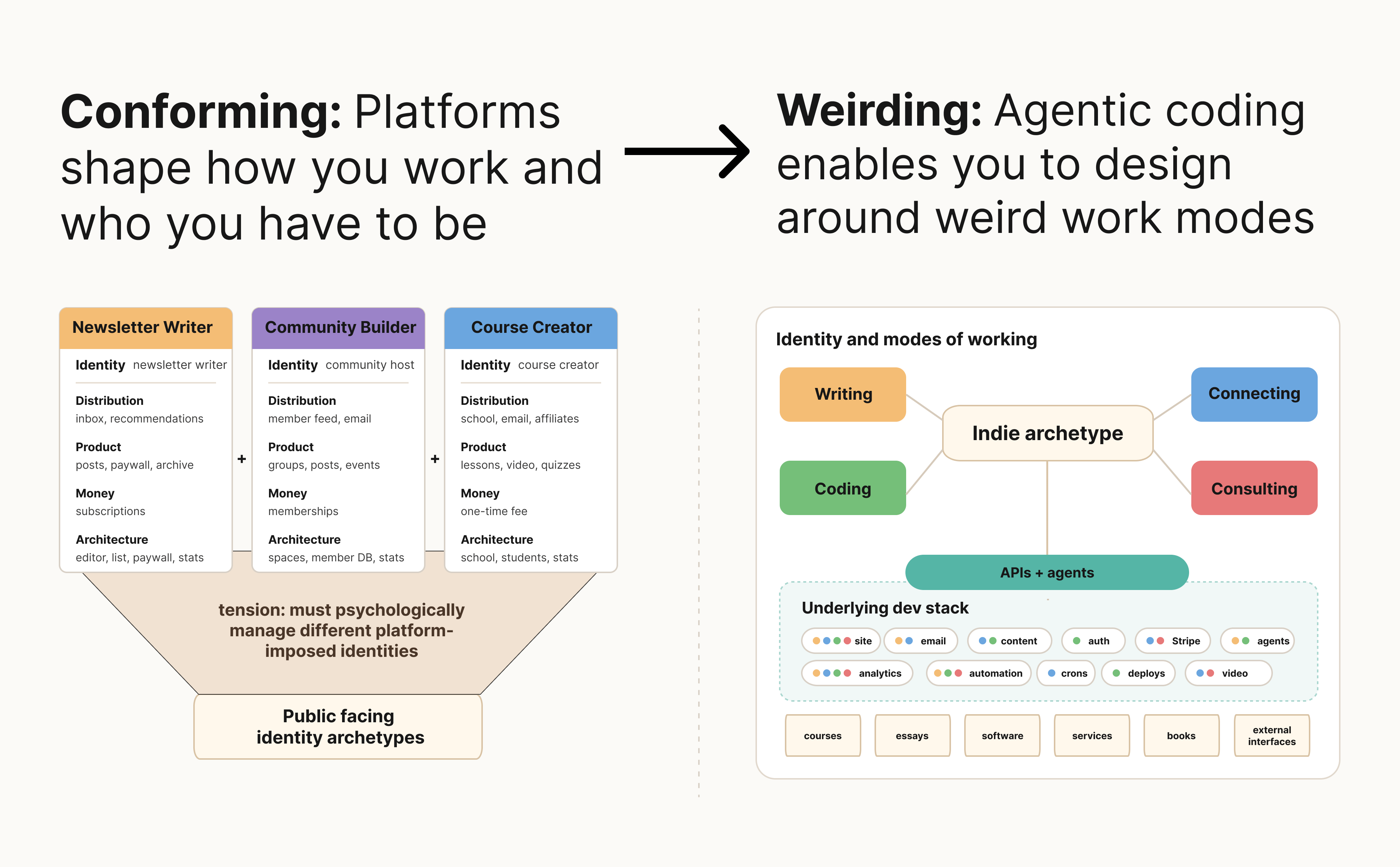
The result of this has been a major shift and vibe shift internally.
I’ve felt a lightness and an excitement about the possibilities of what I can create that I haven’t felt in a while. Part of this is that an endless list of things that I previously wanted to exist moved from too much work/too hard/too costly bucket to now a quick prompt to develop an MVP before deciding if I want to go further. As a former consultant who loves being in the flow of endless iterative work, this is great. I love it. Another part which makes this so fun is that I’m reaping a dividend from optimizing around laziness and not grinding over the past few years. I literally kept saying to myself, something interesting will emerge, I’ll eventually find the way forward.
In December, the bar of coding skills needed to build my own custom stack suddenly dropped and I was upgraded to software engineer. What was impossible or too much work a year ago is now not only possible but fun. I spent ten days completely rebuilding my StrategyU course, moving off Teachable, saving thousands of dollars a year, while also reviving my interest in running the business. Last year I was thinking about finding someone to run it, selling the business or winding it down. Now I’ve rebuilt the course again, I’m adding lectures, and am feeling more energized than ever. My chief of staff, Claude, is an excellent coworker.
The new platform is built around the behaviors and actions I specifically want to be taking. With everything I ship that delights me, I am not only improving the platform, I am increasing the odds of wanting to continue to maintain and improve things in the future. This is the limit of the former SaaS/Platform world: any tension with defaults leads to compounding disinterest and/or the requirement to outsource to a better aligned human. If I don’t like how my current platform is operating, I don’t need to find a workaround or a hack (mentally taxing), I can permanently improve the situation.
Working with tools like Stripe, Mux, Vercel, Cloudflare, GitHub, and leveraging APIs and open source libraries, I can start with my ideal way of working and then ask the coding agents if it’s possible, and if not, give me further ideas. While rebuilding Teachable, I learned more about coding and software development than I have in the last ten years. This “reverse sensemaking” (ship and then figure out what you did) is an underrated aspect of these new tools.
The more I’ve shipped, the more I’ve figured out, and I am seeing things in a different way. Seeing like an agent if you will. But it’s not the tools that excite me themselves, it’s the possibilities for how I run my business, and the degrees of freedom it allows me for how I show up in the world.
A 1:1 bookshop
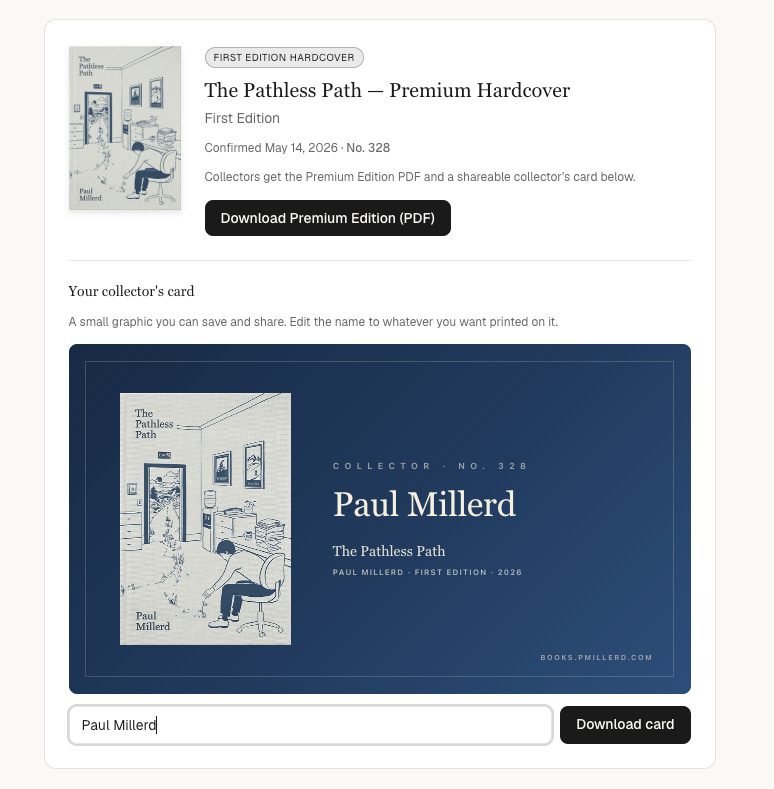
A quick example is the custom bookstore I launched at books.pmillerd.com. For the past few years, I’ve been frustrated with the inability to really create a direct channel to my readers. I’ve always wanted to offer a place where people could buy products directly from me and be able to deliver them in ways that I’d want to receive them as a reader. I’ve dabbled with Shopify and that works quite well for managing the logistics of my hardcover but it never felt right for setting up direct distribution of the digital versions of my work.
Here is the Shopify setup. Its fine, it works, but as you can see on the right, its just an uninspiring downloadable list of files.
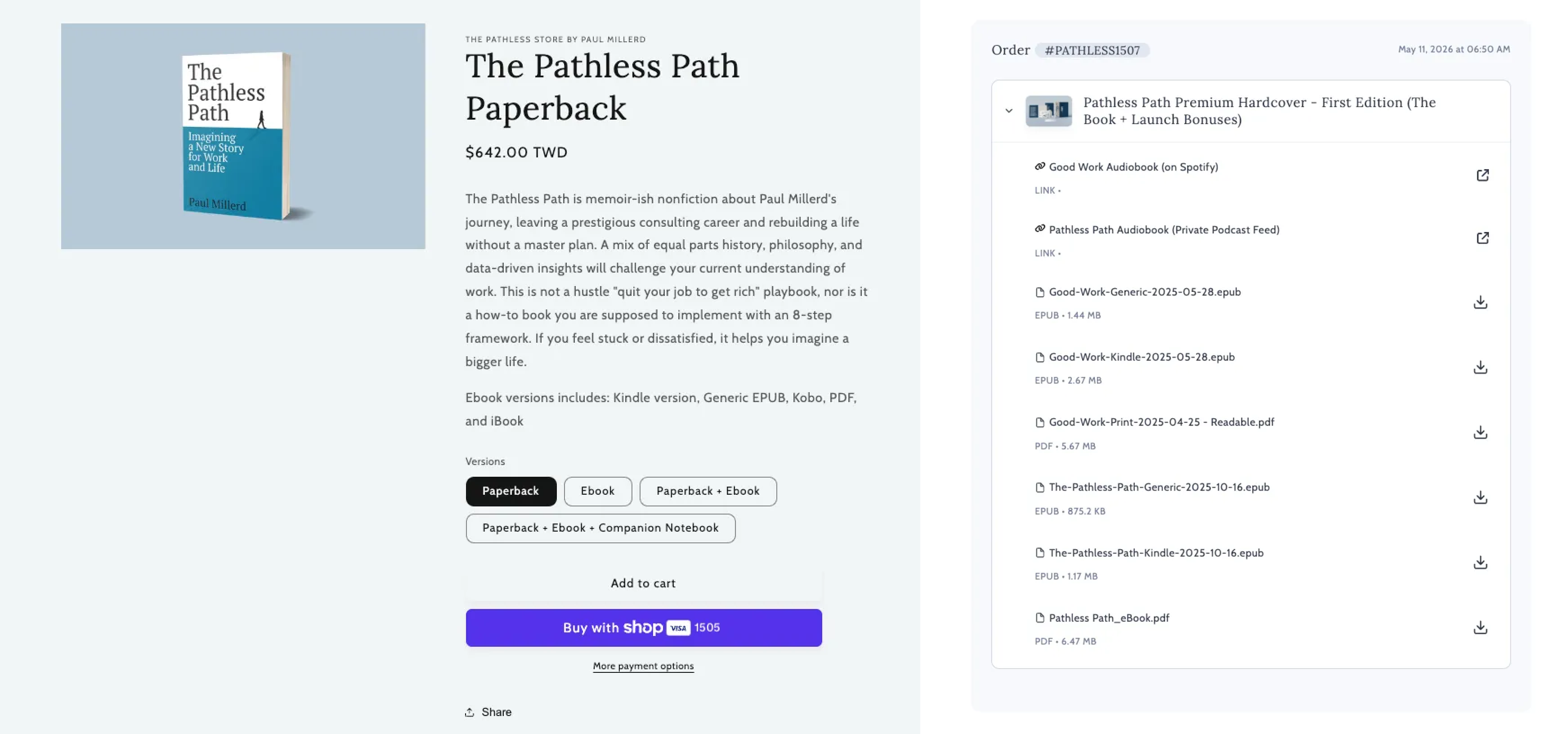
I’ve spent the last couple of weeks tinkering and now have a platform that does many absurd things:
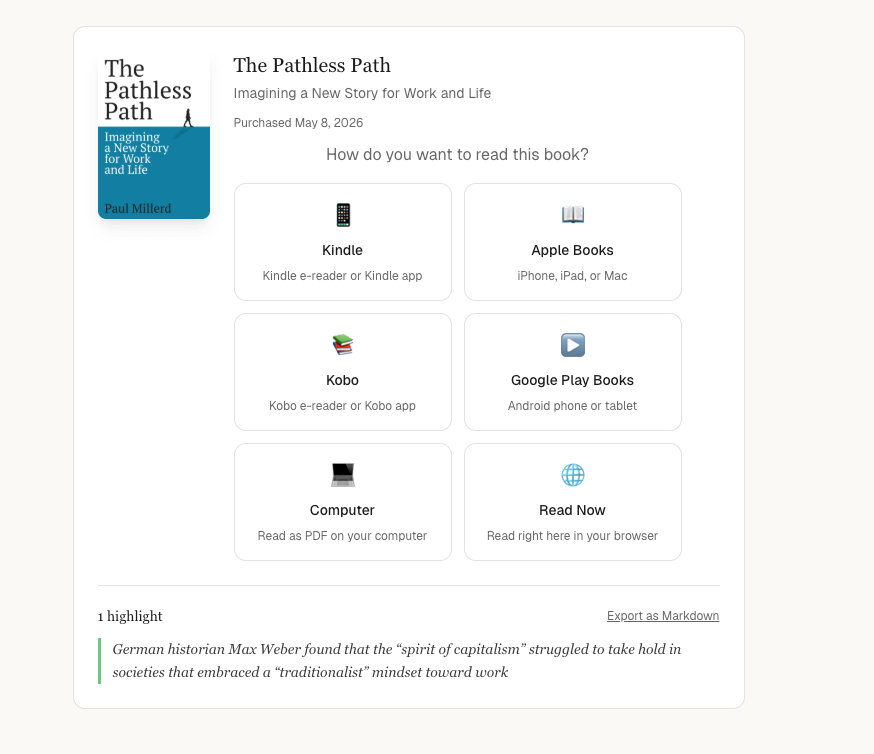
Easy access to my digital books in all formats
My own web reader that has text-to-speech that sounds pretty great (via Amazon Polly)
Has a workflow that allows people to embed custom dedication pages into my EPUBs and PDFs when they gift them (coming to paperback soon)
Automatic syncing with Lulu’s API for ordering paperback books shipped around the world with live syncing of shipping rates
The backend tooling to easily release limited edition drops of my printed editions or any other physical product (if I wanted to ship a custom foreword, or anniversary edition, etc.))
Automatic discounting if you gift multiple copies of my book to others
Highlights and notes with simple export (adding readwise connection soon)
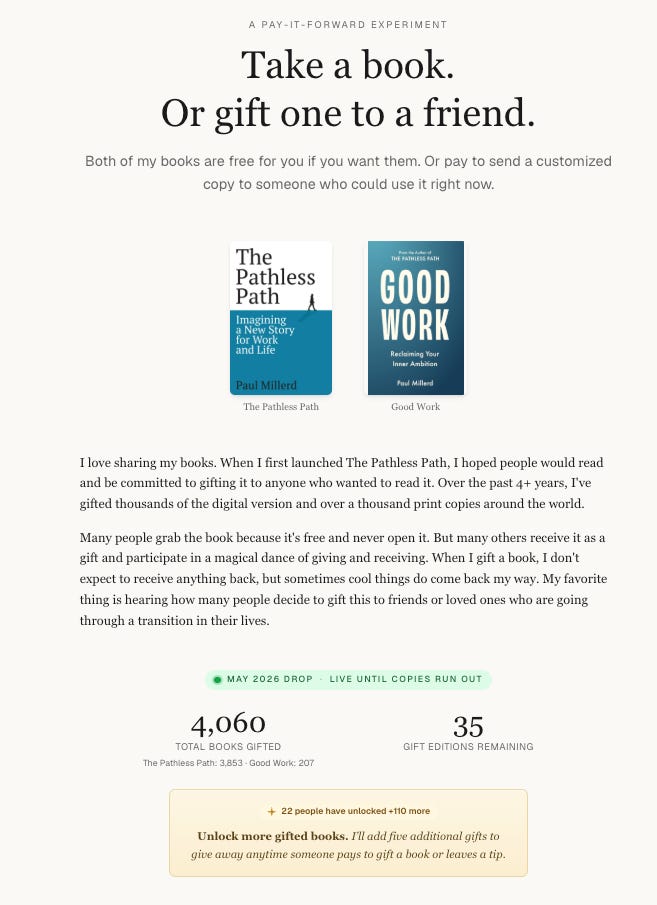
A gifting page where I can give away free digital editions and that also adds 5 copies every time someone leaves a tip or gifts a book to a friend
Here are a couple of the screenshots
This is all absurd and unnecessary and most of this may not make me any money. But it absolutely makes me laugh and smile and I find it incredibly fun. If it makes someone else laugh too then my job is done.
This was a lot harder than the one-shot AI bros make it out to be and sometimes it takes many attempts to get something to work, but with each session I’m able to stay in the loop, experiment with tools like AWS, Cloudflare Workers, Resend and MXRoute, while also having a clearer sense of what I want to be doing. It’s like continuously peeking around new corners.
I’ve been thinking a lot about Venkatesh Rao’s framing of the “Clutch Class,” the workers who are neither part of labor nor capital, as many aspiring feral free agents would. In his book Art of Gig (which is still very underrated for today’s times), he frames the mode of working and exploring in which I find myself now:
We scan the social streams for openings, seek out room to maneuver, ways to deploy high-leverage cheap assets, learn breakout skills, and dream up hacks and arbitrages. And we sneak one-at-a-time into the future, through gaps on the economic frontier, rather than marching rank-and-file in slogan-chanting cohorts.
We flow like water, shaping the landscape even as we get around it, generally making the stuffy old class hierarchy of the industrial age leak “like hell as we flow invisibly through the interstices.”
Causing the world to shift gears.
We are not capital.
We are not labor.
We are clutch. And the future belongs to us.
A fun tongue in cheek rallying call at the end pumps me up but right now it doesn’t feel like the future will belong to me at all.
I sometimes wonder if I’m insane, tinkering away on my own stuff, passing up the continued wealth grab that many of my friends and former classmates are gladly participating in.
It seems like the capital class is going to take it all and anyone willing to conform themselves into a capital shaped worker. That’s certainly terrifying and I’m not going to dwell on the implications of that here, almost every media institution is pounding us with what is bad about AI.
All I’ll say is that if you dig deeper with these tools, there is a promising alternative path that you can take. A chance to really lean into weirdness, feralness, and aliveness.
Which is the best way to find the gaps in the emerging and evolving economic frontier.
Time to go full pathless.
Who’s in?
#2 A small side newsletter
I started “Modern Publishing” to share my deeper dives into the publishing industry. This is an experiment, and we’ll see if I want to keep it running. I may just merge it back into this newsletter, we will see. But the first post is a deep dive into my foreign rights deals and how much I make from each book (hint: not much!)


Hey there
I’ve been doing some form of public writing since 2015. I’ve somehow figured out how to hack a living doing things like writing books and launching premium art editions of my book. If you like what you read here, you’ll probably enjoy my books The Pathless Path and Good Work:

If you’d like to join a virtual community of others on “pathless paths” from around the world, and get access to courses, tools, and other resources I’ve created over the years, you can join The Pathless Path Community. Our recent WhatsApp community is very active if you like hanging out on messaging apps instead of Circle.
Some things I endorse:
Readwise is offering 2 months free (I use it for book notes and reviewing highlights). Or two months free on
Readwise Reader, which I use for RSS reading and epub reading
Crowdhealth, an alternative to US health insurance that I’m still using while abroad
Postbridge: A social scheduling app created by a reader without crazy upcharges for more accounts
Kindred, a home-sharing app
Collective for handling your S-Corp accounting needs, and Nat Eliason’s Build Your Own AI Apps course
If you received this and find yourself in a state of outrage, thinking, “What is this?” I strongly encourage you to unsubscribe below. It is your God-given right, and there is plenty of other good stuff online.
A reminder: I don’t check unsubscribe alerts and never look at my subscriber list. So if you feel like unsubscribing, you can do so below.
What you’re showing is even more attractive than an AI optimist or pessimist vision — but an AI individualist, using it to push through the walls of our current social constraints & malaise to build what YOU want YOUR world to look like. This is the future I want to live in: A realist orientation toward tech to maximize freedom as we want it. And we don’t need to fear it — as long as we wrangle it for our own visions & desires, we can all be more giddy like you.
Perhaps the most insidious path isn't societal pressure into external work, but the one that tooling makes you follow.
It's a truism that "technology shapes us," probably determines us, but perhaps for the first time ever it's becoming obvious in real time how this happens.
Stay pathless, friends :)