


June 29th, 2026: Greetings from Taipei. Enjoy this hand-crafted essay.
The biggest thing missing from the modern conversation around AI and employment is one simple fact: people love work.
Instead of talking about how important work is or how central it is to most of our lives we talk about work at an abstract level, in terms of rates, salaries, and credentials. Even worse, because there’s a stigma around admitting how central work is to our lives, we jump through hoops to downplay its importance, leading to the most powerful people to being unable to talk about work like normal people and normal people unable to truly push back on the post-work-topia plans that excite today’s leaders to no end.
The people with power and influence, cushy knowledge work jobs, and professionals with high-status backgrounds swim in work yet cannot see it. They love work and work all the time, so never have enough of a break to even see how fully work shaped their lives are. They are psychologically dependent on work but see it as an option because of their ability to float from job to job. You can move companies, change cities, or even just take time off while staying in a “scene.” Their lives are built around work-adjacent friends, weak ties that can be activated on demand, and non-monetized hobbies that nonetheless morph into status. For them, work is treated as optional while the work-centered identity explains almost everything about their life.
At the other end is almost everyone else, people with normal jobs or regular paychecks. Some are crushing it, others are coasting, and some work but hate it. No matter their situation, all these people have accepted the modern reality that work is a foundational element of the modern life, providing status, community, and identity. These people don’t see the career as a game. They see it as a fact of life. Which gives them a clearer picture. They see work as a job and so understand that their life is centered around work. Which is fine. Most of these people couldn’t be bothered to spend time networking, sharing in public, or building a career-first reputation but are willing to go along with the whole thing. They just want to do the work they are being paid to do. They are dependent on work, but in a different way. Work is central, but only because it is the most logical way to setup a life in today’s world.
Now, this second group is told that their jobs may be disappearing. They are blasted with news headlines, techno-optimist propaganda, and the token-drunk proclamations of their leadership teams saying that this time, finally, even ignoring the last 15 times the exec invoked VUCA, that everything really is changing and maybe they should prepare to be replaced.
To them it not only feels like they might lose a paycheck, but it feels like people richer and more powerful than them are telling them that their assumptions about how to live are wrong. If you see work this way, you are annoyed.
Elites have been telling us the robots will take our jobs for 100+ years
In 1933, Einstein gave a talk titled, America and the World Situation. In it, he blamed technology for undermining the need for human labor. He even went as far as saying it was the cause of the depression, saying explicitly that the, “improvement in the apparatus of production through technical invention and organization has decreased the need for human labor.” This was a popular take at the time, which, according to Google NGram, didn’t calm down until after World War II.
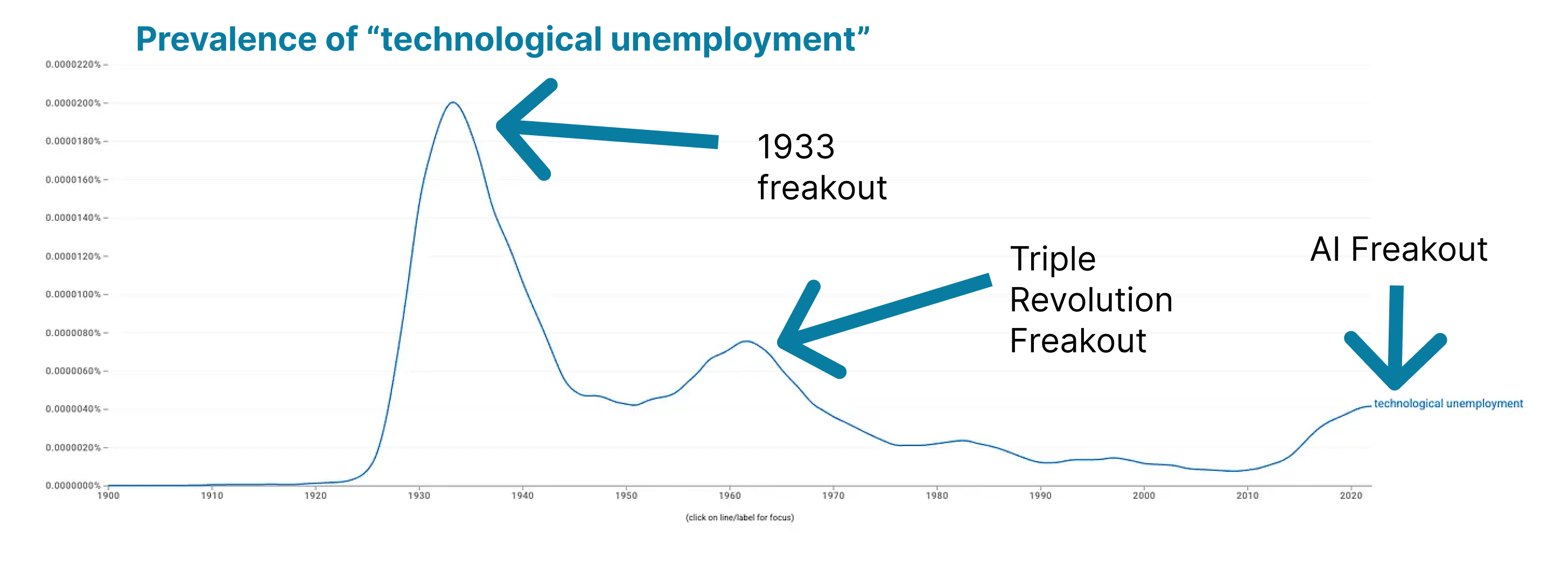
The next panic was the late 1950s and early 1960s, which I am calling the “triple revolution freakout,” which is in honor of the famous memo sent to President Lyndon B. Johnson at the time. It was boldly proclaimed that America will be, “the stage on which the Machines-and-Man drama will first be played for the world to witness.”
In 2018, when I started writing about work, I did a breakdown of the five “conversations” that seemed to repeat endlessly. The first “conversation” I categorized was about how technology, AI (yes even the 2018 versions), advanced manufacturing, and automation were changing work. McKinsey declared that “automation, digital platforms, and other innovations are changing the fundamental nature of work.” Quartz similarly said that, “Automation, advanced manufacturing, AI, and the shift to e-commerce are dramatically changing the number and nature of work.”

This is a timeless trope because it describes big, larger-than-life trends that are happening to us, and as with any technology, it is shuffling things up and is a nice scapegoat for those riding the waves of modernity. Eight years later, in 2026, McKinsey is pretty much saying the same thing, albeit with a little more gusto
The world of work is changing. Artificial intelligence and automation will make this shift as significant as the mechanization in prior generations of agriculture and manufacturing. While some jobs will be lost, and many others created, almost all will change.
I want to argue that we crave these stories, and they go viral, because they are socially acceptable way to show how much we love work.
People in camp one, those who see work as optional, yet work all the time see these trends with excitement. They say, nice, this is something I’m going to learn about, talk about, and hopefully make some money from. They don’t see trends like this as a threat because they see the job element as fungible and sometimes optional. They already have the things many people seek from work and don’t think losing a job would take a lot of that away. Some people get anxious but they also are able to reframe it into a career opportunity.
In camp two, people either ignore these kinds of headlines or react defensively:
annoyance: “they’ve been saying this forever, why am I still workign?”
anger/resentment: “oh so who’s getting rich this time?”
cynicism: “oh so we’ll all just be artists?!”
These stories are so sticky because reacting to them is a helluva lot easier than actually just talking about how much we need. These stories help us grapple with the real disconnect between our craving of work and the inability of many jobs to deliver on those needs. We feel seen when we read about some powerful force shaping our world beyond our control. The stories validate our suspicions that it’s all rigged. That it’s not us. That we don’t have control. They offer relief in a culture where friends and family judge us on our continued achievements and progress. And where work is no longer this thing you can count on.
But more importantly, we love these stories and talk about them all the time because once we go a little deeper, almost everyone is hopelessly in love with work.
We never actually get to that conversation, though, because we see work through a job-shaped reality distortion field.
Which is why conversations about “work” get flattened to conversations about jobs, and mostly the standard unit of jobs, the full-time job. Once we have flattened work further to the standard container of work, we measure it. We look at paychecks, benefits, skills, unemployment ratios, and when we run out of ideas, funds for re-skilling programs.
This might lead us to interesting headlines, but it doesn’t get to the heart of the matter.
If you’re so rich, why can’t you take a day off?
In nine years on this work beat, I’ve seen a few things recur over and over again:
People with the financial resources to quit their jobs are terrified to do so
People with time freedom don’t stop working 5+ days per week
People who could retire don’t stop working in formal jobs
People are morally judgmental of those not grind or work hard enough
People judge themselves solely on their own ability to achieve
None of this makes sense if we are talking about work as just a job. Or just a paycheck. Instead, we’re talking about something more. Work is far more than a job and sometimes has nothing to do with a job at all. Work is something almost all humans crave, something we must do in some form. Work stays with us. It was here before capitalism and will be here after it.
In today’s world, work has a totalizing quality. It is central, and yet somehow we pretend it isn’t. Work is deeply entangled with complex basket of things for most people: identity, stability, self-respect, challenge, an escape, a place to belong to, a place to work out your traumas and dramas, an opportunity for dignity, a chance for glory, and, more simply, a way to smooth out the modern challenge of living.
And this is also why helping people take time off, recover from years of work, make a career transition, or even retire is so hard. People are too deep in it to see it all. You literally need to snap out of it.
This is confusing: Work is central, but you can’t actually see its importance until you make it less central.
And the people that need to snap out of it are those in that first group, the ones so deeply obsessed with their work that it is literally their life but since they don’t feel tied to a job, they see it as something that isn’t necessary.
When people in Silicon Valley talk about the end of employment, they are usually doing so while lost in an AI-induced hyper-work mania. These people are total workers yet casually drop pronouncements about the permanent underclass, industries disappearing, UBI, and reskilling like these are just inconvenient things to figure out on a spreadsheet.
This is going to drive everyone mad.
We don’t have a language big enough for any of this
I joke that people just keep talking about work as a grind because they haven’t read enough fiction or poetry, or even taken an extended break from worker mode in years. Jensen Huang travels around the world giving talks about how the key to his career is that he struggled and suffered at Denny’s in his teens. Why? Not because he is still grinding. He’s not, the dude absolutely loves work, and if you search with a little effort, you will find poetic language about work. He talks this way because it eats up attention, and attention fuels the stock, which ensures he gets to keep working.
We want work, and when we find it, we’ll do anything to protect it. But I think because so few modern legible paths deliver on what we crave, we end up in this weird loop of having to prove it to ourselves and the world that we are crushing it when in fact we still are missing something.
The man who snapped me out of my own narrowed reality is the poet David Whyte. In an interview, he once talked about how “the language we have is not large enough” in terms of talking about work. He regularly talked to executives in the corporate world and could see that many were stuck in a trance. Whyte’s musings on work inspired both of my books and his definition of good work as “work that makes sense, and that grants sense and meaning to the one who is doing it and to those affected by it,” always felt like one of the best definitions I have found. In his telling, work, “done well for the right reasons and with an end in mind, has always been a sign, in most human traditions, of an inner and outer maturity.”
Even if most people don’t have this kind of connection with work, or don’t know how to name it in this way, most people can acknowledge that there is something there. Something that is not only universal, simple, and obvious, but also something far bigger than our current imagination about work.
In 1945, we didn’t guarantee jobs, but we did pick “employment” as a goal and that might have created this modern reality
Before the triple revolution paper, there was a bigger argument in the US around the 1945 Employment Act. The war had just ended, and everyone was nervous that the world might collapse. Some countries didn’t have enough food. Others were crushed by the war. The US’s economy had become a global war machine, propped up by massive debt spending, and now most of it was not needed. On top of that, what would happen as that spending declined and 12 million men returned from abroad?
The politicians had plans. Let’s give everyone jobs.
Senator James Murray from Montana helped write the first draft of the bill: “all Americans able to work and seeking work have the right to useful, remunerative, regular, and full-time employment.”
The right to employment.
That was very bold, and many people pushed back. To republicans, it smelled like socialism. It was eventually trimmed down with fluffier language:
To foster and promote free and competitive enterprise and the general welfare, conditions under which there will be afforded useful employment for those able, willing, and seeking work, and to promote maximum employment, production, and purchasing power.
It’s a subtle difference, but despite not establishing employment as a right, the goal of “maximum employment” might have been even more powerful for the achievement-minded American psyche. Employment became a core pillar of vita Americanus and something politicians saw as their competitive edge to promise and responsibility to provide.
Ever since, the result of this is that almost every politician can’t help themselves. They obsess about jobs. I’ve even tried to coin my own Matt Levine-ism:
Everything is a jobs program.
If you see a government official talking about something, the point is probably jobs.
If a billion-dollar program somehow doesn’t accomplish anything, that’s fine. It was about the jobs.
As I wrote in my first book, Obama explicitly said that pushing for a single-payer healthcare system didn’t make sense because it would cost too many jobs.
This collective force, one that arguably is just about politicians giving the people what they want, is far more powerful than we think.
The interesting thing about the 1964 triple revolution meme is how early it was to these job-creation superpowers, especially in terms of injecting them into the private sector. At the time, 10% of the economy was devoted to military and space, and there was doubt whether that could be maintained. They were also projecting that, “no significant job creation will take place in the private sector in the coming years.” They were pretty much sold on that being the peak of human employment, saying that “In the developing cybernated system, potentially unlimited output can be achieved by systems of machines which will require little cooperation from human beings.”
Despite this lack of sophistication around job creation, I am impressed with the language they used to frame their hypothetical challenge. They argued that, “many creative activities and interests commonly thought of as non-economic will absorb the time and the commitment of many of those no longer needed to produce goods and services.” This meant that “Society as a whole must encourage new modes of constructive, rewarding, and ennobling activity.”
In other words, work beyond a job.
While the memo gets many things laughably wrong about the economy, I think it’s interesting to see that even in the 1960s, people had bigger language for thinking about a life beyond a job.
Somehow we’ve lost this simple way of talking about work and now we live in a time in which people have an easier time imagining the end of the world than life with an extra free Tuesday afternoon.
If AI takes many jobs, I think we will almost definitely create some form of Universal Basic Job
Alas, this time is for real, right?
Honestly, I have no idea.
If I had to bet, I’d bet against many jobs disappearing in the short-term.
Because we love work, and for most people, for now, work is a job.
AI might put a lot of humans out of specific tasks and job but I think we’ll just create other kinds of jobs. Building stuff, relational work, teachers, coaches. People in the US hate when the government does things but will also 100% demand the government do something about big shock to the availability of jobs.
Everything is a jobs program.
We’re good at creating jobs even if they don’t produce things and we’ll get even better at it. Its the reality we know, for now.
In the last few months, AI tools have made my solopreneur life a lot easier and have given me a lot more skills. I’m shocked at how much I am capable of now but I’m also shocked at how much of my work I did in my 20s is now basically “solved.” It’s a weird feeling, to know that my former self-serious self was spending hundreds of hours doing things that are now one click away.
These newer models have updated my view and put more credibility on the bold pronouncements coming from the AI world. I think we should take these people seriously when they say that AI will be able to do a lot of knowledge work in the short-term. The average person is far too skeptical of this right now.
But I don’t think we should take many of these “end of jobs” people seriously when they are talking about work more broadly. They speak about tasks, skills, credentials, processes, and workflows. They don’t talk about dignity, identity, connection, or even, dare I say, love. Those are the things that people deeply care about.
One group of people is betting that they can keep all those things without jobs. Another group is increasingly terrified of having the rug pulled out on them on a normal way of living an adult life.
It’s worth taking much more seriously how we can look at work more broadly than the job. Perhaps it’s time to shift our collective psyche away from guaranteeing maximum employment and toward something weirder, more interesting, and more promising.
Maximum work?
In my explorations of work, one thing has become incredibly clear. We love work. We are obsessed with work. We see work as a core part of life. And employment is the primary way we imagine that is supposed to happen in life.
But nothing is stopping us from dreaming bigger.
Hey there, I do love my work. Want to help me keep doing it?
I’ve been doing some form of public writing since 2015. I’ve somehow figured out how to hack a living by writing books and launching premium art editions of my book. If you like what you read here, you’ll probably enjoy my books The Pathless Path and Good Work:

If you’d like to join a virtual community of others on “pathless paths” from around the world, and get access to courses, tools, and other resources I’ve created over the years, you can join The Pathless Path Community. Our recent WhatsApp community is very active if you like hanging out on messaging apps instead of Circle.
Some things I endorse:
Readwise is offering 2 months free (I use it for book notes and reviewing highlights). Or two months free on
Readwise Reader, which I use for RSS reading and e-book reading
Crowdhealth, an alternative to US health insurance that I’m still using while abroad
Postbridge: A social scheduling app created by a reader without crazy upcharges for more accounts
Kindred, a home-sharing app
Collective for handling your S-Corp accounting needs
If you received this and find yourself in a state of outrage, thinking, “What is this?” I strongly encourage you to unsubscribe below. It is your God-given right, and there is plenty of other good stuff online.
A reminder: I don’t check unsubscribe alerts and never look at my subscriber list. So if you feel like unsubscribing, you can do so below.
I've been thinking a lot about this too. Indeed I seem to be the only one who has used AI to literally reduce hours worked. And I've replaced this time with personal pursuits: personal writing, more climbing, more socializing with friends. Meanwhile all I can read is people who use AI reporting they are working *more* now that they have the tools.
Great read! My favorite observation is that new technology is repeatedly met by the same criticisms - there was a time people were mad about newspapers, since reading quietly on the train ate into "social time".
I've only really started taking AI's impact in my industry seriously in the last few weeks (I'm a software developer by trade), and so far it looks like all the same "laws" are in effect: Just because the tools are there, doesn't mean people want to use them. I mean, we've had Google for nearly 2 decades now, everyone has a smartphone, and most people still don't look things up out of curiosity.
I'd wager AI's impact on knowledge work (or specifically, the workers) will pan out as the early experiments have shown: High performers, early adopters and fast learners that take advantage of the new thing to do their work will get better output. Folks who don't, will eventually start falling behind.
I doubt most companies would simply let people go wholesale because of AI (ClickUp being a notable exception) - it's more likely just going to be many years of difficult ROI conversations and stalled salary bands.