


July 13th, 2026: Greetings all. I have been sitting around without many plans, waiting for the arrival of our second daughter (any day now). So I decided to write another post. Enjoy!
Right now there is a large market for contract work for the sole purpose of training AI models. This work includes screen recordings of people completing tasks, evaluating model outputs, and writing reports.
You likely have heard of the companies buying the data from this work: Google, Meta, Anthropic, OpenAI, and others. But the companies actually compiling this data are ones you haven’t heard of: Scale AI, Mercor, Surge AI, and Handshake. Scale AI was acquired by Meta for $13 billion. Mercor was recently valued at $20 billion. And others have seen skyrocketing valuations.
Other names for this field of work include “work data” and “human data.”
“A majority of work will be training the models”
I started looking into this space after I heard the 23-year-old Mercor founder Brendan Foody on Conversations With Tyler earlier this year.
This specific comment from Brendan stood out:
“Everyone else in Silicon Valley is talking about how we automate away jobs, versus we’re very focused on how do we build this new job category of people training agents, building RL environments to help teach models. That’s what I believe it’ll converge to. Instead of the investment bankers doing the analysis, they’ll build RL environments and train agents. It’ll be the same across consulting and software engineers, and customer support and pretty much every knowledge work vertical... I would not be surprised if, within five years, a majority of high-end knowledge workers are training models.”
This is a pretty radical statement and it would mean a complete refactoring of our entire economy. I’m not going to try to argue against this claim and instead accept it as something that Brendan and many others really believe and a claim that people keep repeating: that we can automate most knowledge work.
I looked into Mercor again recently when I had someone send me a referral link (hoping to collect a referral fee, I presume) for a Strategy Consultant Expert Role:

The job description details it as a “remote job” paying up to $100 an hour as part of something they are calling Project Panacea:
Project Panacea is a Mercor research initiative focused on training AI agents to handle complex, real-world business and consulting work. As a contributor, you’ll help design and refine the scenarios used to evaluate and improve how AI systems approach multi-document, multi-stakeholder business problems. This is a long-term role with flexible hours and a consistent workload.
Key Responsibilities
Conduct market research and competitive analysis
Develop business cases, operational frameworks, and go-to-market strategies
Synthesize data into insights using presentations, memos, and models
Collaborate with stakeholders to define key metrics and decision points
Support strategic planning, scenario modeling, and opportunity evaluation
The listed responsibilities are in my wheelhouse. This is the work I did for about nine years starting in 2018 and I’m pretty good at it. I’ve even had a few gigs doing this kind of work since becoming self-employed.
But I’ve never been recruited to deliver work for consumption by a model and not other humans.
I have to admit it feels a bit weird. It gets to some deep questions. What gives our work meaning? Does it need to be consumed? Can contributing to a large-scale project like AI feel good? If not now, when?
Let’s dig in a little deeper into Mercor and the work it’s hiring people to do
Mercor publishes a strategy consulting benchmark assessing the progress of models against 160 tasks.
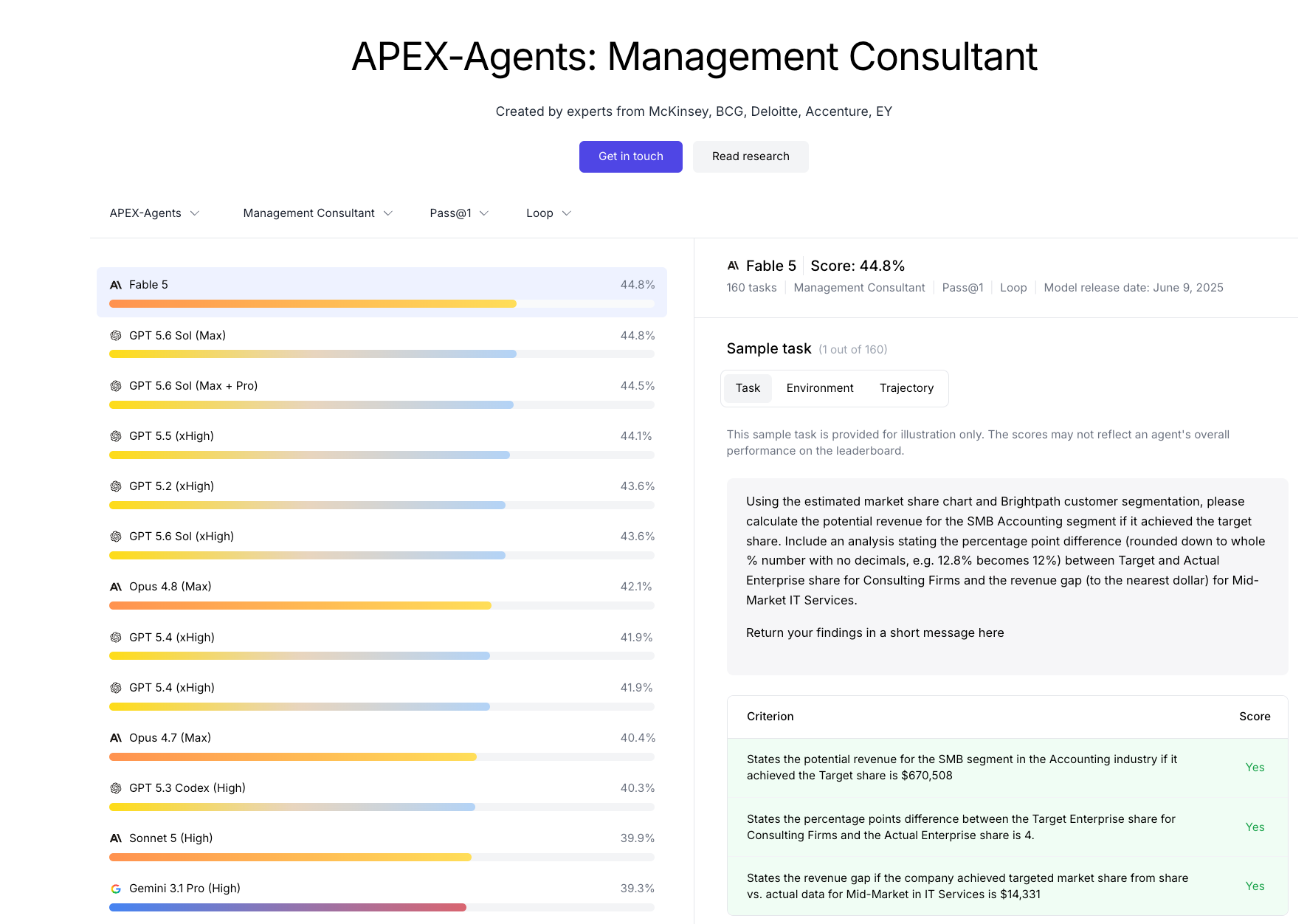
Here’s the sample task:
Using the estimated market share chart and Brightpath customer segmentation, please calculate the potential revenue for the SMB Accounting segment if it achieved the target share. Include an analysis stating the percentage point difference (rounded down to whole % number with no decimals, e.g. 12.8% becomes 12%) between Target and Actual Enterprise share for Consulting Firms and the revenue gap (to the nearest dollar) for Mid-Market IT Services.
If I were hired as a consulting expert, I am guessing I’d be responsible for grading the outputs, generating my own, and then comparing the two and confirming whether or not the model does a good job.
Right now, Anthropic’s Fable is scoring 44.8% on this benchmark and it has similar benchmarks for investment bankers, lawyers, and many other white-collar professions.
While I’d need to see a much wider range of tasks to get a full picture here, I think this kind of task is actually perfect for AI but not actually core to what a consultant does.
This is the kind of work entry-level consultants do while the much higher-paid consultants will almost never do this kind of work. Instead they are spending their time on much more complex work:
Providing relational support and coaching to senior leaders
Connecting with senior leaders based on shared culture, language, and vibes
Being curious about a frontier (industry, function, region) and being obsessed with the latest thinking in that space
Being generative and able to create new frameworks, mental models, or conversation threads on demand in ways that feel invaluable to a client
Taking the fall for a company or leader if a major decision goes the wrong way in a few years
Deploying large on-demand teams that can do work at a different clock speed than your organization with unique skill sets
Maybe I am just coping and am not quite AGI-pilled yet, but I am not convinced that the knowledge economy is going to be replaced by agents while the highest-skilled employees turn into glorified gig workers.
Instead I think what may happen will be weirder and more interesting:
Tasks like entry-level consulting work will be automated and it will mean that teams are able to move faster, serve more clients, or do more work. The most talented advisory firms and consultants will likely be able to charge more money.
It will lead to a lot of existential crises for people who are attached to being able to grind through enormous amounts of data and other tasks that agents are clearly on the verge of “solving”
It will break the stable pyramid hierarchy of most consulting firms where there are a small number of senior partners and a large army of slide and data people. Entry-level employees will continue to be very technically savvy (instead of an Excel pro, it’s now a harness pro), though firms may hire fewer of them. I suspect more junior people may have to go into other fields before becoming indie consultants or joining a consulting firm (this trend has been happening for 10+ years already)
On this last point, I think we’ll continue to see more and more people become self-employed as the costs of operating a business fall and the ease of running it with AI continues to improve.
You’re already seeing this in Stripe data showing the huge increase in solopreneurs over the past few years, with professional consultants showing some of the highest growth rates and rates of AI-tool adoption.
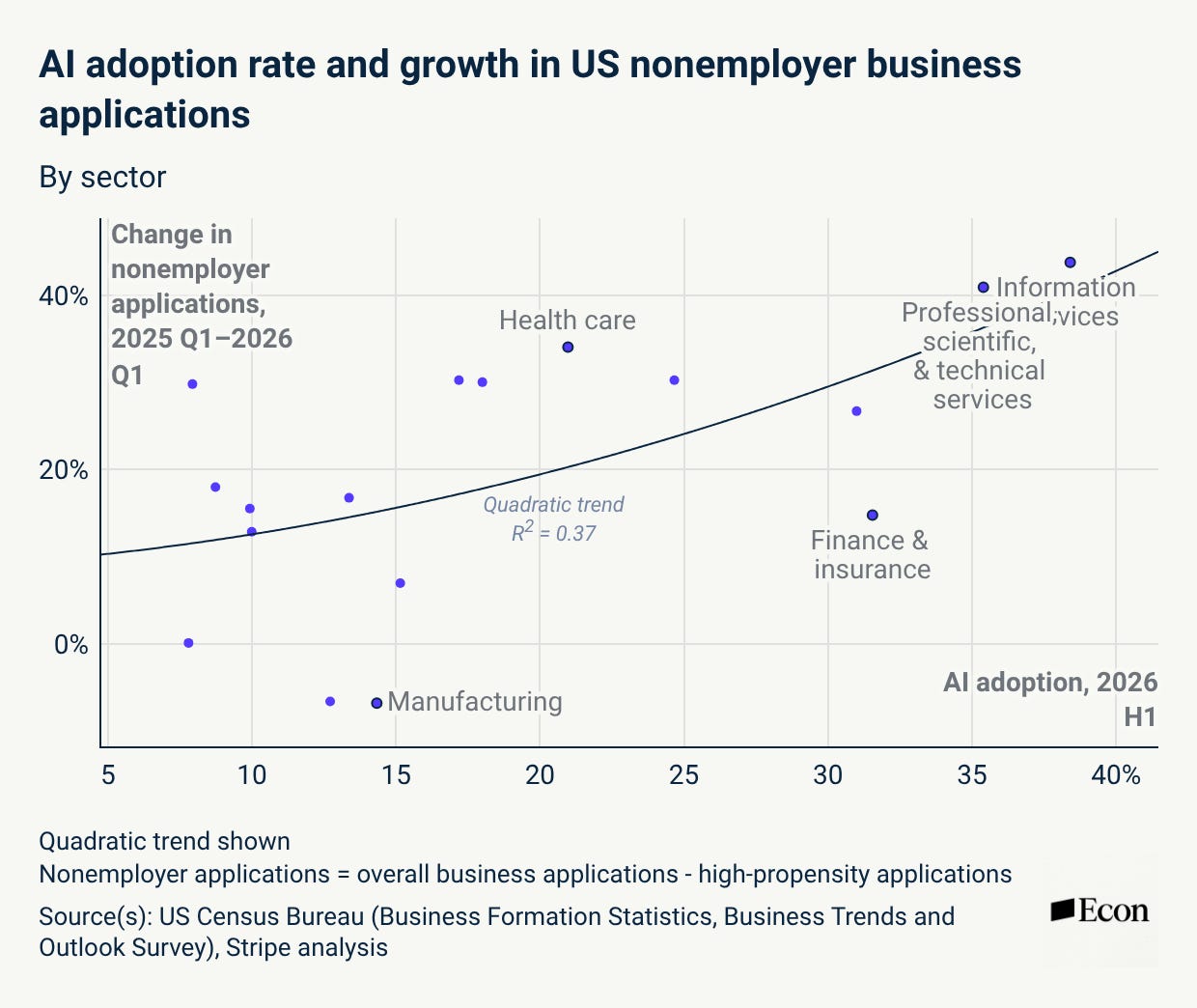
Despite all this, I suspect we are at the start of a gold rush on this kind of data and actual firms may be the best situated to monetize it
In April, there was a leak of an internal memo at Meta about tracking of employee work. It was part of an initiative they are calling Model Capability Initiative. According to their spokesman, MCI involves tracking employees’ “mouse movements, clicking buttons, and navigating dropdown menus.” They were trying to capture work data to improve their Muse Spark models in order to compete with the top AI labs.
Given their acquisition of Scale AI and the promotion of its CEO, Alexander Wang, to lead AI efforts at Meta, it seems like Meta is going all in on this kind of work data.
A recent report from Semianalysis confirms this:
Furthermore, they took their data efforts to another level in late May by announcing a new “applied AI engineering org” as part of their most recent round of layoffs/restructuring. ~3000 engineers, which includes 70% of their new grads and a significant number of seniors, will now be making RL tasks/environments full-time.
So they are literally employing new grads and thousands of engineers to do tasks that will help train the models.
They also had some numbers on Mercor:
Mercor recently disclosed that they logged 2,517,000 expert hours on their platform in 2Q26, which is equivalent to ~4800 people working 40 hours a week. Meta is already in the same ballpark, and their average quality is likely higher. Additionally, they have another ~70k people to pull from if this experiment ends up being as valuable as we think.
Between just these two companies, we now have close to 10,000 people in the economy doing work for the sole purpose of training models.
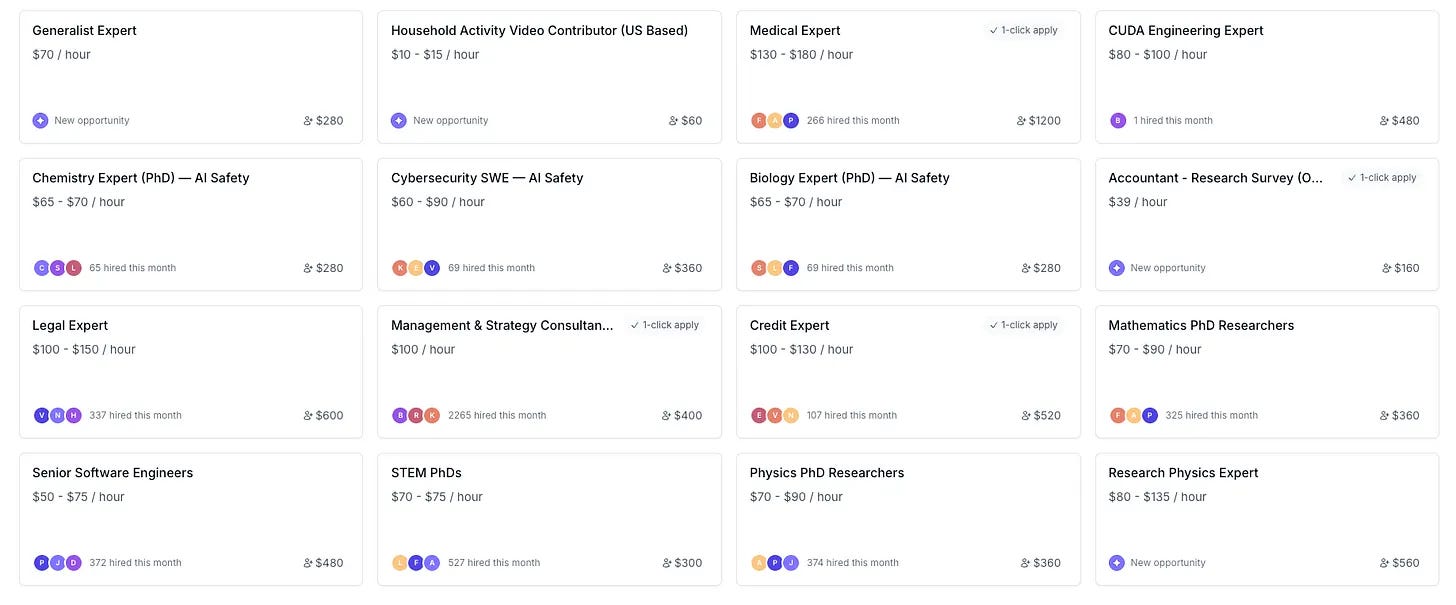
This doesn’t appear to be slowing down either. If you look at Mercor’s gig board, they are hiring for Chemistry and Biology Experts, Lawyers, Physics and STEM PhDs, CUDA experts, accountants, and so on.
Semianalysis argues that this work isn’t mindless work:
At this point, the models are sufficiently smart such that creating a good piece of training data is a real intellectual challenge. Deeply understanding failure modes, ensuring your environment is robust to reward hacking, and scaling task creation without quality degradation are all non-trivial engineering problems.
I am a bit skeptical of this. While this kind of work does sound challenging and it is an interesting problem for me to think about what kinds of work data would be good to train an agent to be a good consultant, I struggle with the idea that many people will be motivated and inspired by doing this kind of work.
A non-trivial number of people already struggle with enjoying the kind of abstract work that is core to our modern labor economy. In the US, more than 40% of workers are doing some form of professional services, finance or insurance work and sustaining interest in this work in the form of a job over decades remains a daunting challenge.
When we go one step further removed from the delivery of our work, I suspect people will not be running toward these kinds of gigs.
I still don’t know what will happen
In the last six months, I have radically updated my priors to believing people in the AI mix about their predictions on model capabilities. They have far exceeded what I have expected and I don’t think most people fully understand the capabilities of the current leading-edge models.
But I have not yet updated my priors on people within AI being able to predict what the impact of AI models will be on the economy, firms, and labor.
About a year ago, I wrote about my skepticism about claims that jobs are disappearing, including my observation that young people in their twenties stand to gain a lot by making the loudest and boldest claims.
From the conversation with Tyler Cowen, Brendan went on to make this claim:
COWEN: To hold those jobs, how much technical AI will a person need to have? Or do they just have to know about the thing?
FOODY: They just need to know about the thing. The only element of technical AI that they’ll need is to find where the model makes a mistake.
This future is grim and uninspiring but we should take seriously that this is a serious belief that people like Brendan and others hold.
Right now, AI is rapidly oozing throughout the economy and no one has good metaphors, stories, or predictions for what it might mean. We are flying blind.
Like I wrote last week, humans love work, and I suspect that the end state of human labor is not reviewing work for machines. The human need to work and contribute runs deep and I suspect this drive is a much more interesting starting point for thinking through what sort of future economy might emerge.
Check out my books?
I’ve been doing some form of public writing since 2015. I’ve somehow figured out how to hack a living by writing books and launching premium art editions of my book. If you like what you read here, you’ll probably enjoy my books The Pathless Path and Good Work:

If you’d like to join a virtual community of others on “pathless paths” from around the world, and get access to courses, tools, and other resources I’ve created over the years, you can join The Pathless Path Community. Our recent WhatsApp community is very active if you like hanging out on messaging apps instead of Circle.
Some things I endorse:
Readwise is offering 2 months free (I use it for book notes and reviewing highlights). Or two months free on
Readwise Reader, which I use for RSS reading and e-book reading
Crowdhealth, an alternative to US health insurance that I’m still using while abroad
Postbridge: A social scheduling app created by a reader without crazy upcharges for more accounts
Kindred, a home-sharing app
Collective for handling your S-Corp accounting needs
If you received this and find yourself in a state of outrage, thinking, “What is this?” I strongly encourage you to unsubscribe below. It is your God-given right, and there is plenty of other good stuff online.
A reminder: I don’t check unsubscribe alerts and never look at my subscriber list. So if you feel like unsubscribing, you can do so below.
Speaking as a still-practicing consultant of 17+ years, and as someone who probably isn't in Mercor's target market, I've been told my role at this particular juncture is less of the crunching and more of the "whisper in my ear/let me confess my sins" … and agents might well take over that confessor-priest role soon!
"It will lead to a lot of existential crises for people who are attached to being able to grind through enormous amounts of data and other tasks that agents are clearly on the verge of “solving”"
Paul, Has Mercor approached you yet to do some screen recordings demonstrating the Pathless path? You’ve got that expert level knowledge in that domain.