


September 19th, 2025: Greetings from Chiang Mai. We are doing some travel next week and heading back to Taiwan, likely until the end of the year.
Asia friends: My simplified Chinese translation is live in China. I’m hosting a meetup in Hong Kong next Saturday, and then in Taipei the following week. Reply and I’ll send you the info. If you have connections to get my book translated in Japan or Korea, please let me know too :-)
From Total Work to The Yoga of Work
What if work dominated your every moment? Would life be worth living?
These two questions rocked my world when I first heard them, listening to him on a podcast in 2018. They helped me look at my former path through a new lens and see that maybe there were some forces beyond my own personal failures that made it hard to feel good on my previous path. I reflected on these questions in my first book, so I won’t rehash them here, but I was thinking back to these questions as I interviewed Andrew a few weeks ago.
Andrew’s writings from 2018 were a strong critique of our modern work culture, something he called “Total Work.” At the time, he felt that a certain way of living life centered around the formal kind of career-work, something Derek Thompson also called “workism,” was so pervasive and “total” that there was probably no escape.1
What attracted me to Andrew’s writings and reflections at the time wasn’t so much the critiques of work, though they certainly were welcome from a confirmation bias standpoint. No, instead, what interested me was Andrew’s solution: embracing philosophy and the contemplative life as a way of life.
One of my favorite things he wrote was a digital PDF he still has available on his site, titled “How An Artist Can Hack A Living.” In it, he offered pragmatic approaches for showing up in the world differently and gently leaning against the more transactional, networking-driven, career world I left behind.
Some personal practices and ideas I took away from his writings:
Noticing when you are doing activity X for outcome Y and moving toward doing X for its own sake (e.g., one might take a book deal to make money from something else instead of writing the book because they want to write a book)
Finding ways to practice generosity and operate in the spirit of the gift in more parts of your life (I practiced these things in several ways and still embrace this in most of the work I do, including my view that my books are a gift I’m happy to give to people for free).
Embracing the reality that I do want to be somewhat of an artist and look at the craft of living a life as something worth contemplating, practicing, and taking seriously, and not automatically accepting the conclusion that an artist can’t hack a living.
All of this is a solid prescription for someone like me, and I’m very grateful that I stumbled upon Andrew’s writings. When I quit my job, I loved the increase in time freedom. I also loved the freedom to attempt to work in new ways. I also enjoyed thinking about all of this in a deep way and felt much happier when I was thinking deeply about how I was working, writing about such contemplations, and then practicing it in real life.
But many of the people Andrew has attracted in his conversational coaching practice have not taken to this kind of stance toward work. Philosophizing with various high achievers throughout the years made Andrew start to second-guess his view that this sort of embrace of the “contemplative life” was possible at scale.
"I thought, and you can look back at a few of the TEDx talks that I gave in 2018 or so, that our time had gotten to a point in which there was a great enough crisis, or the crisis was coming, and that there would be the possibility of a pretty dramatic pivot, a slow pivot or a quick pivot such that people would still continue to be involved in an active life, but would somehow nest it within a broader conception of an examined or contemplative life.”
He admitted the mistake: “I think one of the errors that I made, and it's very common, is to take my own idiosyncratic life and then try to abstract from there.”
In our conversation, he shared a couple of examples of the kinds of people this simply didn’t work for. First was a man in Chicago who no longer needed to work for money but couldn't sit still. About the Chicago man: "I had tried to feng shui his basic temperament, and in his fifties, that's just not going to happen.” As he concluded, “This guy should be starting a nonprofit and doing volunteer work. The Protestants are probably right…the idle hands of the devil actually make sense.” Another example was a Google employee with two kids who said she always needed to be doing something. When Andrew asked her to meditate or examine her life in the traditional philosophical sense, it often made things worse, not better.
And so he’s shifted his perspective. Instead of trying to convert people to contemplation, he tries to meet people where they are through what he calls the “yoga of work.” In his telling, it’s a “backdoor way of allowing you to examine your life, but in the domain you're most accustomed to." "You don't have to start reading Aristotle or Plato. You don't have to think about the nature of reality and get very interested in metaphysics. You can instead simply note that when work is happening, you can become much more aware of all the sorts of things you're passing over."
I’ve come to see work similarly, albeit through a clunky process of trial and error.
In Good Work, my attempt to make sense of my own stance toward work, I wrote about how I just try to see work as something I’m observing in my life:
The search for good work can be long and confusing and any story you whip up in your head about what you “should” be doing or how you are failing will lengthen that journey. If I am writing and struggling to make progress, I notice that. I don’t see it as proof of being a “struggling writer,” or even “embracing the grind,” I’m simply writing. If I am working on a project and feel my body contract, that’s vital information. Something is off and I need to be skeptical of the voice that tells me to ignore it and to keep going. I try to embrace this practice fully, treating my days and projects with lightness, rejecting judgment. None of my work is the right or wrong thing to be doing. Each moment is simply a chance to pay attention and learn.
Zooming Out: What If Everything Is Work?
"It is true, and I challenge anyone to contradict this, that most of a day is given over to work." - Andrew Taggart
Yesterday I spent the entire day with my daughter. We went for a walk, we rode on the bike, we went to the park, moved blocks around, we played pretend clean-up, we danced, we got ice cream and mango smoothies, we read a couple of books, we changed clothes, and I changed several diapers. It was a lot of work.
I’ve spent quite a bit of time with my daughter over the last two years, and a common question I received was, “When are you going to go back to work?”
In today’s world, taking care of your kids is not “real work,” it’s the thing that happens in the background of a life built around formal work or work for a paycheck.
But when we zoom out and take away the stories, isn’t it all pretty much the same?
Early on my path, I knew I wanted to spend a lot of time writing. But making money from writing is hard. So I actually decided that I would simply write without any intention to make money, or aims to turn myself into the identity of someone who writes: an author, writer, or now, a “substacker.” Despite this, I decided it would be an interesting experiment to prioritize this kind of activity above paid work. This wasn’t as hard as it might seem because I found writing pretty fun. Writing happened as a result of living my life. I couldn’t not write. Friends thought I was crazy. Some people who became friends later said they thought I was naive. But I was having a ton of fun and it was an interesting experiment to invert the implicit priorities of my previous path.
Setting up my life in this way led to the interesting result that I pretty much dissolved the resentment I had toward work. This is because I was “working” mostly on things I enjoyed doing, and seeing work as something that sucks is really hard when you do that for a long period of time. It helped me see that my definition of work was too narrow.
From the introduction of Good Work in which I write about this shift:
When I quit, it wasn’t an act of defiance but surrender. I had been vanquished by the demands of a modern career and as I walked away, I saw work itself as my unofficial adversary. It had done this to me.
With this mindset, I had no bold visions of success when I became self-employed. I wasn’t taking a leap to build a successful startup or even trying to increase my earnings. Quite the opposite. I saw work as something I needed to escape and my plan was to eliminate as much of it from my life as possible. I’d live simply and scrape by.
As I cut my cost of living in that first year, I had the thrilling sensation of becoming free. Wow! It was working. I was doing the bare minimum to pay the bills and I felt better.
I thought I had it all figured out, but I was only getting started. Without “work,” I spent more time doing things I enjoyed, like writing. No matter where I was I kept finding myself lost in flow, typing away, trying to find a rhythm with my words. But it was not until sitting at that table in Taipei that I saw it for what it was: work worth doing. I didn’t want to escape work; I just craved work I cared about.
In other words, it wasn’t what I was doing; it was the way I was observing and noticing what I was doing. It was my stance toward work that changed.
And over the last several years, I’ve come to see almost everything as work, and nearly all of it in the same way: not that special, just part of my life.
Or as Andrew puts it: mundane.
The Mundane Truth
Andrew makes a simple but somewhat provocative observation in our conversation:
"Most of what most knowledge workers are doing on an everyday basis is extraordinarily common and ordinary."
His point isn’t that you aren’t doing cool stuff.
It’s that we’ve added so many layers of stories and abstractions to how we talk about work that it’s often hard to notice what’s going on.
You can see this in how some people glorify the grind of being a creator or solopreneur. But when it comes down to it, it’s just a bunch of yapping, clacking at keys, and sending emails to others, asking them to work.
As he says:
"When someone says, 'I love the work that I do,' that's an abstraction. One has to step back and make some kind of summary statement... I would invite you to go back to what it was like to be sitting there in front of the keyboard, slow down and actually experience what you're experiencing."
He argues that if we're honest about our moment-to-moment experience, we'd find countless micro aversions and dislikes we're not admitting to ourselves. The meeting is dull. We have some dissatisfaction with our colleagues. Or we might actually find a task that we deem unimportant, something that we can do with ease.
I think this is an interesting stance for someone who’s struggling with their relationship to work. It’s notable that in my own experience, when I was searching for a dream job and trying to find “meaningful work”, I remained dissatisfied.
Yet when I loosened my grip, things started to flow.
As Andrew comments:
Nothing about your happiness hinges upon any of the notions that we have been fed: success, productivity, wellbeing, discipline, lack of discipline, and so forth.
It is simpler:
Work is used to go beyond work, but not for work to stop.
So how do we do this?
Work As A Spiritual Practice
I think one thing that led to me going in circles while on my previous path was that I wanted to “arrive” at a happy, blissful future state, where I finally had my dream job and everything was great.
I was trying to fix the future instead of noticing what was happening.
But Andrew urges us not to try to change the “objective conditions” and instead just continue to notice what is happening in all its mundanity. For example, when taking out the trash:
"Work is happening. There's nothing wrong with the fact that there is trash to be taken out... Yet something very strange happens very quickly for most people, and that is a thought appears, and the thought is, 'I hate taking out the trash.'"
In his newer writings, Andrew urges us to strip away the stories, notice the unease that many of us have, and consider working with that energy:
I think a fair number of people in the West, regardless of what happens with regard to this wave of AI, will continue to find that they are rajasik, a vendantic word that means. That they tend toward an active, somewhat energized, often feverish mode. So what Tantra says is rather than trying to convert someone to a life of contemplation, I definitely put that word in quotes. One is better off working with that kind of energy
Andrew suggests work is actually "a spiritual stage upon which your resistances and your desires are brought before you are slowly worked out." Every email, every mundane task, every moment of frustration or boredom becomes an opportunity to see how we create our own suffering through identification with thoughts and resistance to what is.
The end goal isn't to transcend work or to love it or to find a dream job.
It's about embracing a new stance.
"Before enlightenment, chop wood, carry water. After enlightenment, chop wood, carry water... In one case, you're pulling your hair out though. In the other case, you're not. Something has changed within."
Or as I joked: "Before enlightenment, send emails, change diapers. After enlightenment, send emails, change diapers."
Full Episode
More Writing on This
Andrew has a lot of great writing on his Substack here, and I’ll be sharing when his book is out, too.
Heyo you made it all the way down here
I’ve been doing some form of public writing since 2015. I’ve somehow figured out how to hack a living doing things like forming collective for 8+ years now. I’m amazed myself, don’t worry.
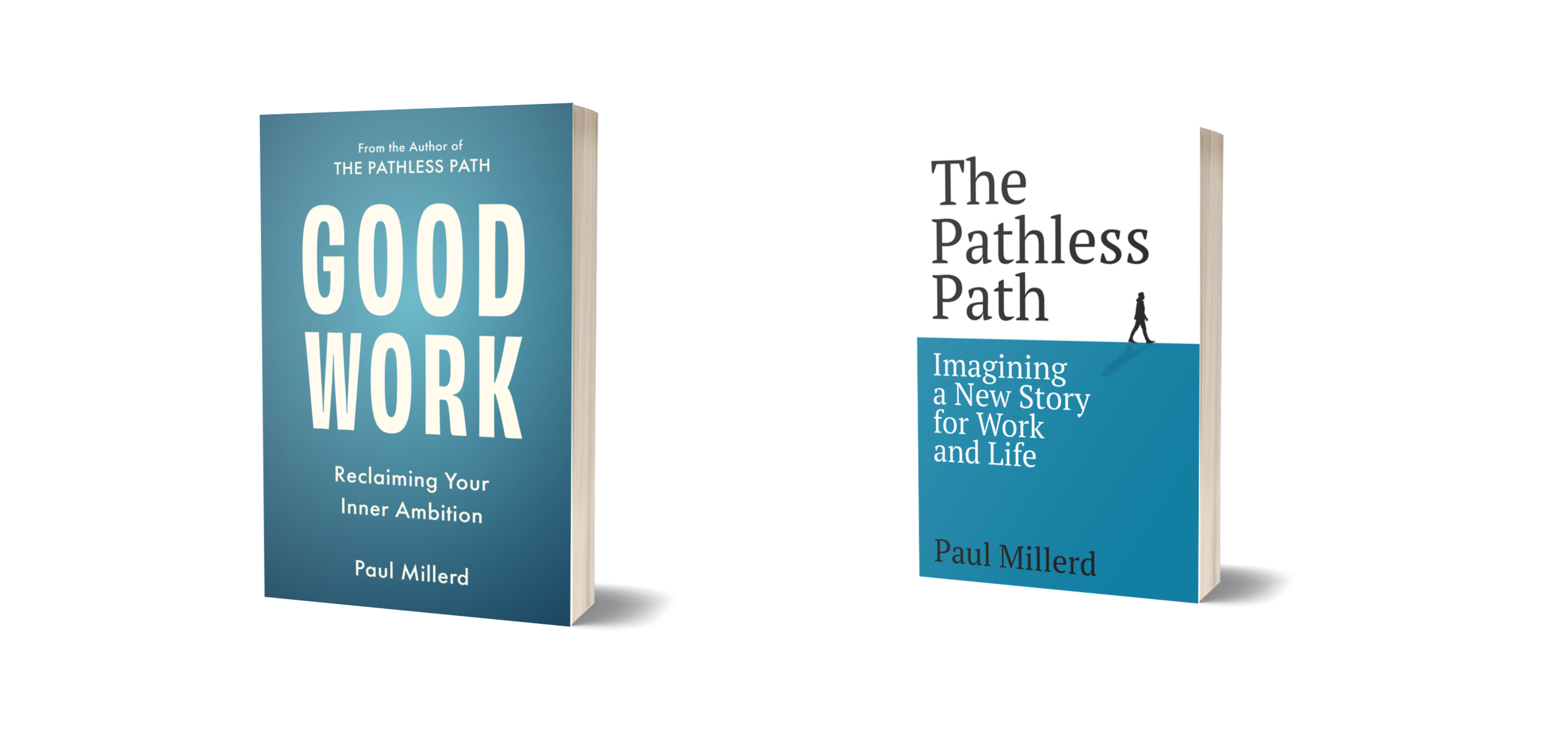
If you like what you read here, you’ll probably enjoy my books The Pathless Path and Good Work:
If you’d like to meet others on “pathless paths,” or potentially get involved in the next release you can join The Pathless Path Community.
Some things I endorse: Readwise is offering 2 months-free (I use for book notes and reviewing highlights). Or two months free on Readwise Reader, what I use for RSS reading and epub reading. Crowdhealth, an alternative to US health insurance that I’m still using while abroad; Kindred, a home-sharing app; Collective for handling your S-Corp accounting needs; and Nat Eliason’s Build Your Own AI Apps course
If you received this and find yourself in a state of outrage, thinking, “What is this?” I strongly encourage you to unsubscribe below. It is your god given right, and there is plenty of other good stuff online.
A reminder: I don’t check unsubscribe alerts and never look at my subscriber list. So if you feel like unsubscribing, you can do so below.
This video is probably the most complete synthesis of a lot of the ideas:
Synchronicity❣️ I think this was probably the best post you’ve written, or at least the one that has aligned with me the most. There’s something here that you didn’t convey in either of your books. I will have to reread this a few times.
Happy blissful future state…
When I think of what you are talking about here, I think of some of my general problems with the pathless path, certain elements don’t allow me to be at my best.
I really like to work, I probably define work differently than most people. I like to help people, using the skills and expertise I have to guide them to better outcomes that they desire.
I didn’t start a fund, because the economics of the fund would force me to do X to return y to investors.
I want to help people being their vision to life in a way that allows them to operate at their financial goals, if possible.
Great post Paul.