



July 22nd, 2025: Greetings from Chiang Mai!
+ I’m partnering with Will Mannon as he launches “Act 2,” a reboot of the now-retired Write Of Passage. He’s launching a 6-week course for people’s creative projects (not just writing), and I’ll be helping with a book-writing group within it if there is enough interest. He asked if I wanted to be an affiliate, but I asked him just to offer a discount to Pathless friends directly instead. He’s also discounting the first go-around pretty substantially, so if you want to join for 50% off for the first cohort, apply for that here. I’ll be doing a special pre-call for anyone joining through this path too. I’m not taking any pay for this, I just love what Will is up to.,
It’s 7:00 pm, and it’s time to head home to put my daughter to bed. Nature has other plans. The rain pounds down on the tin roof of the small establishment we’ve gathered at, and I surrender. Back in the U.S., rain is a predictable event, and the “rain will stop in 17 minutes” alerts on the weather app everyone uses are pretty accurate.
Here, the rain arrives uninvited and leaves just as randomly. It’s one of the things that made me fall in love with Southeast Asia during my first extended stay in Bali. While there, I was headed to meet a friend on my scooter when Mother Nature commanded everyone to pause. I pulled over to the nearest warung with others who found themselves stranded, ordered some food, and let go of my expectations for the day.
Today, seven years later, I’m gathered with a random collection of people from Thailand, Hong Kong, Myanmar, Singapore, Malaysia, Bangladesh, Vietnam, and another American.
This is the end of a week where I participated in my first in-person “meeting” in many years, or “Studio,” as the organizer, Sam Chua, is calling it. It is a gathering under the banner of a single word: Seapunk. A work that is both exciting and confusing, but that still intrigued me enough to join a bunch of internet semi-mutuals for a week of exploration. Despite my relative comfort with uncertainty, my consulting brain still tries to pin Sam on the first night, when I meet him, “What’s the goal here, dude?” No clear answer emerges, and I decide to channel my pathless powers and release my grip on the world for a week.
It seems as if this kind of ambiguity is a perfect fit for Sam, who is a kindred pathless spirit who has been well on his way doing his remix on this side of the planet for much longer than I.
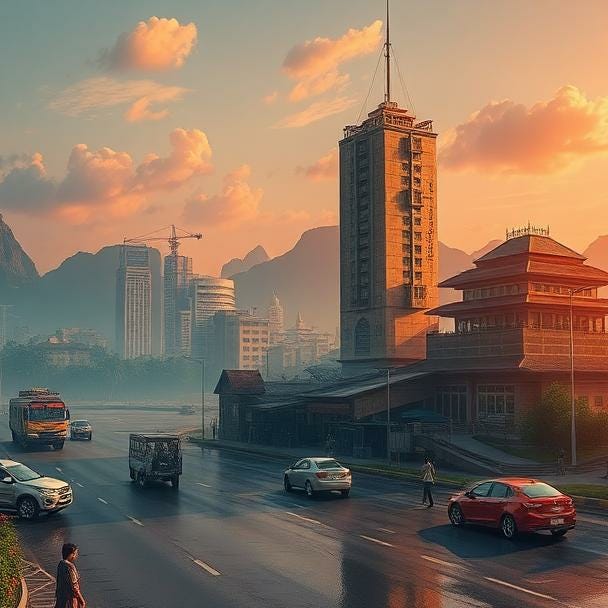
The best way to understand “Seapunk,” at least as I am now thinking about it, is to see it as a blend of two ideas. The “SEA” refers both to water, which shapes life in this region, and to the acronym for Southeast Asia. The “punk” part draws inspiration from “solarpunk,” a popular aesthetic and movement known for its utopian images of solar-powered, sustainable futures. If you’ve seen art depicting green cities or futuristic eco-communities, you’ve seen solarpunk:
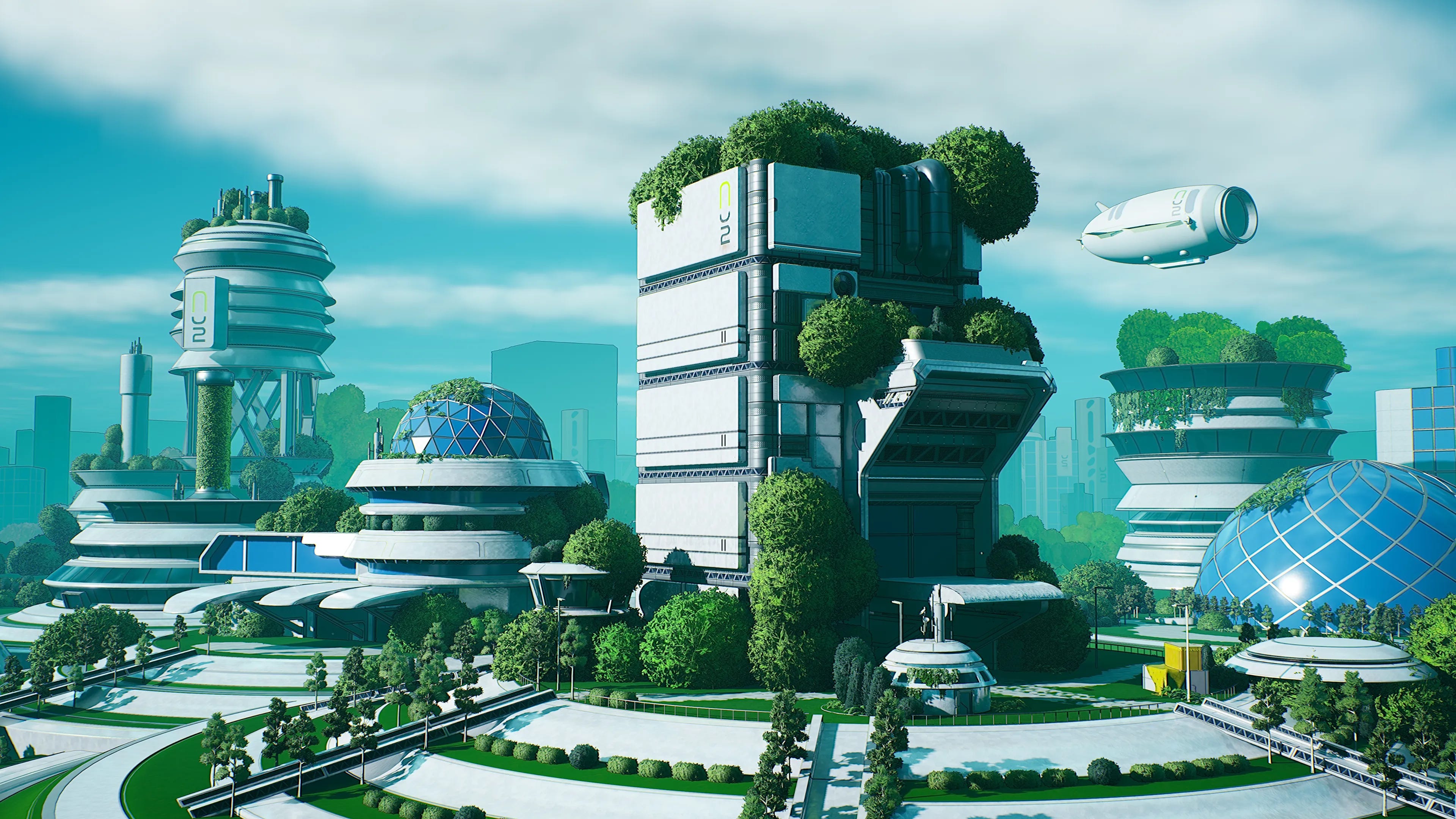
If, as Wikipedia described it, solarpunk is “a literary, artistic, and social movement…that envisions and works toward actualizing a sustainable future interconnected with nature and community,” then my attempt to describe seapunk would be as follows:
a nerdy collection of digitally native curious humans / creators / consultants / activists who are deeply curious about southeast asia and suspect it is a more interesting place to start in imagining more possible futures
Sam offers his own diagram:
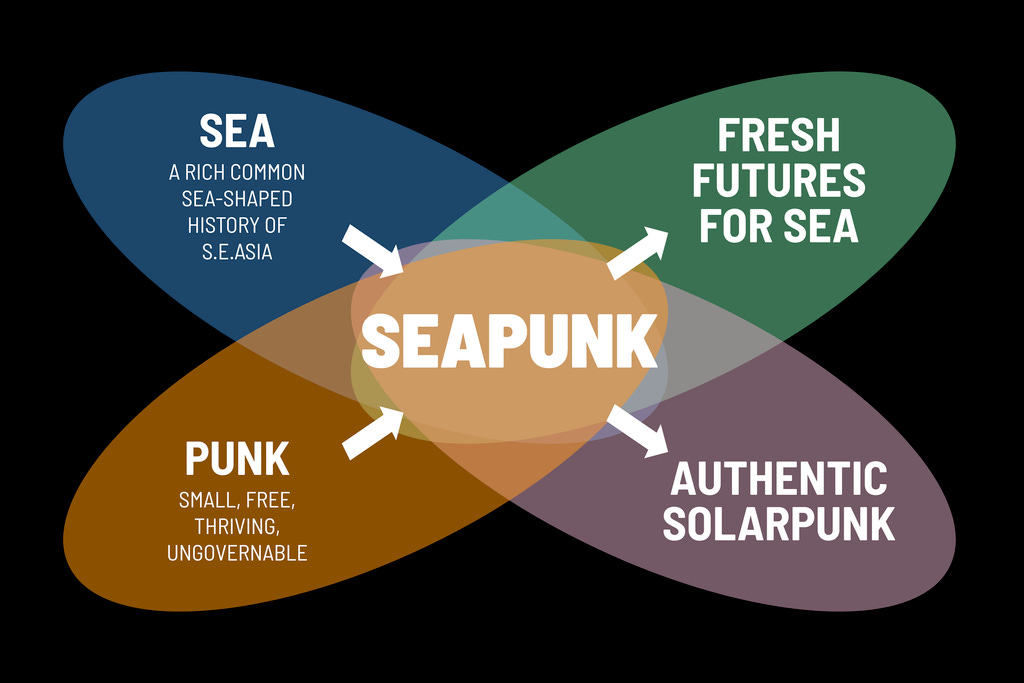
Edit/Addition: Sam’s summary of the event is a great read if you want to queue it up.

If I’ve lost you already, that’s okay.
The reason I’m writing about this is that my confusion was front and center throughout the week, too. I kept asking, “What the hell are we doing?” and also at the same time, “Why is this so good?”
First,
What the hell are we doing?
I realized my inability to answer the first question comes from the way we’ve been taught to think about doing knowledge and intellectual work. That is, we should be doing it inside institutions, and it should be part of a plan. At McKinsey, we had “KIPs,” where teams would be staffed to investigate new areas of knowledge. While there was some freedom in these explorations, the goal was always the same: create stuff that you could turn into revenue-generating consulting projects, directly or indirectly. Luckily, the margins of places like McKinsey meant there was often a real element of freedom in these explorations, but still, everyone knew they were still part of a firm that hoped to make a profit. While institutions like consulting firms used to be interesting places to go to do intellectual work, their ideas rarely break out in a bigger way, and they’ve become “too big to think.” We can think of this kind of institutionally approved exploration as “top-down” intellectual work.
On the other end is bottom-up intellectual work. This might describe what I’ve been up to for the last seven years, following my curiosity, reading widely about work, and writing up emergent thoughts and reflections over time. This has been great and the peak of my intellectual work life so far, and I’m satisfied with the books and writing I’ve produced. Still, I’ve always had the sense that I was missing something and that there are limits to my n=1 explorations.
Participating in this week-long studio made me realize what I was missing: other people. This may seem obvious to those of you working on teams and in normal jobs, but to me it wasn’t obvious. For the last seven years, I’ve been hyper-independent, optimizing around time freedom and also a need for complete control and autonomy in how I do my work. This worked well for me because I had quite a bit of experience doing research, managing myself, and, more importantly, endless reps doing the final 10% of a project at the highest level, which, honestly, is hard to figure out on your own.1
I joked during the week that the in-between kind of gathering of people could be called “middle-out” work (iykyk). It’s not top-down in that it doesn’t require permission, but it’s also not purely bottom-up either in that you aren’t optimizing around a single person’s interests. Protocol studies is a good example here.
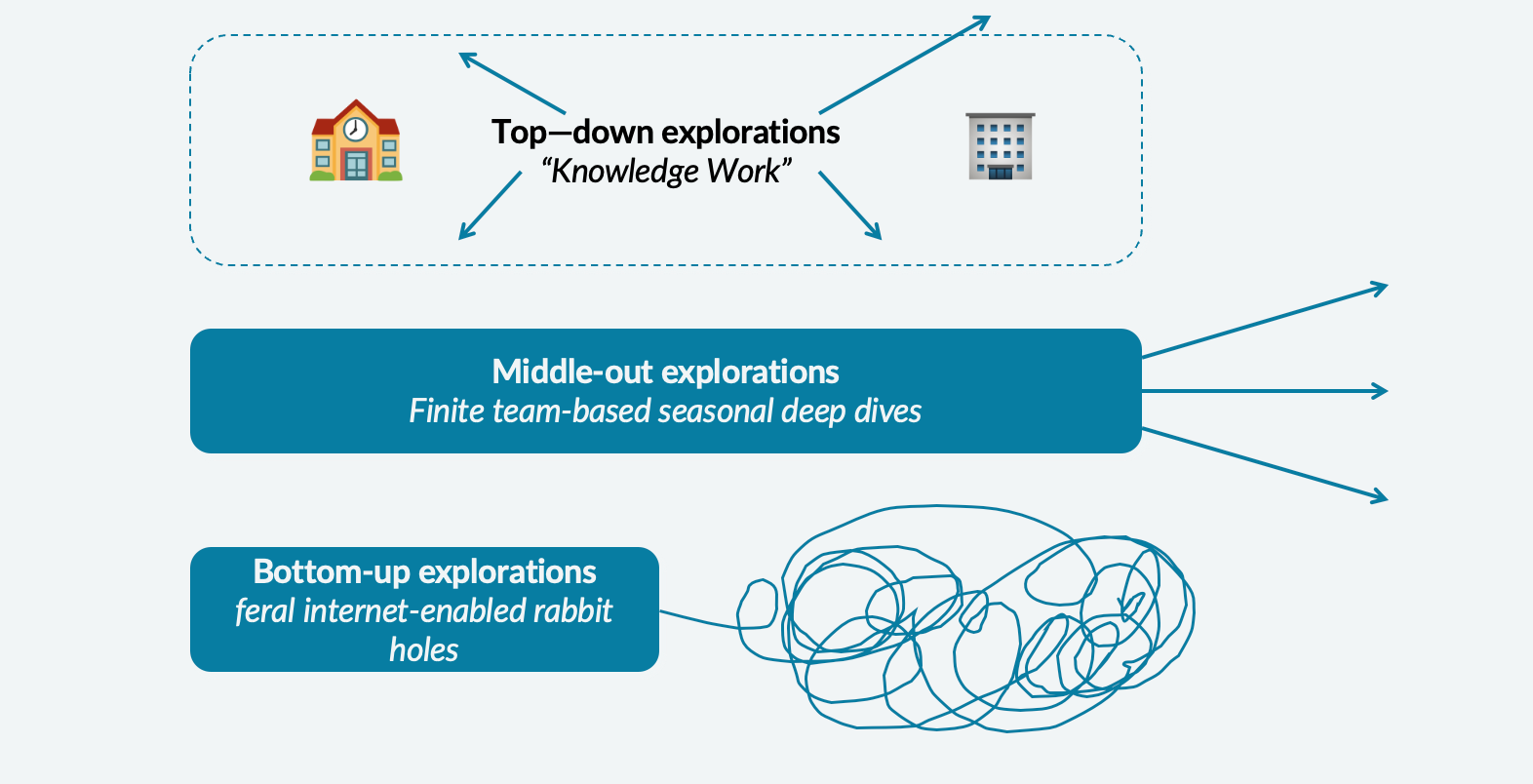
The “missing middle” is a kind of emergent container, often built around a finite seasonal exploration that aims to harness diverse bottom-up curiosities and interests while also moving toward a somewhat legible outcome.
And why is this so good?
This helps answer the second question I was pondering: “Why is this so good?” It combined the fun of bottom-up exploration, namely not having a clear destination, with the biggest upside of top-down explorations, being able to co-create something beyond yourself.
For an example of this kind of work, they held a similar session in March exploring what distributed AI might look like in a Southeast Asia-inspired future ecosystem:
This release comprises thirteen videos that collectively depict a fictional world, supported by an introductory video trailer, expository essay, and dozens of imagined artifacts and concept imagery.
You might look at this and think, “What the hell is the point of this?” And I’d push back and say, that is exactly the point. Too much of our modern intellectual work is co-opted to fit narrow institutional aims, and/or dies too soon because individuals can’t sustain a long period of exploration either financially or mentally. Collectively, I think it’s resulted in massive latent and under-deployed curiosity and interestedness, or as I’ve attempted to frame it, a widespread inspiration deficit.
From doing my intellectual explorations on my own over the last decade of my life, I’ve realized that the best work often results from not knowing where you are going. And this is why I think Sam’s ongoing series of workshops is a valuable innovation and something that more scenes and groups should look at emulating.
Here are a few elements of the experience worth highlighting:
#1 A mini seminar
a reading from the Leaves of The Same Tree: Trade and Ethnicity in the Straits of Melaka, which captured some of the ideas that I think make Southeast Asia such an interesting region now, captured by the following quote (bolding mine):
In short, precolonial Southeast Asia was not subject to international conventions confining individuals within a fixed space and imposing on them a specific legal identity. Ethnic identity was a fluid concept, and the decision to adopt one or more ethnicities was the privilege of the individual. The mandala/galactic polity encouraged rather than opposed such practices because people were a source of wealth. The relative paucity of people in Southeast Asia until the twentieth century made rulers particularly anxious to retain their subjects and to attract others. Indigenous documents exhort rulers to perform good deeds to attract followers and thereby bring prosperity to the land. In this regard, Southeast Asian groups were more concerned with the maintenance of the porosity rather than the impermeability of their ethnic boundaries.
So many cultures have been built around constructing walls and making it hard to enter. But what can we learn from this era of fluid identity and permeable borders? The downsides and challenges of all kinds of global migration are constantly interrogated, talked about, and debated. I’m more personally interested in what healthy migration might look like. Thailand is an interesting case as it is embracing its tourism economy and trying to attract more long-term residents who will stay and engage with the culture and economy in a deeper way than a five-day stay at a luxury resort.
#2 An LLM-powered fiction writing section
We each started with a prompt, “It wasn’t pretty, but it was exactly what we needed,” and then used LLM tools to write a fictional story in 45 minutes. I think this was the most interesting exercise because I realized:
Wow, everyone can easily write fiction now
Damn, everyone still injects their essays with unique and personal perspectives despite using AI
I’ve always had some natural fear around writing fiction, mostly finding it a bit too jarring to imagine worlds myself, but the combo of having someone else give us the prompt and then being nudged to use LLMs helped me move past this fear. The biggest unlock was asking ChatGPT for a list of “starter ideas”:
I want to come up with three stories in the vein of Paul millerd / imaginal futures / pathless paths that starts with the sentence:
It wasnt pretty but it was exactly what we needed
Give me some options first
One of the options was a “post-burnout” story that then inspired me to make it about Taiwan and night markets. Here’s my next prompt:
Ok so can we actually turn this into a future where sea levels are rising and in taiwan they create a floating night market in taipei - less about burnout - but more springing to action - comparing the tension of staying at a day job working in digital infrastructure monitoring data centers and actually taking action to floating the night markets - and then exploring how this changes the dynamics of food relationship and protocols in the city
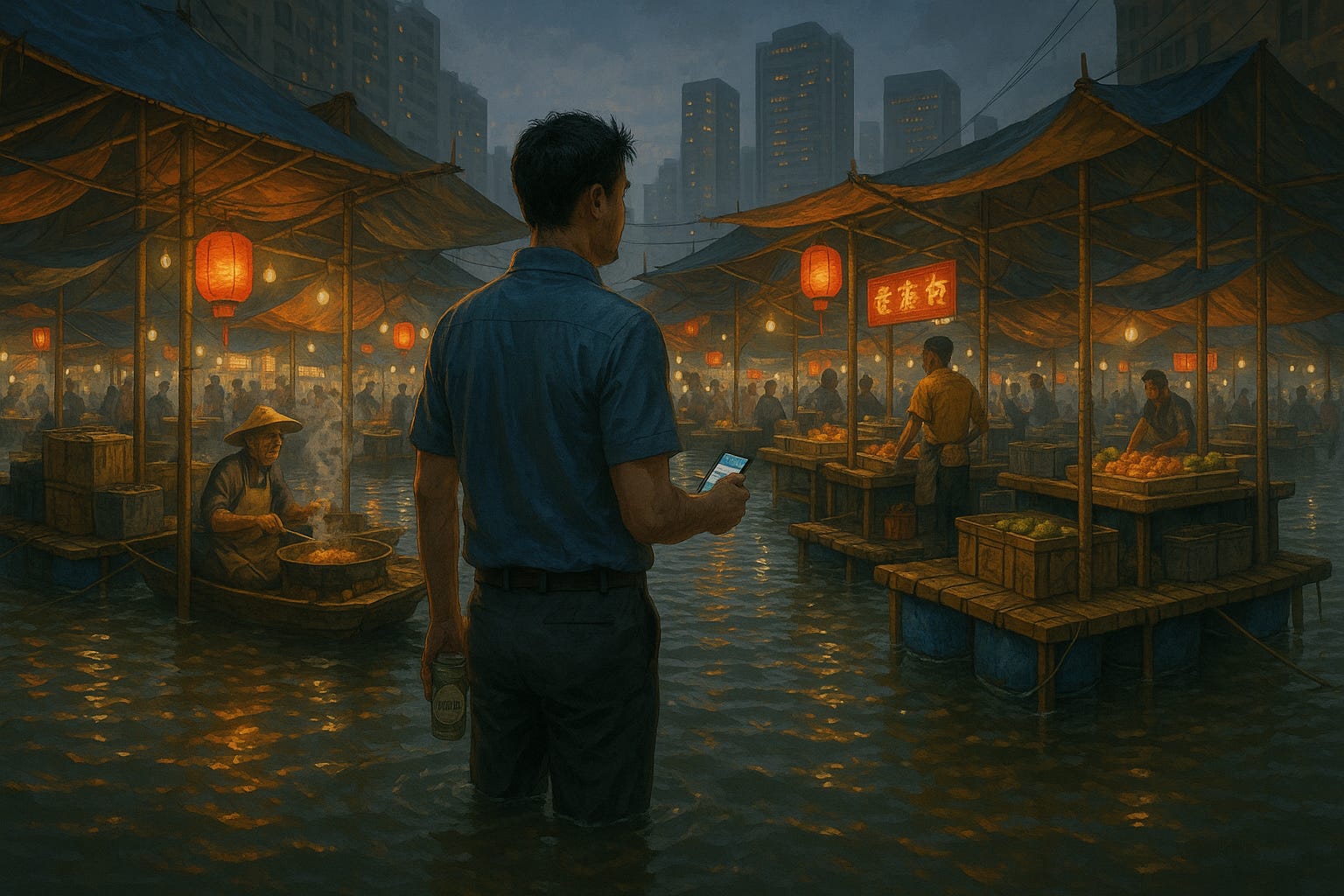
From there, I hand-crafted a story about floating night markets in Taiwan that also integrated ideas of workweek protocols, a new social ethic in this world and the tensions between the “old” world and new world. It was quite a generativee exploration. I might polish it up and share it in the Seapunk newsletter soon.
If you’d be interested in doing something along these lines for a “pathless futures,” I’d love to host something virtually in the coming months. Let me know!
#3 Aligned With An Academic Conference
While the gathering is very much in the spirit of internet-first collaboration, and all the ambiguity of such an endeavor, what was interesting is that a couple of people from the group were also presenting a paper at a traditional Academic conference.
I suspect there are interesting opportunities for internet-first thinkers to hack their way into Academic conferences for two purposes:
Attract more traditional support and funding for longer-term projects
Find people inside these institutions who have latent capacity for working on side explorations and may be supporters in the future.
There’s probably a longer perspective here on how I think these kinds of scenes might be absorbed into or hack the traditional institutions over the long-term, but I’m going to spare you those words for now.
#4 Social Aspect
I told Sam I was impressed by his ability to attract a mishmash of people from a wide range of different worlds. He said he was a “container-first” person. He was great at gathering people and then figuring out where they should go. I realized I’m sort of the opposite. I’m a content-first person. I like to explore my perspective fully and deeply, and then put things out into the world and let people come to me as they wish.
I’ve had the desire to gather people for the last couple of years, and I haven’t really found the right way to do it. After this week, I realized that letting people come together to co-create is an interesting frame I never considered. Most of us were there because we wanted to participate in something. I’ve always thought of doing an event, as I need to deliver a service that’s worth it. But just joining a group around a shared interest, for finite seasonal explorations aiming at specific outcomes, is a powerful mode that many others, not just myself, are craving.
Future Explorations
As you can tell from the last issue and this one, I’m still in a sort of reorientation/reinvention of my path. I’m starting to get a clearer picture of what I think the next few years might look like for my path.
Specific to Southeast Asia, I don’t have much to add right now, but I’m interested in exploring it more over time. Topics I’m curious about include ethnic diversity, historical migration patterns and modern migration protocols, the Chinese diaspora and its influence, the role of water, and the impact of global travel. If you have anything interesting, especially historical fiction, which I like as a first entryway into different regions, send it my way.
I’ll likely be doing some writing on the Seapunk substack along with others, and I encourage you to follow along
Thanks for indulging my explorations
I’ve been doing some form of public writing since 2015. I’ve somehow figured out how to hack a living doing things like exploring random seapunk rabbit holes for eight years now. I’m amazed myself, don’t worry.
If you like what you read here, you’ll probably enjoy my books The Pathless Path and Good Work:
If you’d like to meet others on “pathless paths”, you can join The Pathless Path Community.
Some things I endorse: Readwise for book notes and reviewing highlights; Readwise Reader for my attempts at re-creating RSS readers (2 months free for each. Crowdhealth, an alternative to US health insurance that I’m still using while abroad; Kindred, a home-sharing app; Collective for handling your S-Corp accounting needs; and Nat Eliason’s Build Your Own AI Apps course
If you received this and find yourself in a state of outrage, thinking, “What is this gobbledygookityboop in my inbox?” I strongly encourage you to unsubscribe below. It is your god given right, and there is plenty of other good stuff online.
A reminder: I don’t check unsubscribe alerts and never look at my subscriber list. So if you feel like unsubscribing, you can do so below.
I’ve had a couple of people nudge me to write about this, which I will at some point. I think I have
Heh, yeah Sam is hard to pin down. Like the PG Wodehouse joke goes, he’s the sort of person who enters a revolving door after you but still exits it before you.
There is quite a bit of newer sci-fi and fantasy set in Southeast Asia, some of it historical in nature (Yangsze Choo's work, for example, which I admittedly haven't read yet). Personally I love Ken Liu's book The Paper Menagerie, which is more generally Asian and imagines a number of different futures (and pasts). I also found this Spicepunk Manifesto which might be adjacent to your conception of Seapunk: http://strangehorizons.com/wordpress/non-fiction/a-spicepunk-manifesto-towards-a-critical-movement-of-southeast-asian-heritage-based-sff/