



January 12th, 2026: Greetings from Da Nang, Vietnam. Angie and I joining 20 families for a four month adventure in three cities across Asia. I decided to take a bit of a pause at the beginning of the year on a bunch of my work. I’ll be sharing some guest posts and a couple posts I wrote up last week over the next few weeks. I plan on getting back to the newsletter in early March, likely with a slightly different approach.
How To Leave The “Casino”
There is a lot written on how to build a startup, but not enough written on how to build a solopreneur business. My go-to book for years has been Venkatesh Rao’s Art of Gig series, but his writing can be a bit challenging for beginners (these books are still in my must read category if you are committed to an indie path for more than a year).
Luckily, Jessica Lackey’s new book and workbook, Leaving the Casino, offers an absurdly useful guide on how to think through building a business on your own. What made it great, something I’m excited to recommend, is that it goes beyond tactics and pushes people to think through prompts, frameworks, and a well-thought-out process to go much deeper, focusing on the foundation level of your business.
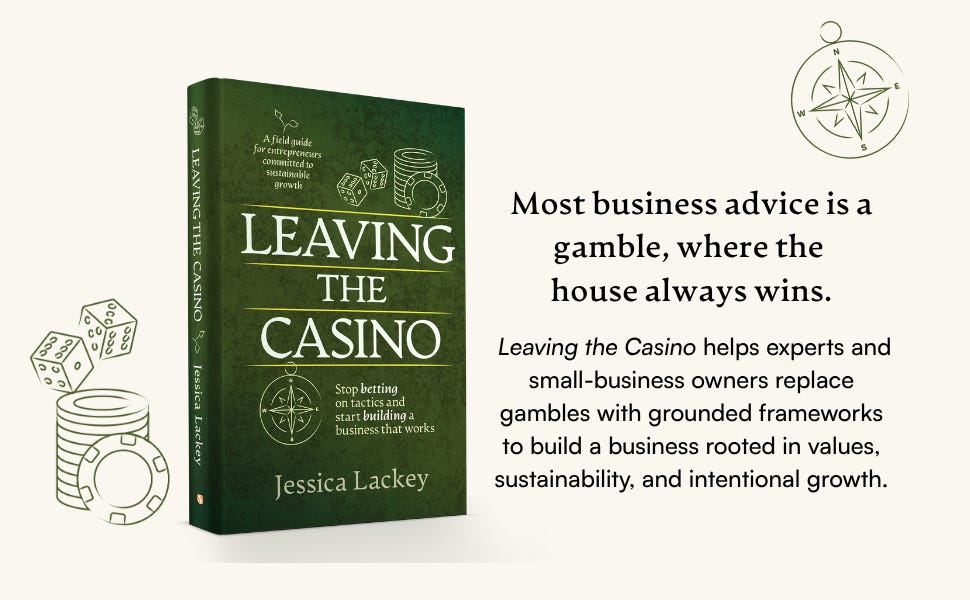
It’s also pretty funny as she pokes fun of what she calls the “Entrepreneurial Casino”:
The Entrepreneurial Casino is a multibillion-dollar industry built around the dream of entrepreneurship, focused on selling quick and easy solutions to grow your fame and fortune. The influencers selling you these solutions are experts at using every marketing tactic in the book to ensnare you—scarcity, urgency, social proof, even sex appeal. It’s the course-based version of diet pills: fast promises of big results with little effort. This makes the tech platforms the ultimate winners of this game—you pay big bucks to advertise while your attention and data are commoditized and sold to the highest bidder.
…
And when their strategies didn’t work? I was told to try again. Just invest a little more. Take the next course, upgrade to the premium mastermind, “fix my mindset,” and the oasis of success would finally be within reach.
And she goes on:
Because I’ve had such a variety of experiences—engineering, consulting, big corporate businesses, the startup world, and building my own business (first as a life coach and then as a fractional COO)—I can see across all of the different floors of the Casino.
The boss babes and manifestation girlies on Instagram showing off their luxury lifestyles.
The Twitter/X and YouTube bros promising that you can have six-figure revenue months just by writing content for one hour a day.
The B2B marketers turning LinkedIn into a sea of homogenized and flattened expertise that always leads with a “hook.” (Feels like a hook, line, and sinker to me.)
But I can use my experience to curate what does work in business and turn a torrential sea of information and shoddy promises into frameworks and tools specifically designed for small, knowledge-based businesses (like the ones I’ve built myself). The skills I honed in corporate strategy—diagnosing systems, analyzing trade-offs, and building sustainable solutions—are the same tools that can be applied to help entrepreneurs create profitable and sustainable businesses without sacrificing their values or well-being.
I have felt many of the same things and it’s not a coincidence that we both spent time working in strategy consulting before exploring an indie path.
A lot of people like to dunk on consulting but the best part of the experience was being exposed to hundreds of different global businesses and seeing how businesses actually make money. On top of that, we both DID ultimately leave consulting because sometimes it does get caught up in buzzwords, fads, and doesn’t quite deliver.
So I asked Jessica to do a little Q&A for us.
Without further ado, I’m handing it over to her:
The metaphor of the “casino” for the modern state of advice around doing your own thing made me laugh. When did you first come up with this idea?
I left my full-time job in March 2021, and I did contract consulting work while building my own book of business. Later that year, I wanted to grow faster, so I did what “everyone” was doing—I joined a $25,000 mastermind, because in the silo of the online business ecosystem I was in, that was the common step at that point in time.
I could cashflow it from corporate savings (ex-McKinsey, ex-Nike) and my contract work. But I got in the room and looked around—and at least 12 of the other 14 people had no substantial business. I’m thinking: How are they paying for this? And also: Are they even paying full price? Because I was, and I felt like the sucker who pays full freight at a Vegas hotel, while everyone else got their room and drinks comped.
Then we started talking about marketing. At this point, I was building a fractional COO service, and the advice was all about email funnels, social media launches, cohort-style selling. I’m recognizing: This doesn’t fit my business model at all. Nor does it fit theirs, based on their stage of business.
That’s when I asked myself: Who’s really making money here?
Because the person leading the group was making multiple six figures, from people who had no business paying for that level of support.
And I thought, “Of course. The house always wins.”
Once I had that metaphor, everything clicked. What people were being taught wasn’t business building—it was gambling. Spin the wheel on a high-ticket program. Keep pulling the slot machine of social media posting, and hope you go viral.
A few lucky people win big (often due to pre-existing advantages, market timing, or platform arbitrage), and everyone else loses their money.
The hook: “Make six figures from just doing an hour of deep work every day!”
The reality: “Make six figures by getting on Twitter at its peak (and YouTube seven years ago) and build an audience teaching people how to make six figures from an hour of deep work a day!”
I think you do a great job of painting the picture of what a solopreneur path requires. I don’t think there’s been enough written about all the tradeoffs you constantly need to make, and also the variety of tools and content decisions you need to be making in the modern world.
Talking about trade-offs invites nuance. And the entrepreneurial casino is designed to make you stop thinking about trade-offs and just dangle support.
When I tell people it’s going to take two to three years of effort, probably at a minimum, to build back up to their corporate salary, few people want to hear it. One, because that’s not sexy. Two, because many people don’t have that kind of cash saved up to bridge the gap.
So to get the broadest audience, you must sell the dream.
And early on, I believed that if you talk about the trade-offs, no one buys from you.
Gain a lot of followers to have “influence”? You might end up resenting talking about the same topic on a relentless publishing schedule for years.
Build an agency so you can have your team deliver while you’re the CEO? Most agency owners I know make less take home than profitable soloists because of the costs of running their team.
Every path requires the time and effort to walk it, which isn’t an easy sell, especially to newer entrepreneurs who want hope and clear next steps.
I love Paul’s writing because he’s so honest and talks about the tradeoffs. To do entrepreneurship with a high level of creative autonomy and flexibility means his business is less financially lucrative than it could otherwise be.
I wrote this book because I couldn’t find one that articulates the practicalities of how to navigate those trade-offs for expert-led businesses. Many books are memoir mixed with “this is how I did it” to help fuel a speaking career. Mine is meant to be “here’s everything you won’t get from an MBA that I’ve learned from tens of thousands of dollars in programs and years of pattern-matching”.
You seem to find a good balance between engaging in content and sharing online and mostly focusing on your business behind the scenes. I think people who want to work independently feel like they need to be doing social media but that’s not quite true (it’s just the loudest voices telling us that). What forms of content have worked well for you and feel sustainable?
For my business to be successful early on, I didn’t need thousands of followers. I needed five clients.
And replicating what I saw from working at McKinsey, they weren’t posting on social media every day to get clients. They were doing traditional business development—tapping networks, building relationships, building authority through long-form asset creation.
So that’s what I did.
My content strategy is the codification of patterns I’ve seen or topics I want to explore with my clients next.
Every week I write a long-form newsletter.
Every month for three years I taught a free class (not a sales pitch webinar, an actual free business building class). Those classes and long-form content ended up laddering into the book.
And then I guested on other people’s podcasts and guest taught in other communities, because of those relationships I’d built and the frameworks I’d developed.
I’m terrible at anything that requires algorithmic discoverability, like short-form video or tweets/Notes. What I lack in performance, I make up for in relentless consistency.
Now, as I’m moving into more visibility with the book, I need more eyeballs on my work. But in order for me to make money when I started, I didn’t need to have a ton of followers. I needed to have 50 solid relationships.
How long did it take you at the start of your journey to find your footing and have the feeling like “ah, okay, I have confidence that I want to stay on this path”?
I knew immediately I never wanted to go back to corporate. But wanting to stay on the path and having confidence in the path are two different things.
The first two and a half years? I was running from something—toxic corporate environments, doing two jobs with the salary and time of one, poor leadership decisions I could see from a mile away. I hated every moment of the corporate theater shenanigans where I had to spend more time prepping absent leadership for meetings than making decisions.
So I did contract consulting and fractional COO work to pay the bills while building my own book of business on the side.
Around year three, something shifted. I realized the business skills I’d learned at McKinsey and Nike—the ones that made my financial success faster than most soloists—weren’t being taught anywhere. That’s when I moved from running from corporate to running toward something: teaching the foundations that actually work.
It’s taken me five years to feel like I have solid momentum and can take the foot off of the gas a bit related to my pace. Now that the book is in the world, it’s an asset that people can really share that has already started to bring in new people to my world.
You also come from a consulting background, working at McKinsey for several years. For me, experience at McKinsey was invaluable prep for working on my own, but not for the reasons people think. For me, the value was being part of a well-run organization where I could get tons of reps, aiming at a high-quality bar, working at a fast pace, and where everyone around me was always pushing me to do better. I don’t think I could have written a book on my own without this. What stands out from consulting for you?
I couldn’t have written the book without McKinsey. And I couldn’t have run my business without Nike.
McKinsey taught me how to pattern match quickly, how to get to root causes, how to architect my business experiments with an hypothesis-led approach. It taught me to think in frameworks. When you start thinking in slides—when everything has to be bucketized, structured, framed—that shapes how you communicate.
My signature framework—what business are you running—only exists because McKinsey taught me MECE (mutually exclusive, collectively exhaustive). I had to see that this person’s business is fundamentally different from that one, but both are distinct from this third one. Bucketizing and creating coherent structures is pure McKinsey training.
But running my business? That’s Nike.
McKinsey teaches you one pace: on. Full sprint, all the time. Which is why I left after 3 years because the pace was just too intense for me.
Nike taught me rhythms. I worked in planning and inventory management for five years, and you’re thinking in multiple horizons simultaneously. What’s coming from global design three years from now, and how does that information affect what I need to buy based on what I’m liquidating right now?
Nike gave me the rhythms of repeatability. Every season, we ran the same playbook of dates, gates, stages. Every month, similar processes for reviewing results. Those rhythms were ingrained in me through years of leading sales and operations planning processes.
McKinsey taught me how to think. Nike taught me how to operate.
One side effect: my course slides are very dense. At McKinsey, your slides had to be your entire talk track—just put in slide format. My slides still work that way, incredibly dense with all of my thinking on the slides.
You go pretty hard against the promise of passive income, which I think makes sense given how much it’s oversold to people. However, now you have a book in which you will earn income…passively. I’ve come to reframe this as “less than grind” income, or LTG income, meaning its less energy than a job to maintain but still requires maintenance. How do you think about this now that readers of this newsletter are about to purchase your book and send money to your bank account while you sleep :-)
I like your reframe—”less than grind.” I call it leverage.
Now that I’ve done years of learning and years of writing and teaching, it’s much more effective for all of us if I codify that into a single artifact you can consume at your own time and pace, instead of you having to buy my time to share that information.
Readers get a painstakingly crafted book, or buy my membership and get a curated curriculum and set of tools, and know that it’s the best I could make it instead of the best based on how I explain the concept during their call. I want people to spend their time and money on implementation, not just information.
Sure, I’ll have purchases come in while I’m asleep. But what people may not know are the years I’ve spent building a relationship with Paul, supporting and sharing his work, making sure I met him IRL when we were at the same conference, gifting him the book before it came out, etc. Over five years of relationship building which has culminated in Paul trusting me enough to read my book, recommend it, and letting me share this with his readers.
Nothing about that approach is passive. 🙂
Of course, I still make the money I need to fund my life through maintaining an active roster of consulting clients and cohort members—which isn’t passive either.
Who are some underappreciated voices for engaging on these kinds of paths that people may not have heard of?
My favorite two underappreciated voices are Lex Roman and Amelia Hruby, PhD. Lex runs Revenue Rulebreaker, a newsletter and membership collective devoted to publishing the rulebreaking revenue stories of solopreneurs and fostering indie business collaboration. Amelia Hruby runs Softer Sounds, a podcast production studio and Off the Grid, a podcast, book and community dedicated to a vision of the internet where we create, connect & make money online without extractive algorithms.
Okay Paul here again. Please follow Jessica. She is a wise guide in the world of indie entrepreneurship. And purchase her book here.
Great stuff, Angela and Paul. Purchased the book (on Amazon), as the first chapter really resonated with me.
I know I’ve fallen for the same tactics and, unfortunately, used them myself in past product launches.
It’s one reason I either give away or sell my digital products at very low prices (often $9 or less). I try to follow the adage of providing 10x more value.
Jessica - The title is brilliant and the origin story you have to back it up is top notch. A stellar example of communicating and anchoring thought leadership with storytelling. Inspired by this.