


October 7th, 2025: Greetings from Taipei!
Last week, I did a book talk in Hong Kong with Ali Abdaal follow by a meetup. It was really fun to meet people, especially in Asia, who are exploring alternative paths. Then this week, I did an event followed by a meetup in Taipei, which was extra special. I never imagined I’d be promoting the Chinese version of my book when I was writing it in Taiwan in 2021.


In addition to the event in Hong Kong, Ali and I recorded a conversation about the process of quitting your job. Both of us have gone through reinventions over the past ten years, leaving prestigious careers to do ideas on the internet. Over the years, both of us have heard countless objections and roadblocks people have faced, and so we sat down and talked through them.
I’ve noticed that the people who actually do make a change in their work trajectory all have one thing in common: they were able to replace a default story about what they should be doing with an alternative story. When it comes to the act of quitting and trying something new, people almost always have some story related to money.
As I’ve jokingly said, money is like the final boss of self-reflection. It’s the place we hide our deepest insecurities.
In terms of taking a leap, I’ve been playing around with an idea I’m calling “leap capital.”
Leap capital is a specific quantity of money or other resources and an accompanying story that someone uses to convince themselves that it is reasonable to make a change in their work life.
It almost always shows up in the following formula:
I have X, which means it’s reasonable to take risk Y for Z period.
X is the leap capital. It can be an amount of money, a level of wealth, or even a recent change in income or wealth that convinces you that it’s reasonable to make a change in your life, either temporarily or permanently.
After graduate school, I had some long-term investments but also $70k in debt. It felt unreasonable to do anything except continue on my path. It wasn’t until I paid the debt off and started building savings that I thought about anything other than working full-time.
When I hit $50k in savings, something shifted. Part of it was the reality of growing my savings each month. But the deeper shift was that I was starting to do the math. With some small reductions in spending, $50k in savings represented a year of living expenses. This quantity of time, a year, felt important. I don’t know why, and I don’t have a detailed model of the math behind it. It was arbitrary but also personally persuasive.
As I started dealing with some stressful situations at work and contemplating the fact that maybe jumping to my sixth job wasn’t the answer, I started playing with the idea of “testing” a freelance version of my current path.
Hmm, one year, I could make that work, right?
When I quit, I didn’t think past a year. I wasn’t quitting forever; I was just going to test the waters for twelve months. Even though I was scared, this felt reasonable. I felt safe. The worst case was that my savings would go back to where they were only a couple of years earlier. I could get a job again and move on.
For some, $50k is not nearly enough. One guy told me straight-faced that once he had $10 million, he could finally take a break to write the book he wanted to write. Another tech guy told me he would only quit once he fully replaced his $300k tech salary via a side gig. Others need less, like Angie Wang 安吉, who quit her job and traveled for a few months with only $7,000 to her name.
We all have a unique relationship with money. And what feels reasonable to one person often feels terrifying to another. The important thing about these stories is that they help you arrive at a feeling: I am not completely reckless.
This feeling, rather than spreadsheet reality, seems to matter a lot more for people in being able to leap.
There are many examples of this:
Months of expenses: Sinem In Flux shared that, “For me, it was monthly expenses *12 for a year-long sabbatical, and I multiplied that by 2 again just to feel extra safe. It also helped that I never expected to save growing up, and I wouldn’t have, if I had never left Turkey, so it felt like an extra that I could spend.”
One feature of the months of expenses approach is that it sets a clear deadline: “This is when I will run out of cash and need to change my plans.”
Side gig income: “I’m making $2,000 a month from a side gig right now.” For some people, this is enough. It’s proof that this alternative path has potential. For others, they need to match their current salary. Anything less is failure or brings up too much insecurity or guilt.
Net worth: “I’m worth $2 million, that seems like enough to take a risk.” What I’ve found interesting is that people using this approach often don’t run the numbers. They care much more about total amounts. If they had run the numbers, they might have realized it wasn’t quite a big risk to take a year off when they were at $1 million. Regardless, net worth has become increasingly important to many people, and hitting a milestone can help some shift stories.
Paid leave: Josh Knox shared that “My leap capital came from becoming a father - California paternity leave covered our family’s minimum expenses for 12 weeks, which gave us runway to be more creative and contemplative.”
Unexpected earnings / one-time sum: Like Sinem above, when some people earn more than they expected, they view the money as permission to do something different in their lives. Other examples of this include receiving an inheritance, making an investment, or winning a grant, such as the O’Shaughnessy Fellowship. For some, an unexpectedly big bonus can serve the same purpose:
Jessica Lackey shared that during the first year of COVID, she started thinking about leaving her job: “I finally hit my breaking point in November of 2020.” What made the choice easier was that her company “had the first good sales year in a while.” She was due to get about “4 months of salary” as a bonus in March 2021. "So for 4 months, I had to keep my mouth shut, not get fired, cash my bonus check, and only then put in my notice.” To her, the four months meant time to figure this out: “I could take the summer to get clients, take a break, or otherwise figure out my next steps. It meant I could leap without a total plan in place.”
Gift from past self: For me, one thing that helped me early on was considering the money I earned in consulting a “gift from my former self.” I’m not sure why this worked so well, but it cracked me up thinking about my spreadsheet self making a presentation telling me why he was investing in my wanderings and creative experiments.
A self-funded personal MBA: When I took out $70k in debt and went 27 months without working and earning $0, I was seen as successful. But in my first year after quitting my job, I broke even, and people thought I was doing something incredibly risky. Seeing this year as a “personal MBA” helped me get more comfortable with potentially not earning enough money and having to tap into savings.
New identity: While this is often counterintuitive for people, many people who go through a life change, like having a child, feel an increased urgency to make a change. It used to surprise me how many parents I met who made big changes after having a child, but it makes more sense now. Going through health crises can do the same thing. I know for me, once I recovered from three years of health nonsense, I no longer wanted to waste days at work doing things I didn’t enjoy for people I didn’t respect.
Off-ramp: A “no-brainer” opportunity can often make the transition smoother, like the potential of moving to a part-time contractor role at your company, or a freelance gig that pays well:
SJ Eastley commented on the original version of this post that, “For me, it was finding 2 people who were working as freelance consultants in my area of work. I worked under them, they brought me in as a subcontractor on projects, and they mentored me. Seeing up close how their lives worked (and how much free time it opened up), but how they were still earning “good enough” money and were “well respected” made keeping my regular job seem silly.”
Safety net: Anytime you write about quitting your job, Americans, no matter how much money they have, mention healthcare. It is an awful system we have, but I think it tends to be a default excuse that most people find acceptable rather than a hard and fast reality. Having many ongoing health issues and being uninsured (using Crowdhealth) for two years and on five different state exchanges over the last eight years, it’s not as bad as people think. It does take a little hacking, but Obamacare fixed many of the worst issues. Before Obamacare, many self-employed people couldn’t even buy insurance if they wanted to. Now, you can buy it in every state, and the amount you pay is capped as a % of your income by federal law. Despite this, some people will never leap unless they have coverage through a spouse or some form of part-time gig.
One of the most consistent things I’ve noticed about doing your own thing or taking a break from work is that people feel they need permission. But you can get permission in many different forms. Seeing others do the same thing. Reading a book about someone’s experience. Through unexpected cash injections, or even through a better story that you create.
I’d love to hear other stories or kinds of “leap capital” that inspired people to make a change.
Heyo, you made it all the way down here
I’ve been doing some form of public writing since 2015. I’ve somehow figured out how to hack a living doing things like writing book,s and next week, launching my own fancy hardcover edition.
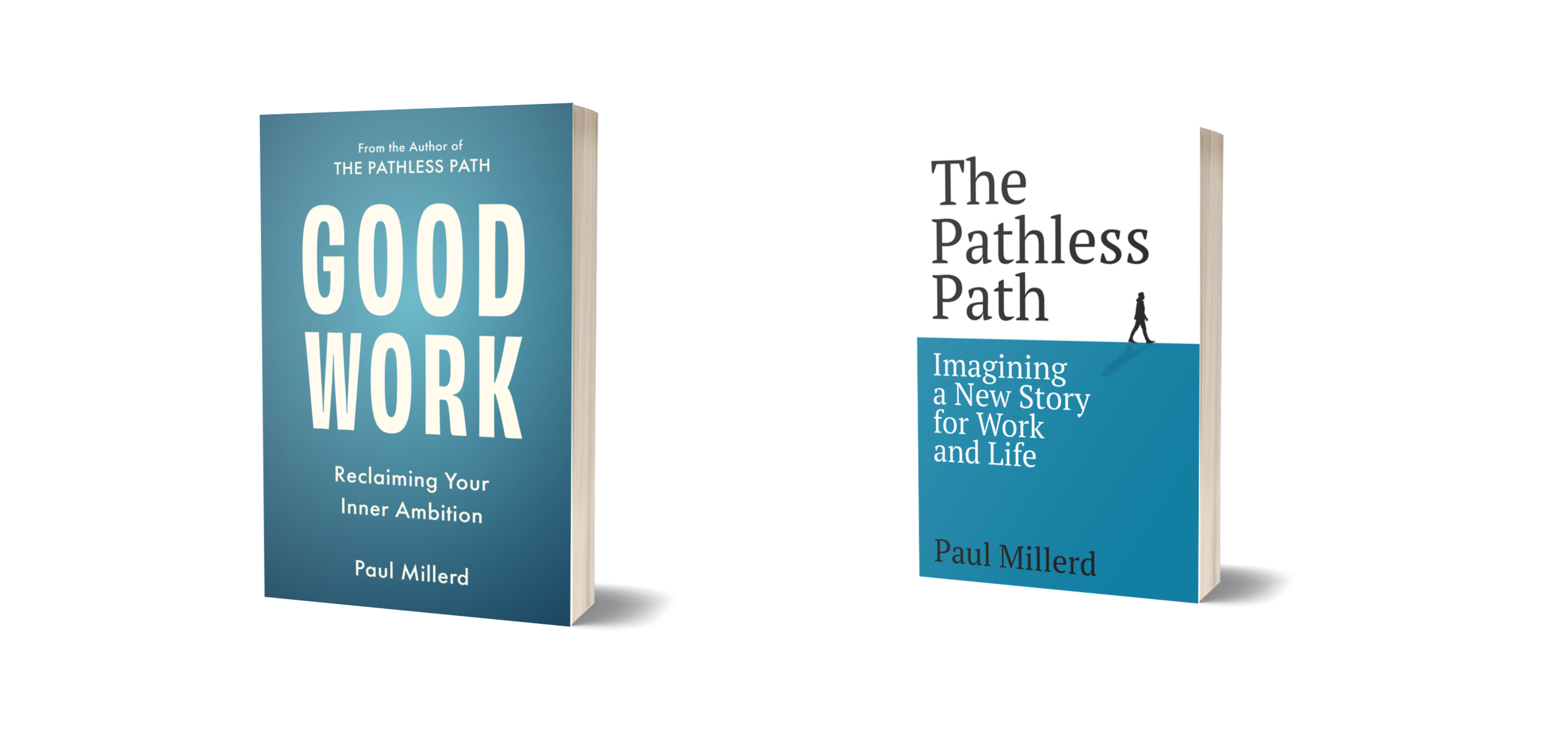
If you like what you read here, you’ll probably enjoy my books The Pathless Path and Good Work:
If you’d like to join a virtual community of others on “pathless paths” from around the world, and get access to courses, tools, and other resources I’ve created over the years, you can join The Pathless Path Community. Our recent WhatsApp community is very active if you like hanging out on messaging apps instead of Circle.
Some things I endorse:
Readwise is offering 2 months free (I use it for book notes and reviewing highlights). Or two months free on
Readwise Reader, which I use for RSS reading and epub reading
Crowdhealth, an alternative to US health insurance that I’m still using while abroad
Postbridge: A social scheduling app created by a reader without crazy upcharges for more accounts
Kindred, a home-sharing app
Collective for handling your S-Corp accounting needs; and Nat Eliason’s Build Your Own AI Apps course
If you received this and find yourself in a state of outrage, thinking, “What is this?” I strongly encourage you to unsubscribe below. It is your god given right, and there is plenty of other good stuff online.
A reminder: I don’t check unsubscribe alerts and never look at my subscriber list. So if you feel like unsubscribing, you can do so below.
I really appreciate how clearly you broke this down, Paul. Your way of analysing and framing ideas always sticks with me.
Here’s how I think about my own leap capital:
I first told myself I’d quit for a year to slow down and spend time with my aging parents after twenty years abroad.
But deep down, I probably knew I wasn’t going back.
Health issues, colleagues passing away, and my parents getting older all reminded me that “more money” wasn’t making life freer.
I’d spent four years studying to become an engineer and building that version of life, so it felt fair to spend the next four building something new and more aligned.
My takeaway from your essay is that the story we tell ourselves gives us emotional permission. It’s how we can hack the system, turning “not ready” into “ready enough.”
If we’re already making up stories to feel safe, then the fastest lever isn’t changing the numbers. It’s changing the beliefs behind them.🥳
I leaped in 2021, but after 20+ years in corporate life. My three rules of thumb were: 1) No leap before being debt free 2) Passion project replaces >40% of my annual salary while I am employed full time 3) Corpus which is 25-30x of my annual expenditure (based on FIRE principle).
When I took the leap, the first two conditions were fulfilled - which was a sufficient safety net to never go back to a full time job. The third condition was fulfilled 2-3 years AFTER I went solo, but it all worked well.
P.S: Already had life and medical insurance to protect the fort.