


November 17th, 2025: Greetings from Taipei! A few quick shoutouts:
I’m participating in this wise agency multi-part workshop with Peter Limberger. It’s offered on a gift pricing basis, and you can learn more here.
Will Mannon is hosting a multi-city “internet serendipity” tour. Pathless people will be at many locations, including Boston, DC, Austin, Seattle, Vancouver, SF, Denver, Miami, and Columbus: Register here
I’m judging a writing competition with the London Writers' Salon. Here’s the prompt: Write about a moment when you (or a character) stepped off the expected road, or dreamed of doing so. What happened when you stopped following the map? Lots of cool prizes included, including a copy of my hardcover: see details here.
When Paperbacks Were Too Sketchy For Publishers
In the 1950s, paperbacks were not considered serious works of art by publishers and even some authors. Using cheaper paper and appealing to “lowbrow” mass audiences, paperbacks were the bottom rung of the literary hierarchy. Trade publishers were initially leery of paperback publication, “fearing it would cheapen authors’ reputations and cut revenues.” In a conversation I had with Eric Jorgenson, diving into the weird history of publishing, we both took a peek at what some of these “lurid” covers looked like:
Also, it wasn’t just publishers. Many authors also didn’t want their books “between the lurid paperback covers in favor of the 1940s and 1950s.” Some hardcover houses went so far as to include “the right to approve paperback covers in their reprint contracts.”1
Despite this, consumer preferences were undeterred. In 1947, approximately 95 million mass-market paperbacks were sold for slightly more than $14 million, but five years later, 270 million copies were sold for $40 million. By 1959, nearly 286 million copies were sold for $67 million, and “dollar sales of paperbacks exceeded those of hardcover trade books for the first time, even though paperbacks were much cheaper than hardcover books.”2
But the stance of seeing the hardcover as the only “real” book persisted, which basically meant less money for publishers and a bigger upside for authors. While his novel, Carrie, was purchased in hardcover for $2,500 in 1973, Stephen King’s writing journey really took off when he sold the paperback rights, one year later, for $400,000, to a completely different publisher.
This pattern repeats throughout history
In my research into the publishing industry, this pattern repeats throughout history:
Publishers look down on new formats (see paperback, ebook, audiobook, translation, and even merchandising rights)
Authors embrace them independently, profiting from them, or authors find ways to retain and sell rights after already having a successful book
Publishers eventually move to own and restrict more of these rights
If you want to publish a book through the traditional route, it is nearly impossible to avoid giving up these rights as an entire basket without investing in the book yourself or through a hybrid publisher.
Increasingly, however, this doesn’t make sense for the author nor the publishing house.
For the author, it’s clear why it doesn’t make sense. The authors care about being a viable creative person and making money from their work in any way possible. The publisher is not in the best position to actually execute on this. The publisher is great at packaging a book and selling it via traditional distribution channels. But even after 10+ years with ebooks and audiobooks, they appear to have no interest in doing anything creative with these formats or even pricing them competitively, let alone unleashing authors to make money using the IP and content despite many being world-class creative humans!
For a publisher, I think this is a weird self-own, too. In the age of the internet, a book is a meme, and the publisher should be interested in helping the meme spread as much as possible. But many publishers make it incredibly hard for authors to share their work. Unless the authors commission the cover or illustrations themselves, authors often are not legally able to take pictures of pages, pictures, images, or anything related to the book. They cannot remix the content, do interesting bundling deals, discount the ebooks and audiobooks over extended time periods, create interesting merch, or create alternative or high-end collectible editions of the book, like I did with The Pathless Path.
If I had sold the rights to my work, I never would have been able to create this:
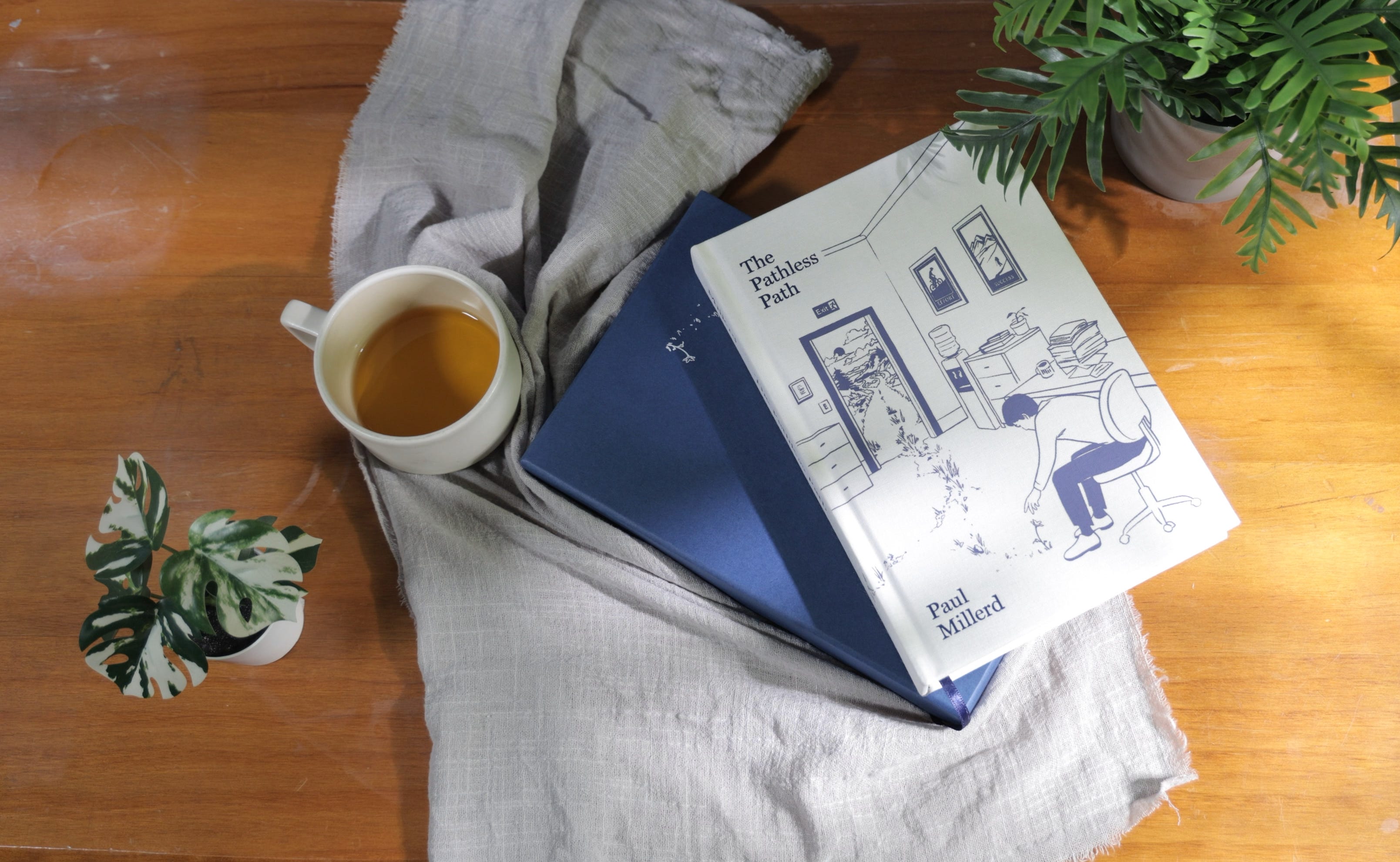
This is a silly creative tax on our best writers
More than that, I likely never would have even thought about doing such a thing because as soon as I signed away all my rights, I would no longer be the creative director of my own work and likely would have lost motivation to come up with any ideas. This is a hidden creative tax on the most impressive writers of our generation.
The Pathless Path is clearly “working,” and as I interact with readers, I’m in a virtuous cycle of learning and playing with better ways of sharing and packaging my work. At scale, publishers have distribution advantages, but indie types can outcompete them with speed and experimentation. While these old companies still rely on the one, big, beautiful launch, I’ll be out here trying stuff, launching, relaunching, and having fun along the way, not needing to worry about the business case for any single decisions.
AI will expand the possibilities and real options of creators just like every technology has throughout history. Just this week, Amazon enabled AI-assisted English-to-Spanish translation. I already have some interesting AI-generated custom printed editions in the works for readers that I’ll share in 2026. With such cutting-edge technology moving so fast, I am excited to be in a similar position to King and others, retaining rights to capitalize on the upside of progress without needing to wait for a committee at a random company to decide that it makes sense.
I suspect this is why self-publishing, at least in the non-fiction tech/productivity circles I hang out with, appears to have hit a tipping point.
Self-publishing is having a moment in non-fiction
Interestingly, as I reflected on my reading habits, 90% of the non-fiction books I’ve finished (I’ve started many others) have been written by people who self-published. This happened without me being aware until I took stock last week.
While many popular non-fiction books are increasingly predictable, these books were weird, interesting, unpolished (in a good way), and thought-provoking.
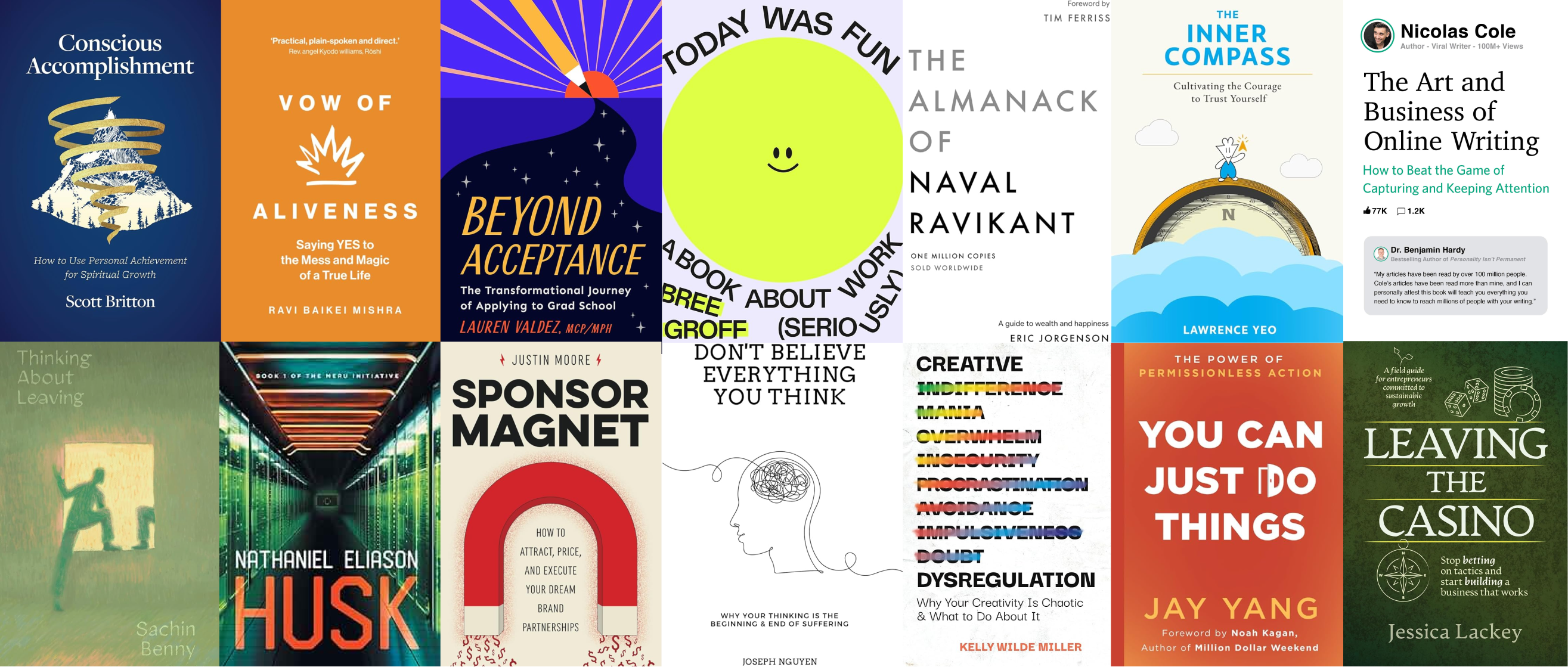
Every time I write about this stuff, I get tons of messages from authors. This week,Prof. Brian Keating shared a reflection on his experience with publishing.
His story captures his own disillusionment with the industry, which started almost immediately after signing his book deal, Losing the Nobel Prize. He makes a trip to New York City to visit his editor at W.W. Norton. As he makes his way through the building, he finds that his editor’s office “was, in fact, the janitor’s closet. Broom, mop, cleaning supplies, and all.”
Early on, he faced pushback on his decisions. He had to fight for the title, eventually winning. But the publisher won, choosing their own image they preferred for the cover. In a weird twist, the publisher bought the rights from someone who didn’t own them and had to redo the cover. But Brian shares: “Embedded in my contract was a clause I’d barely noticed. Any new edition—paperback, audiobook, revised hardcover—required a new launch, new publicity, and a new book tour.” It forced a 2nd release, and the hype from the new launch enabled the book to take off.
What would have happened if they had never made the mistake? Would people have forgotten about it? Would Brian have stopped talking about it?
He pondered these same questions and had an awakening: “I used to walk past those grand Mad Men-appointed publisher lobbies and feel envy. Now I see them for what they are: monuments to a past that no longer exists.” He decided to self-publish his next three books and concluded, “The institutions you revere are more fragile, more arbitrary, and more human than you think.3
When I step back, I think this sort of waking up is happening to many more people working in creative fields, especially those who started doing their work online, and even more so for younger people who may not have inherited the scripts from the “old world.”
We need new plumbing to enable creatives
Yancey Strickler, founder of a very internet-first company, Kickstarter, has been doing some interesting work in this vein with his attempts to get an “Artist’s Corporation” (A-Corp) established in the US. It would be a legal vehicle for creators that would enable outside investment, payments, revenue-sharing, and even non-profit donations. His work on this made me realize so much of what we see as possible is downstream of the legal and financial plumbing of the economy.
Change the protocol layer, and you can shift the imagination of the participants of the system.
In a recent podcast with NPR discussing the idea, he pointed to the absurd status quo: “Artists are service providers who create assets that these larger enterprises acquire and capitalize on.”
With the internet, you no longer need to create raw material for bigger companies. You should own your own creations.
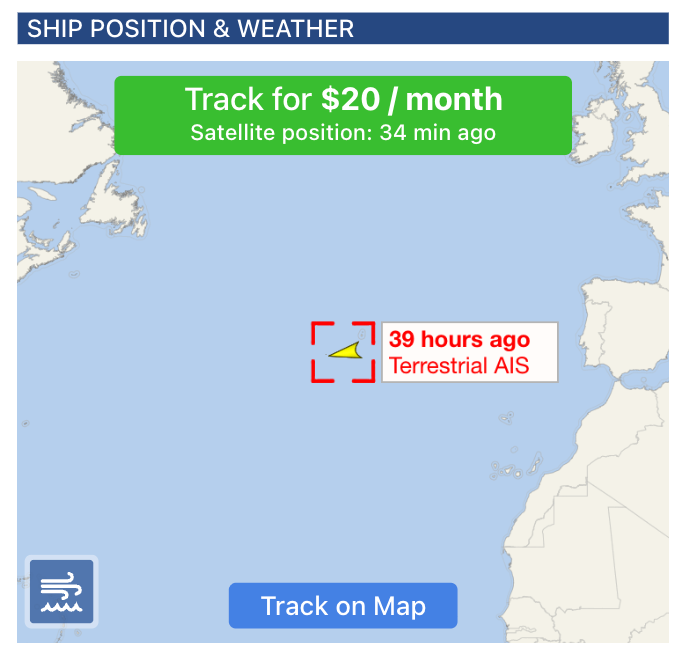
P.S. The hardcover bundles are on track to ship by early December; we are only waiting on a container ship that’s carrying the notebooks, which is currently in the middle of the Atlantic. If you purchase the Medici tier, I’ll send you daily updates.
Here are some reviews from friends I’ve shared it with so far.


History of the Book, Volume 5
History of the Book, Volume 5
“A book is a meme” - love this Paul. It encapsulates the shift from traditional extraction-based models owned by gatekeepers to cultivation-based models that enable creatives to create and distribute at scale.
Regarding the history of publishing, I really appreciated the point about how trade publishers were initially leery of paperbacks, fearing it would 'cheapen authors’ reputatons and cut revenues.' It's such a clear example of how resistance to change and perceived threats can hinder innovation, not just in literature but in all fields, even tech sometimes. Very insightful.