


January 26th: Greetings! As you know, I’m on a mini sabbatical until March 1st. I wrote this post a couple of weeks ago.
If you haven’t filled out the reader survey, that would be a huge help:
(or survey here if you don’t have a Substack account)
I really enjoyed Jonathan Goodman’s book Unhinged Habits, and I’m happily writing a short post to promote it.
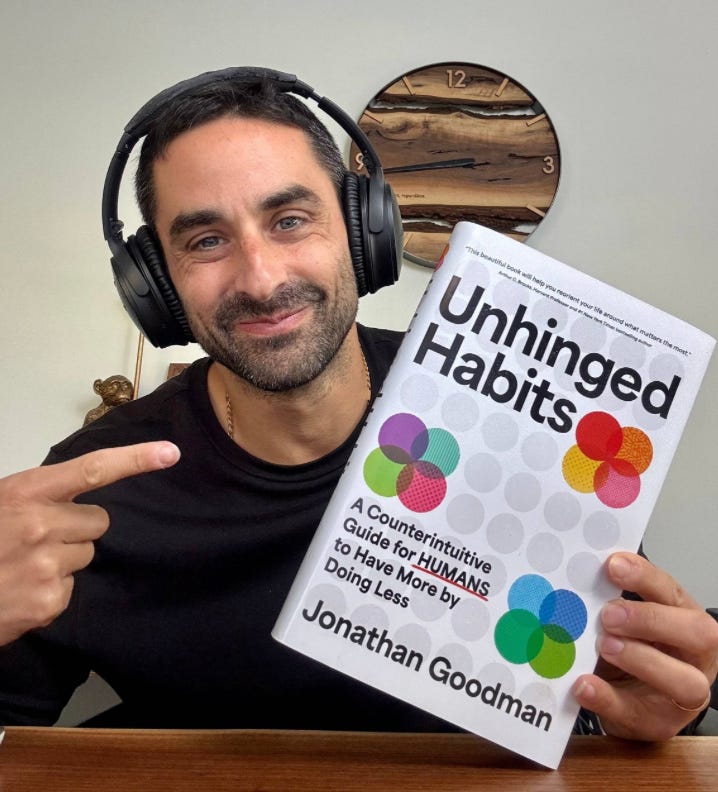
Too many books in this space are trying to be Deep Work or Atomic Habits. Despite using “habits,” I am grateful he did not attempt that playbook.
Some quick thoughts:
It was refreshingly honest: he keeps telling the reader about his experiments, successes, and failures in a down-to-earth, honest way. He didn’t seem to make any attempt at “selling” his own journey or story to make himself look impressive, nor did he try to package his life reflections into a neat framework. I liked it.
He shares unique perspectives and ideas he has actually tested and used in his life. Like me, he’s done many time-consuming and costly experiments on how he’s living his life. He’s made many mistakes. But that also makes his approaches useful because they are working. His 8:4 seasonal on-season/off-season approach is my favorite idea from the book (more on this below).
He shows the tradeoffs: Most “be successful” books are not that useful once you’ve read a few. Tactics are easy to figure out. But the tradeoffs? That’s where all the interesting ideas about the art of living are found. He has young children and other interests and preferences that take him away from work and success at this point in his journey. People may dismiss him because he’s already “made it” to some degree, but that didn’t bother me at all. Most of the interesting tradeoffs are not about money at a certain point. They are about deeper human desires like belonging, identity, and dignity. I connected with his journey of grappling with these.
Real personal stories: He weaved in two personal stories uniquely, as interludes to the chapters, that worked incredibly well. This made the book for me because when I finished it was like I read a good book, not just some playbook I had to feel guilty about not implementing.
YMMV, but if you liked The Pathless Path, you’ll likely enjoy this one too.
My high-level take on the book: I think Jonathan did a great job questioning the assumptions of the productivity/hustle complex and actually shows how he’s transcended many of those dynamics in his own life. Jonathan has been semi-nomadic with a family for many years and has also done the author/creator/entrepreneur thing for longer than me so the book was especially useful for me in terms of questioning and challenging a lot of my own ideas.

The book took a little to get into, but I ended up finishing it quickly after getting into a flow. The book had its own unique structure which was really well executed with several personal interludes that made the story much more than a traditional self-help book.
Here are two ideas I’ve been thinking a lot about since:
Idea #1: The value of highly inefficient life tinkering
Your life is not a predetermined path but an ongoing conversation between who you are and who you might become. Exploration is the language of that conversation. - Unhinged Habits
There’s a part where Jonathan talks about outsourcing the work to buying a bike. It’s not a major priority for him, so he lets someone else decide on the bike for him. I was expecting it to go smoothly and for him to espouse the benefits of optimizing your time. But then, he says, “the bike sucked.”
It made me laugh because I am constantly running similar experiments, often resulting in wasted time and money or finding myself in situations with unforeseen downsides.
I’ve come to see these experiences as a blessing. Earlier in my life, I was surface-level efficient, trying to manage the world. I avoided moving in uncomfortable directions because it was easier on a day-to-day basis. Now I know that the right amount of discomfort is not zero. I build inefficiency into my life. While sometimes it is annoying, it helps me be more effective in terms of constantly aligning and moving toward the life I actually want.
From Jonathan:
“There’s this old saying that goes “the unlived life is not worth living.” Well, an overly productive life is not worth living, either. But the unbalanced life . . . the 8:4 life . . . is absolutely worth living. Because the unbalanced life is full of meaningful work, serendipity, exploration, and wonder.”
I agree.
Idea #2 The 8:4 season/off-season approach
Try taking a Microseasons Approach: Instead of 8:4 months, test out 6:2 week cycles or maybe even 30:10 day sprints. For example, try dedicating thirty days to intensely focus on a career project while maintaining baseline parenting duties, then shift focus to family enrichment for the next ten days with special outings or quality time. - Unhinged Habits
My favorite part of the book was his 8:4 framework for seasonal living. He takes 8 months of the year when he’s “on season” and then four months when he’s in an “off season.” For him, his off-season is when he and his family live abroad, homeschool their kids, and spend more time as a family.
This is something I’ve been thinking a lot about since becoming a parent: Is there a way to live seasonally like this instead of trying to have it all? When I try to be excellent at work, parenting, health, and my relationships at the same time, I end up feeling like I’m dropping the ball on everything.
I’ve been thinking a lot about moving toward a more seasonal approach while my daughter is young, and the book was helpful, mostly because Jonathan has been A/B testing this for years.
Here’s an example when he’s in writing mode:
I’m in a season of writing. It’s three months long. I hope to mostly fin-ish the first draft of this book.
Four mornings a week, I wake up early to write for two hours. Before bed, I review my notes and plan the next day’s writing. Three days a week (Mondays, Thursdays, and Fridays) my entire work day is dedicated to this book. I have no meetings, no phone calls, and I don’t respond to emails.
When he’s in an off season, he creates a checklist of maintenance tasks he needs to keep up with. For example, shipping a newsletter once a week, doing financial reports, fitness, and payroll for his team.
For some reason, this reframing around “maintenance tasks” really clicked for me. It made me realize that I’ve kind of been in a never-ending offseason, always in maintenance mode, never really designing any “on-season” periods.
Inspired by the book, I decided to formally embrace off-season mode and take a more formal work sabbatical from January 15th to March 1st.
One thing the book spurred me to do was an audit of my “projects” in progress, and seeing it visually confirmed how many things I’m passively managing.
I started charting out a plan for this mini-sabbatical:
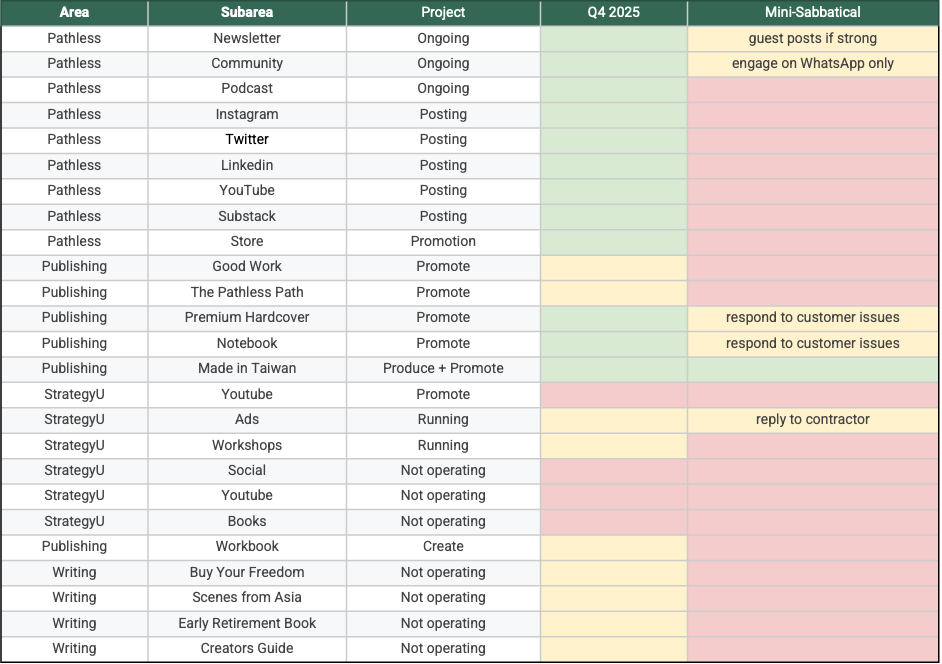
For this upcoming period, I drafted some very clear priorities:
Off-season priorities:
Enjoy the traveling village community and time with Angie and my daughter
Trying to experiment with dealing with some long-term health issues that are lingering
Off-season maintenance tasks:
Check email once or twice a week in a dedicated block of time
Help Angie with any tasks needed to help launch her book in March
(Optional): Publish guest posts from others if needed
Reply to the one contractor helping me with a small project as needed
At the end, I’ll start adding things back, reflect on what I’ve learned, and start tinkering (inefficiently, of course) with what a more seasonal approach to life might look like.
For me, this sabbatical is exciting. It’s also me walking the walk of my own advice, I often give of “doing less on the problem.”
I may post some guest posts people are working on (submissions of fully finished posts are welcome) or a quick reflection on the traveling village, but otherwise, see you in March!
Free Copies of Unhinged Habits - I’m doing a drawing and giving away copies of Unhinged Habits in my community. If you are in there, check out the WhatsApp community announcements for the link.
Hey there! I’m still on sabbatical, but I hope you enjoyed this issue
I’ve been doing some form of public writing since 2015. I’ve somehow figured out how to hack a living doing things like writing books and launching premium art editions of my book. If you like what you read here, you’ll probably enjoy my books The Pathless Path and Good Work:

If you’d like to join a virtual community of others on “pathless paths” from around the world, and get access to courses, tools, and other resources I’ve created over the years, you can join The Pathless Path Community. Our recent WhatsApp community is very active if you like hanging out on messaging apps instead of Circle.
Some things I endorse:
Readwise is offering 2 months free (I use it for book notes and reviewing highlights). Or two months free on
Readwise Reader, which I use for RSS reading and epub reading
Crowdhealth, an alternative to US health insurance that I’m still using while abroad
Postbridge: A social scheduling app created by a reader without crazy upcharges for more accounts
Kindred, a home-sharing app
Collective for handling your S-Corp accounting needs, and Nat Eliason’s Build Your Own AI Apps course
If you received this and find yourself in a state of outrage, thinking, “What is this?” I strongly encourage you to unsubscribe below. It is your God-given right, and there is plenty of other good stuff online.
A reminder: I don’t check unsubscribe alerts and never look at my subscriber list. So if you feel like unsubscribing, you can do so below.
The post I'm always looking forward to read
this inspired me to make my own spreadsheet today! So many little tasks (many just deadweight...) that kinda run in the background, it's nice to think about what I can *intentionally* turn off in a given quarter/chapter.