


May 30th: Greetings From Las Palmas!
👋 Welcome to Elliot, Rosario, Brian, Ryan, Oren, Scott, Mark, Edwin, Nicholas, G, Iva, Martin, Larry, Garrett, Bernie, Vijay, Jony, Clark, Christian, Ben, Corey, Blanchard, Guy and Peet
It’s been a rough and confusing week for many. Sending love and well-wishes to everyone. I watched this speech from “Killer Mike” right before sending this off and it made this newsletter feel a bit silly to be sending. Definitely watch it if you get a chance.
I’ve been battling some health issues in May but hope to kick-off some of the extra issues of Boundless in the coming weeks. I spent a day outlining a vision and some general themes of how I want to shape this newsletter, but would love feedback as well:
👉 5-Minute Boundless Survey: Would you help me out? I want to get a better grasp of what resonates with the growing number of followers who tune in each Saturday and what I can do to support all of your journeys as well.
If you’d like to subscribe or upgrade to become an ongoing patron of the newsletter, you can do this here before you dive into this week’s issue:
✍ ESSAY: Chaos Theory & Building Resilient Organizations
I published a 5500-word essay this week on how chaos theory might inform a new lens for thinking about modern organizations and leadership.
Except instead of suggesting that we abandon the status quo, I argue that looking at modern organizations as complex adaptive systems can help capture some of the positive energy and “chaos” that already exists within most organizations.
This is something I’ve been thinking about for a while. While working with large companies and leaders, it was always striking that there was little thought put into how things get done and that most of the energy is spent on what should be done.
This influences the language people use, the types of meetings people have and the resulting reports from those meetings as well as how people mold themselves to be selected for higher-level roles within organizations.
I believe this has led us down a path towards increased fragility rather than resilience. I’ll let you decide whether or not you are convinced, but I’ve also outlined five roles I believe that a modern ““chaos manager” can embrace:
Emergence Architect: Design for emergent outcomes that help you adapt & shift
Authority Aligner: Increasing legibility gaps between position & credibility
Reality Sensemaker: Strengthens command and control control through cultural and reality sensemaking
Chaos Injector: Defends against stagnation & injects “controlled burns” where necessary
Survival Guide: Orients teams and the organization towards survival
Special shoutout to Jeremy Finch for the amazing illustrations and Thomas Hollands for the creative collaboration!
🎤 PODCAST: 12 Year An Indie Consultant
Will Bachman has been an independent consultant for 12 years since leaving McKinsey in 2008 and runs Umbrex, which helps solo consultants connect, learn and find work. He recently launched a course helping new independent consultants build a consulting practice. This is a good course for someone that is confident they want consulting to be the focus of their self-employed path. He’s offering this at $100 off for boundless readers (code: Boundless) or through a gift form (email here).
We also had a conversation about the course and his journey over the past 12 years:
How he thought about independent consulting in 2008 versus now in 2020
How his talent platform, Umbrex, was born and how it has remained community focused
What led him to create his course and some of the common questions and misconceptions people have
What makes him want to keep playing “the game” of self-employment
How independent consultants can think about finding new clients
How he designs experiments to keep his learning journey alive
How he filters everything he does through a 5-decade time horizon
🎧 Listen 👉Apple | Google | Spotify | Overcast
🎬 Want To Join Our 1-Week Action Challenge?
It’s week three for the participants in the self-paced Reinvent cohort happening now, which means they’ll try to deliver on an “action challenge” - putting something out into the world in less than a week (can be a blog, podcast, starting a newsletter, hosting a facebook cooking class, creating a learning internship, etc…)
If you’d like to join us, check out this deck of ideas and then register for the call here
📊 CHARTS: Wealth Since 2008
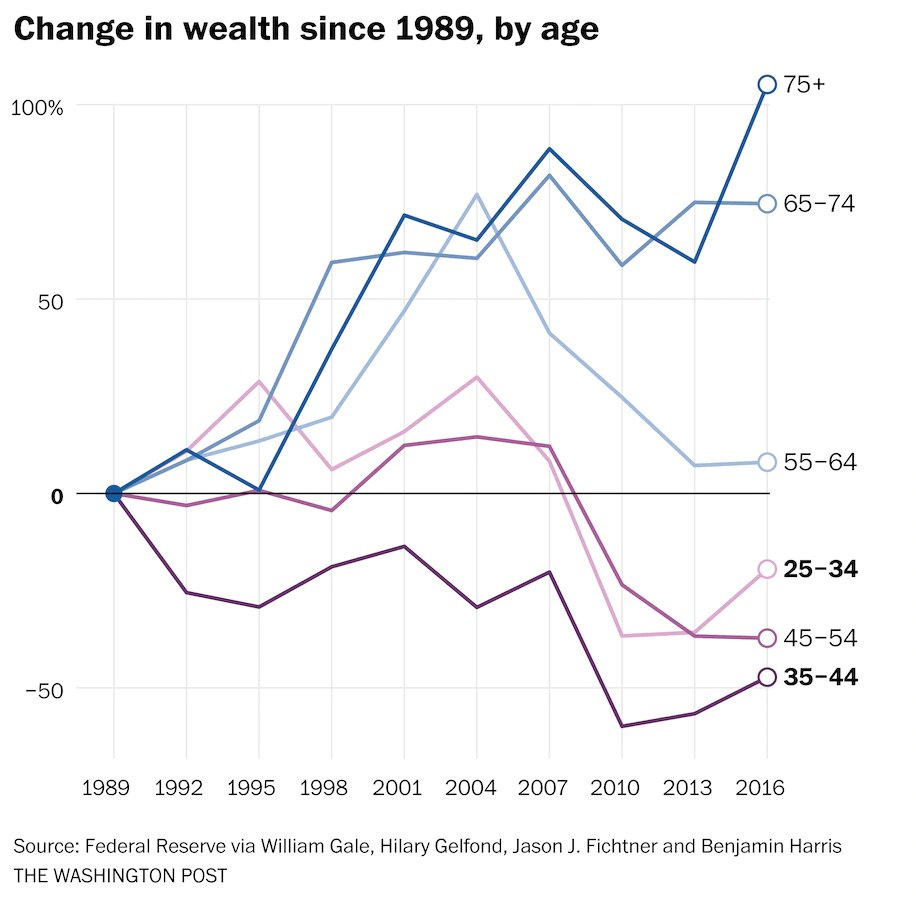
I stumbled upon this chart which shows a clear shift in wealth patterns after the 2008 crisis. Older people did well, younger people did not. (more: Boomer Blockade)
💡 IDEAS: Short-Time Working (Germany)
Daniel Thomason shared the “Kurzarbeit” system from Germany with me on Twitter:

In the US they have the furlough, but without the government support. The recent CARES program attempted to be the stopgap for wages and its too soon to see how that will turn out.
In Germany, the Kurzabeit program supported 1.5 million in the 2008 crisis and is credited with saving up to half a million jobs. It seems similar programs are behind the lower levels of pandemic unemployment in Europe compared to the US right now.
In the US, there is an unprecedented experiment happening with letting 40 million+ layoffs happen. It is too soon to know how many of these jobs will come back, but there is really nothing like it. In 2008, the US never shed more than 700,000 jobs in any week while it has shed more than 2 million each week for the last ten weeks.
I would not be surprised to see a program like Kurzabeit emerge in the US. It seems much more likely than something like UBI based on our work beliefs.
💻 REMOTE: Stripe’s One-Year Remote Reflection
Stripe launched its sixth “hub” as a remote hub about a year ago. In a blog post this week they highlighted some of their remarkable achievements, including a nod to the their understanding of chaos theory (“This is a fractally complex project”).
Other achievements included:
Better customer coverage: “We feel closer to customers because we literally are.”
Customized local solutions: “One member of the Checkout team launched a local push payment method from Singapore”
They were forced to upgrade onboarding:
An unexpected benefit to onboarding cohorts of remote engineers was that we got better at supporting engineers everywhere. Our onboarding curriculum became more polished and efficient, given the limited window of the work day shared by regionally scattered remote employees
Influences from other industries outside tech: “We now hire engineers in cities where financial companies, larger enterprises, and agencies hire larger swaths of the engineering population. This helps us incorporate more DNA from their practices and informs how we build products for adoption for those sorts of companies.”
A couple of the design choices they made in trying to raise the odds of success:
Head of remote experience: They appointed a “site lead” who was responsible for the success of the remote hub
Experiment before scale: “run experiments on individual engineering teams to determine how to best integrate remote engineers—and then horizontally scale the ones which generated notable successes.”
All of this is wildly impressive but it is worth noting that Stripe was a very well-run company before “going remote” with the leadership of an impressive CEO, Patrick Collison (I recommend this podcast interview with him).
One more lesson was that they were able to hire people in non-tech cities and seemed to absorb some of the practices from other more established industries:
We now hire engineers in cities where financial companies, larger enterprises, and agencies hire larger swaths of the engineering population. This helps us incorporate more DNA from their practices and informs how we build products for adoption for those sorts of companies.
Finally, their efforts over the last year put them in a powerful situation to still succeed during the current crisis:
This would have, candidly, been extremely difficult for Stripe a few years ago, and is still not easy by any stretch of the imagination. But we continue to develop and ship new products, thanks in part to an increased focus on supporting remote engineers last May.

💻 I have an open calendar for curiosity conversations every Wednesday, lets chat
🙋♂️Who is Paul? If you want to learn more about who I am or what I’m working on, find me here, say hi on twitter, or check out some of my longform writing.
If you’d like to become a supported and receive occasional paid posts (more to come!) in addition to the current Saturday newsletter, become a subscriber